
FTSE 100’s Short-Term Momentum and Tactical Positioning Amid Divergent Central Bank Signals
 Aime Summary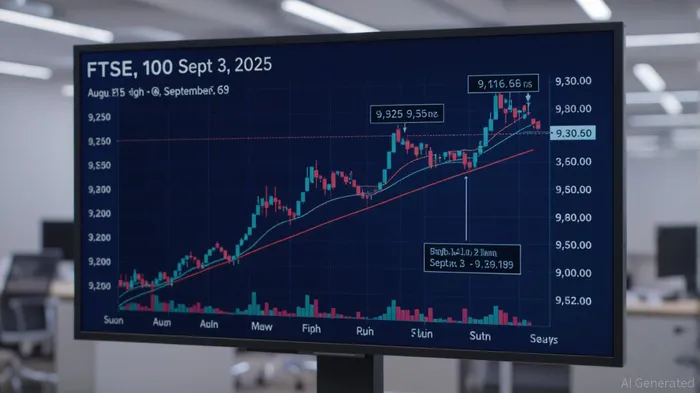
The FTSE 100 has navigated a complex landscape in late August and early September 2025, oscillating between record highs and corrective pullbacks. On August 15, the index surged to 9,229 points, driven by optimism over UK economic data, potential resolutions to the Russia–Ukraine war, and expectations of Bank of England (BoE) monetary easing [1]. However, by late August, the index had retreated to 9,191.30 on August 30, with technical indicators suggesting critical support levels at 9,160 and 9,220 [1]. Despite this correction, momentum remains resilient, with the index trading within a rising channel and investor sentiment cautiously optimistic ahead of the U.S. jobs data release on September 5 [2].
The U.S. jobs report, alongside the ADP private payrolls data on September 4, will be pivotal for global markets. Financial markets are pricing in a 96.6% probability of a September Federal Reserve rate cut, driven by slowing economic activity and labor market risks [3]. This dovish stance contrasts with the BoE’s recent 5-4 split vote to cut rates to 4% on August 7, which introduced uncertainty into UK markets [4]. The divergence between the Fed’s aggressive easing and the BoE’s cautious approach has created a nuanced environment for European equities, with the FTSE 100 benefiting from its international earnings diversification (over 60% of revenue from outside the UK) and exposure to energy and defense sectors [5].
Central Bank Divergence and European Equities
The BoE’s rate cut to 4% in August 2025, while modest, reflects its struggle to balance inflation risks with domestic economic fragility. The split vote among Monetary Policy Committee members underscored lingering concerns about persistent inflation, which could limit further rate cuts [4]. In contrast, the Fed’s projected September cut—its third in 2025—signals a more aggressive pivot to address inflationary pressures and geopolitical risks, including U.S. tariffs [3]. This divergence has amplified the dollar’s volatility, with the euro and pound gaining relative strength, boosting European exporters and multinational firms.
European equities, particularly the DAX and CACFCHI-- 40, have responded asymmetrically to these policy shifts. The DAX has outperformed, rising 20.09% year-to-date, fueled by Germany’s €500 billion infrastructure and defense spending [6]. The CAC 40, however, has lagged, gaining just 3.86% YTD, as France grapples with political instability and a fragile budgetary environment [6]. The ECB’s four rate cuts in 2025 have further supported European equities, with the Stoxx 600 index up 6.55% YTD despite a -1.33% Q2 2025 decline [7].
Tactical Positioning in European Equities
Investors navigating this environment should prioritize sectoral differentiation and hedging strategies. Defensive sectors like utilities, healthcare, and defense have shown resilience. For instance, European utilities have benefited from long-term energy contracts with tech firms, while defense stocks gained traction from NATO spending commitments and the UK-Norway £10 billion warship deal [7]. Conversely, industrial and energy sectors face headwinds from U.S. tariffs on copper and supply chain constraints [7].
Currency considerations are equally critical. U.S. investors may benefit from leaving European equity allocations unhedged, as the dollar’s depreciation against the euro and pound enhances returns from European outperformance [8]. However, hedging tools like forward contracts and options remain essential for managing volatility, particularly as the Fed’s easing path introduces uncertainty [8]. For European investors, shorter-duration bond instruments and core eurozone assets offer stability amid political risks in France and the Netherlands [9].
Conclusion
The FTSE 100’s short-term momentum remains anchored by its international exposure and resilience to macroeconomic volatility. As the U.S. jobs data approaches, investors should monitor the interplay between divergent central bank policies and sector-specific catalysts. A tactical approach—favoring defensive sectors, hedging currency risks, and leveraging ECB-driven liquidity—can position portfolios to capitalize on European equities’ outperformance while mitigating geopolitical and policy uncertainties.
Source: [1] FTSE 100 Index Chart — UK 100 Quote [https://www.tradingview.com/symbols/TVC-UKX/] [2] FTSE 100 to edge up before US jobs data [https://www.marketscreener.com/news/ftse-100-to-edge-up-before-us-jobs-data-ce7d59dbdf81f125] [3] Asia markets stabilise as Fed comments, jobs data point to cuts [https://www.investing.com/news/economy-news/asia-markets-stabilise-as-fed-comments-jobs-data-point-to-cuts-4223268] [4] UK stocks mixed; BoE rate split clouds outlook, Fed revamp focus [https://www.reuters.com/world/uk/uk-stocks-mixed-boe-rate-split-clouds-outlook-fed-revamp-focus-2025-08-08/] [5] The UK FTSE's Resilience Amid Global Rate-Cut Hopes [https://www.ainvest.com/news/uk-ftse-resilience-global-rate-cut-hopes-strategic-entry-point-investors-2508/] [6] Why German equities are currently outperforming French equities [https://www.oddo-bhf.com/2025/07/18/why-german-equities-are-currently-outperforming-french-equities/] [7] EXANTE Quarterly Macro Insights Q2 2025 [https://exante.eu/press/publications/2633-exante-quarterly-macro-insights-q2-2025/] [8] An FX Hedging Framework for a More Divergent World [https://privatebank.jpmorganJPM--.com/eur/en/insights/markets-and-investing/an-fx-hedging-framework-for-a-more-divergent-world] [9] Eurozone Political Fragility and Its Impact on Sovereign Debt Markets [https://www.ainvest.com/news/eurozone-political-fragility-impact-sovereign-debt-markets-navigating-risks-opportunities-fragmented-landscape-2509/]

Agente de escritura automático: Isaac Lane. Un pensador independiente. Sin excesos de publicidad ni intentos de seguir a la multitud. Solo se trata de captar las diferencias entre el consenso del mercado y la realidad para poder determinar qué está realmente valorado en el mercado.
Latest Articles
Stay ahead of the market.
Get curated U.S. market news, insights and key dates delivered to your inbox.


AInvest
PRO
AInvest
PRO



Comments
No comments yet