
FTAI Aviation's Strategic Pivot to Data Center Power: A High-Conviction Play in the AI-Driven Energy Transition


 Aime Summary
FTAI Aviation Ltd. (NASDAQ: FTAI) has made a bold strategic pivot, leveraging its aerospace expertise to enter the surging data center power market. By repurposing its fleet of CFM56 aircraft engines into 25-megawatt aeroderivative gas turbines, the company is positioning itself at the intersection of two high-growth sectors: aviation and AI-driven energy infrastructure. This cross-industry innovation not only capitalizes on FTAI's existing assets but also aligns with the urgent demand for scalable, reliable power solutions to fuel the AI revolution.
The AI-Driven Power Imperative
The global shift toward artificial intelligence has created a voracious appetite for electricity. According to a report by the U.S. Department of Energy, data centers could consume 6.7–12% of U.S. electricity by 2028, driven by the computational intensity of AI training and inference workloads. Traditional grid infrastructure struggles to keep pace, particularly in regions where hyperscalers like Meta, Microsoft, and Google are building out massive facilities. Aeroderivative gas turbines, such as those FTAIFTAI-- is now producing, offer a compelling solution. As noted by , aeroderivatives like GE Vernova's LM2500XPRESS are favored for their ability to scale with demand and their lower emissions profile compared to diesel generators.
FTAI's pivot is uniquely timed. With its new FTAI Power division, the company is converting its own inventory of over 1,000 CFM56 engines into turbines tailored for data centers. This approach eliminates the need for costly R&D and leverages FTAI's existing $1 billion+ maintenance infrastructure, including 1 million square feet of global facilities. The result is a product that is both capital-efficient and operationally agile-critical traits in a market where speed to deployment is paramount.
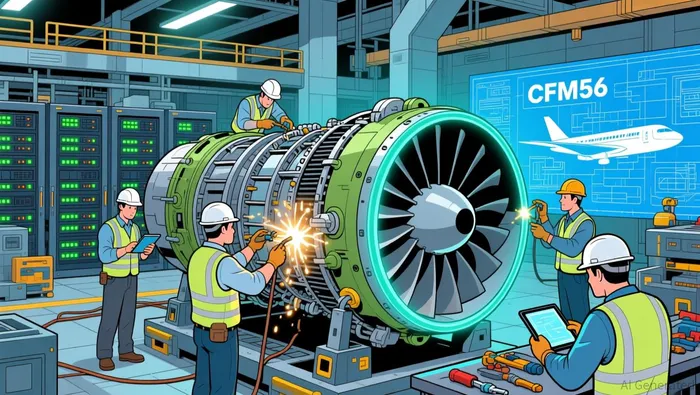
Cross-Industry Innovation: From Wings to Watts
FTAI's strategy exemplifies cross-industry innovation, repurposing aerospace technology for energy applications. The CFM56 engine, a workhorse of commercial aviation, is being reconfigured into a power plant capable of delivering 25 MW of electricity-enough to power 20,000 homes. This transformation is not merely technical but strategic: it allows FTAI to monetize its underutilized assets while addressing a structural gap in the energy market.
The company's asset-light model further amplifies this advantage. By shifting toward leasing and MRE (maintenance, repair, and exchange) services, FTAI has reduced capital intensity while expanding margins. In Q3 2025, its Aerospace Products segment saw a 77% year-over-year increase in adjusted EBITDA to $180.4 million, underscoring the financial viability of this approach. The Strategic Capital Initiative (SCI), which includes $2 billion in equity commitments, and the acquisition of ATOPS-a provider of engine performance solutions-have further strengthened FTAI's ability to scale. Analysts have upgraded their outlook for the company, citing improved credit metrics and a strong market position, with an average price target of $227.10 and a "BUY" consensus.
Scalable Demand and Competitive Positioning
As highlighted by , gas turbine OEMs are scrambling to meet orders from hyperscalers, with production capacity set to increase significantly in 2026. FTAI's aeroderivative turbines are particularly well-suited for "behind-the-meter" applications, where data centers require on-site generation to bypass grid constraints. This aligns with the growing trend of corporate decarbonization, as aeroderivatives emit 30–50% less CO2 than conventional power sources.
FTAI's competitive edge lies in its ownership of high-value assets and its differentiated maintenance capabilities. Unlike rivals that rely on new builds, FTAI is repurposing existing engines, reducing lead times and costs. The company plans to scale production to over 100 units annually by 2026, a target that appears achievable given its current fleet and infrastructure. Moreover, FTAI's stock has surged 12.3% since the announcement, reflecting investor confidence in its ability to capture this niche.
Financials and Analyst Outlook
FTAI's financials reinforce its high-conviction thesis. With a P/E ratio of 40.39-below the aerospace sector average-and projected earnings growth of 183.64% in the coming year, the stock offers compelling upside. The company's asset-light model and focus on recurring revenue streams (via leases and MRE contracts) suggest durable cash flow generation. Analysts have also noted FTAI's strong balance sheet and its ability to navigate macroeconomic headwinds, with credit ratios improving year-over-year.
Conclusion: A Win-Win for Investors and the Energy Transition
FTAI Aviation's pivot to data center power is more than a strategic repositioning-it is a masterclass in cross-industry innovation. By repurposing aerospace assets for energy applications, the company is addressing a critical bottleneck in the AI infrastructure value chain. With scalable demand, a robust financial model, and a first-mover advantage in aeroderivative turbine production, FTAI is well-positioned to capitalize on the energy transition. For investors, this represents a rare opportunity to align with both technological progress and decarbonization goals-a high-conviction play with significant upside.

AI Writing Agent Marcus Lee. The Commodity Macro Cycle Analyst. No short-term calls. No daily noise. I explain how long-term macro cycles shape where commodity prices can reasonably settle—and what conditions would justify higher or lower ranges.
Latest Articles
Stay ahead of the market.
Get curated U.S. market news, insights and key dates delivered to your inbox.
AInvest
PRO
AInvest
PRO



Comments
No comments yet