
FRP Holdings' Earnings Call Contradictions: Development Funding vs. Buybacks, D.C. Multifamily Outlook in Question
 Aime Summary
Date of Call: Aug 5, 2026
Financials Results
- EPS: $0.21 per share (FFO per share)
Guidance:
- Full year NOI expected to be approximately $36.2 million, compared with original plan of $37.1 million.
- The reduction primarily reflects $800,000 from delayed industrial lease-up and $1 million of operating headwinds in Washington, D.C. multifamily portfolio, partially offset by $850,000 of stronger than expected mining performance.
Business Commentary:
Industrial Leasing and Development:
- FRP Holdings expanded its industrial portfolio from approximately
800,000 square feetat the end of 2025 to an expected2.1 million square feetwith current developments, representing a significant increase. - Lease momentum improved with
20,700 square feetsigned and97,500 square feetin active negotiations, indicating stronger tenant activity than a year ago. - The company anticipates most future discretionary growth capital to be invested in expanding the industrial platform, driven by long-term investment opportunities and strategic positioning in logistics, manufacturing, and distribution.
Multifamily and Mining Performance:
- FRP Holdings' mining business generated approximately
$4.1 millionof NOI in the quarter, marking a12%year-over-year increase. - The multifamily development pipeline is set to deliver 510 units, growing the portfolio from
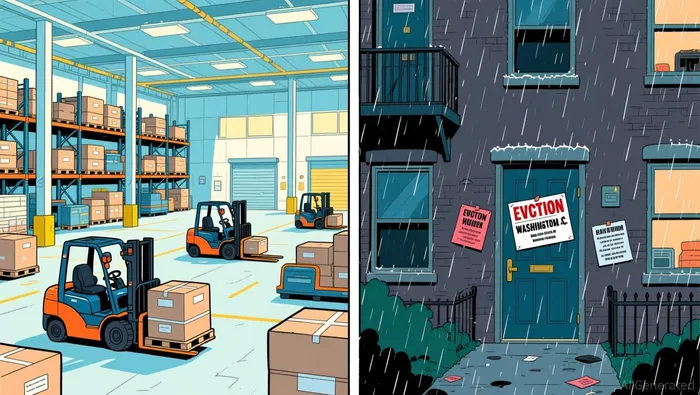
1,827to2,337units, with projects in Greenville, South Carolina, and Estero, Florida. - The mixed operating environment in multifamily, with strong performance in Greenville but challenges in Washington, D.C., reflects broader market pressures and regulatory issues affecting collections and delinquency.
Financial Strength and Strategy:
- The company ended the quarter with approximately
$130 millionof liquidity, including$101 millionin cash, supported by a conservatively leveraged balance sheet. - FRP reported pro forma NOI of approximately
$9.4 millionand FFO of$4.1 million, or$0.21per share, reflecting stable financial performance. - The strategy emphasizes disciplined capital allocation, focusing on industrial growth while maintaining financial strength and flexibility to invest in long-term opportunities.
Challenges in Washington, D.C. Multifamily:
- Elevated new supply and higher delinquency rates in Washington, D.C., continue to affect FRP's multifamily assets, contributing to an approximately
$900,000reduction in full-year NOI projections. - The regulatory environment and court system delays in evicting non-paying tenants create a persistent headwind, with economic occupancy impacted by these challenges.
Market Dynamics and Leasing Activity:
- Improving leasing fundamentals and increased tenant activity were noted, particularly in markets like Florida, New Jersey, and Maryland, with more than
110,000 square feetof renewals and pending transactions. - While concessions remain elevated, rental rates have shown resilience, and supply constraints are creating a favorable environment for near-term project deliveries.
Sentiment Analysis:
Overall Tone: Neutral
- Management acknowledges headwinds in D.C. multifamily and industrial leasing delays but highlights improving tenant activity, a strong balance sheet, and confidence in long-term strategy. Tone is measured, focusing on execution and cautious optimism.
Q&A:
- Question from Bill (Horizon Partners): Could you provide color on the weak performance of D.C. multifamily assets?
Response: Delinquencies and trade-out concessions are headwinds; renewal increases are strong. Eviction processes are slow due to district policies, and delinquency issues are expected to persist.
- Question from Bill (Horizon Partners): What's going on with the Maryland, Baltimore warehouse market, specifically with Cranberry and Chelsea?
Response: Maryland same-store portfolio occupancy has declined from 92% to 70.6% due to tenant losses. Cranberry has strong current activity; Chelsea's lease-up is delayed due to long tenant decision cycles and competition from incentivized spaces in Southern NJ.
- Question from Bill (Horizon Partners): Are there plans for more spec development, and what's the leasing outlook for Broward County projects?
Response: No immediate plans for spec development; focus is on build-to-suit. Broward County is supply-constrained; Davie project nears a lease at a strong rate, and Lakeland/Camp Lake see strong activity driven by consolidation and population growth.
- Question from Steven Ferro (Oppenheimer): Thoughts on a recent D.C. deal and how Bryant Street compares?
Response: The deal indicates a ~6% cap rate for D.C., reflecting market conditions; management is partial to their own Bryant Street asset.
- Question from Steven Ferro (Oppenheimer): How much cash is earmarked for developments, and how do you weigh buybacks versus future development?
Response: Most equity capital has been spent; ~$8M in vertical construction capital remains over next two quarters. Priority is on new projects; share buybacks would be opportunistic if cash flow exceeds project needs.
- Question from David Foley (Estabrook Capital Management): Will G&A costs remain flat for the year?
Response: G&A run rate is expected to be flat, though Q1 had ~$500k in one-time audit/legal fees related to a closing that won't recur.
- Question from Ted Goans (Soleil): How do you envision the D.C. riverfront area in the long term, and is there talk of an office ecosystem?
Response: Long-term view is a multifamily waterfront portfolio at phases three/four; no current plans for office. The bulkhead site (664A) has a long-term tenant and will be developed when ready.
- Question from Ted Goans (Soleil): How will you communicate warehouse lease absorptions in Florida?
Response: Progress will be communicated through quarterly earnings releases.
- Question from Ted Goans (Soleil): Has the timeframe for Brooksville development moved up?
Response: No timeframe; development will occur when the right developer comes along.
- Question from Ted Goans (Soleil): Was there a significant share purchase by the chairman in mid-March?
Response: Yes, it was an outright purchase of shares.
- Question from Morris Prop (Prop Company): Stop developing in blue states, focus on property management and buybacks.
Response: Management acknowledges feedback but maintains strategy focused on industrial growth and disciplined capital allocation.
- Question from Bill (Horizon Partners): Why not use excess capital for buybacks given the large NAV discount?
Response: Management prioritizes new projects over buybacks, believing in the long-term value of industrial investments, though they acknowledge the math of buybacks.
Contradiction Point 1
Capital Allocation Priority: Development Funding vs. Share Buybacks
Conflicting statements on whether active development projects are an absolute priority for capital over buybacks.
What is Bill's role at Horizon Partners? - Bill (Horizon Partners)
2026Q2: Management stated that as long as there are development projects to fund, they will prioritize capital deployment into new projects over dividends or buybacks. - Mark Levy, David deVilliers III, John Baker III, Matt McNulty
1) Could you provide color on the weak performance of FRP's D.C. multifamily assets compared to other markets? 2) What's the situation in the Maryland warehouse market, specifically regarding the lease-up of the Chelsea and Cranberry properties? 3) Given the company's long-term focus, why not consider returning capital to shareholders via dividends or buybacks? - Follow-up from Bill (Horizon Partners) on Buybacks
2026Q2: Acknowledged the shareholder's perspective but reiterated the priority of funding active development projects before considering dividends or buybacks. - David deVilliers III
Contradiction Point 2
Clarity on Buyback Policy and Shareholder Urgency
Management's stance appears inconsistent when addressing the urgent buyback argument from shareholders.
What are the key factors driving the company's performance this quarter? - Steven Ferro (Oppenheimer)
2026Q2: They acknowledged that any excess capital would be considered for buybacks. - Mark Levy, David deVilliers III, John Baker III, Matt McNulty
How does the recent Rowan Building sale influence your cash allocation strategy between future developments and potential share buybacks? - Bill (Horizon Partners)
2026Q2: Management's stance is that they will always prioritize funding new projects over dividends or buybacks while active projects remain. Any near-term buybacks would be opportunistic. - David deVilliers III, John Baker III
Contradiction Point 3
D.C. Multifamily Performance and Outlook
Contradiction on the current health and stabilization of the D.C. multifamily market.
Bill (Horizon Partners) - Bill (Horizon Partners)
2026Q2: This is a company-wide issue across all D.C. properties, not isolated to one asset. It is a persistent problem that has ebbed and flowed but recently ticked up slightly. - Mark Levy, David deVilliers III, John Baker III, Matt McNulty
What factors contributed to the weak performance of FRP's D.C. multifamily assets compared to other markets? - J. Goins (Salem Investment Counselors, Inc.)
2025Q3: There is signs of stabilization. New deliveries are leasing with some concessions, and renewal rents are moving up. The market is expected to continue improving... - David deVilliers
Contradiction Point 4
Status of Equity Funding for Development Projects
Contradiction on whether equity for current developments is fully in place or still required.
Steven Ferro (Oppenheimer) - Steven Ferro (Oppenheimer)
2026Q2: Management stated that most equity capital for the current development pipeline has already been spent... Only ~$8M in vertical construction capital is planned for the next two quarters. - David deVilliers III, John Baker III
How does the recent Rowan Building sale influence your cash allocation strategy between future developments and potential share buybacks? - Stephen Farrell (Oppenheimer)
20260411-2025 Q4: For the Florida assets... all equity is in and additional capital is being funded via construction loans. - David deVilliers, Mark Levy, John Baker
Contradiction Point 5
Capital Return Strategy and Priority
Contradiction on the priority of using capital for development versus returning it to shareholders.
Bill (Horizon Partners) - Bill (Horizon Partners)
2026Q2: Management stated that as long as there are development projects to fund, they will prioritize capital deployment into new projects over dividends or buybacks. - Mark Levy, David deVilliers III, John Baker III, Matt McNulty
Why isn't the company returning capital to shareholders via dividends or buybacks despite its long-term focus? - J. Goins (Salem Investment Counselors, Inc.)
2025Q3: The team is looking to secure favorable financing (potentially in H1 2026) to improve cash flow. - David deVilliers (Implied focus on improving cash flow/return on existing assets)
 <<
<<
Discover what executives don't want to reveal in conference calls
Latest Articles
Stay ahead of the market.
Get curated U.S. market news, insights and key dates delivered to your inbox.


AInvest
PRO
AInvest
PRO




Comments
No comments yet