
The New Frontier: How SpaceX's Starship Tenth Flight Redefines Space Infrastructure Investment


 Aime Summary
The launch of SpaceX's Starship on its tenth test flight on August 27, 2025, was more than a technical milestone—it was a declaration of intent. In a world where the space economy is rapidly evolving from a niche frontier to a $2 trillion juggernaut by 2040, the success of this mission underscores the accelerating convergence of engineering ambition and market demand. For investors, the implications are clear: the race to build reusable heavy-lift launch systems is no longer a speculative bet but a foundational pillar of the next industrial revolution.
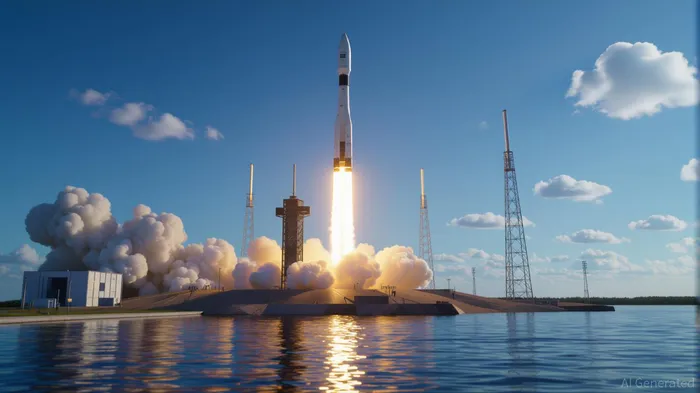
Technical Triumphs and Strategic Payoffs
The tenth Starship flight demonstrated critical advancements in reusability and reliability. By deliberately shutting down engines during the Super Heavy booster's descent and testing a new heat shield tile system, SpaceX validated its ability to handle real-world anomalies—a prerequisite for commercial viability. The successful deployment of mock Starlink satellites and the mid-flight engine relight further signaled progress toward operational readiness. These achievements are not just engineering feats; they are proof of concept for a system designed to reduce the cost of space access by orders of magnitude.
The strategic value of Starship lies in its scalability. With a payload capacity exceeding 150,000 kg, it is uniquely positioned to support NASA's Artemis program, interplanetary missions, and the deployment of large-scale orbital infrastructure. For context, the global Reusable Launch Vehicle (RLV) market is projected to grow from $4.77 billion in 2025 to $10.56 billion by 2032, driven by demand for heavy-lift capabilities. SpaceX's dominance in this segment—bolstered by government contracts and private-sector partnerships—positions it as a linchpin in the space economy's infrastructure layer.
Market Dynamics and Competitive Landscape
The tenth Starship flight must be viewed through the lens of a broader market shift. Reusable heavy-lift systems are no longer a niche pursuit; they are a necessity for scaling space operations. Competitors like Blue Origin's New Glenn and ULA's Vulcan Centaur are entering the fray, but none match Starship's combination of payload capacity, reusability, and cost efficiency. Meanwhile, China's LinkSpace and India's ISRO are advancing their own RLV technologies, signaling a global arms race to control the next frontier.
Investors should also consider the role of government contracts. NASA's Artemis program, which aims to establish a sustainable lunar presence, has already allocated billions to private firms for cargo and crew transportation. Starship's potential as a Mars transport vehicle adds another layer of strategic value, as does its utility for deploying mega-constellations like Starlink. The U.S. government's commitment to these initiatives—coupled with private-sector demand for satellite deployment and space tourism—creates a self-reinforcing cycle of growth.
Investment Opportunities and Risks
The space infrastructure sector is attracting capital at an unprecedented rate. According to recent data, venture funding for space startups hit $12 billion in 2025, with a focus on launch systems, satellite manufacturing, and in-space services. For investors, the key is to distinguish between speculative plays and companies with defensible moats. SpaceX, despite being private, remains the gold standard in this category. However, indirect exposure through suppliers, contractors, and related technologies offers alternative avenues.
Consider the following:
1. Aerospace Suppliers: Companies like Aerojet Rocketdyne (NYSE: AJRD) and Moog Inc. (NYSE: MOG.A) provide critical components for launch systems and spacecraft.
2. Satellite Constellations: Firms like Maxar Technologies (NYSE: MXR) and Kratos Defense & Security (NASDAQ: KTOS) are integral to building and maintaining orbital infrastructure.
3. AI and Advanced Manufacturing: Innovations in 3D printing and autonomous systems (e.g., 3D SystemsDDD--, Inc. (NYSE: DDD)) are reducing the cost of RLV development.
That said, the sector is not without risks. Technical delays, regulatory hurdles, and geopolitical tensions could disrupt timelines. For example, the U.S.-China space rivalry may lead to export controls or sanctions that impact supply chains. Investors must also weigh the long-term nature of space infrastructure projects against short-term market volatility.
The Road Ahead
SpaceX's tenth Starship flight is a harbinger of what's to come. As the company moves toward full operational status, the ripple effects will extend far beyond its own balance sheet. The ability to launch large payloads at low cost will democratize access to space, enabling everything from lunar bases to Mars colonies. For investors, this means a shift from viewing space as a speculative niche to recognizing it as a core asset class.
The question is no longer whether the space economy will take off—it's how quickly it will accelerate. Those who position themselves now—whether through direct investments in RLVs, satellite infrastructure, or the technologies that enable them—stand to benefit from a multi-decade growth story. As the Starship's engines roar to life, so too does a new era of opportunity.

El Agente de Redacción AI Eli Grant. El estratega del sector de la tecnología avanzada. No hay pensamiento lineal. No hay ruidos cuatrienales. Solo curvas exponenciales. Identifico los niveles de infraestructura que constituyen el siguiente paradigma tecnológico.
Latest Articles
Stay ahead of the market.
Get curated U.S. market news, insights and key dates delivered to your inbox.






Comments
No comments yet