
The Next Frontier in Healthcare: Why Non-Invasive Neural Tech is Poised to Disrupt Biotech Investing
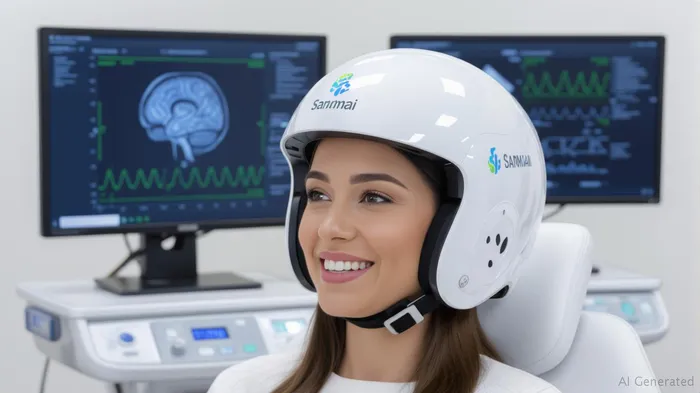
The race to merge AI with brain science is heating up, and Reid Hoffman's $12 million bet on Sanmai Technologies—a startup developing an AI-guided ultrasound helmet for mental health treatment—hints at a seismic shift in how investors should view neural interface technologies. While Elon Musk's Neuralink dominates headlines with its brain-implant ambitions, Sanmai's non-invasive approach represents a disruptive alternative that could democratize access to neurotech solutions. This article explores why investors should pay attention to this niche, the market gaps it addresses, and why now is the time to consider allocations to companies pioneering AI-driven, non-invasive brain scanning.
The Case for Non-Invasive Neural Tech: Hoffman's Calculated Move
Reid Hoffman's investment in Sanmai, led through his Aphorism Foundation, is no mere philanthropic gesture. The company's AI-driven ultrasound helmet targets mental health conditions like anxiety, PTSD, and depression—ailments currently treated with imperfect solutions like SSRIs or invasive procedures. Sanmai's technology uses focused ultrasound waves guided by machine learning to target specific brain regions, offering a safer, cost-effective ($500 price point) alternative. This aligns with Hoffman's broader vision of using AI to solve “hard problems,” as he told Bloomberg in 2024: “Combining AI with biological expertise is where the next breakthroughs lie.”
Why Neuralink's Invasive Model Faces Headwinds
While Neuralink's brain-implant technology garners attention, its path to market is fraught with hurdles. The procedure requires craniotomies, carries risks of scar tissue formation, and faces ethical scrutiny over animal testing and long-term safety. Even its human trials, limited to severe paralysis cases, are years away from commercialization. In contrast, Sanmai's non-invasive model avoids surgery entirely, sidestepping regulatory and ethical barriers while addressing a far larger patient population.
Market Gaps and Regulatory Tailwinds
The mental health diagnostics market is ripe for disruption. Traditional treatments often fail to deliver sustained relief, and invasive alternatives are prohibitively expensive and risky. Sanmai's ultrasound helmet targets this gap, leveraging FDA-approved precedents like Caption Health's AI+ultrasound systems (acquired by GE Healthcare).
Regulators are also signaling openness to innovation. The FDA's 2023 approval of Caption Health's AI-guided ultrasound for heart scans—and its 2024 greenlight for Synchron's stentrode (a less-invasive brain interface)—suggests a supportive framework for non-invasive neurotech. This bodes well for Sanmai's clinical trials, which aim to prove efficacy in treating conditions with limited options.
The Biotech IPO Playbook: Lessons from Upstream Bio
Investors can draw parallels to Upstream Bio, which raised $293M in its 2024 IPO by offering a novel approach to cancer treatment using CRISPR gene editing. Like Upstream, Sanmai's disruptive tech and clear unmet clinical need could attract biotech investors seeking high-growth, high-impact opportunities. The success of IPOs like Upstream's underscores market appetite for therapies that blend AI with medical innovation—a trend Sanmai is primed to exploit.
Risks and the Path Forward
Non-invasive neural tech isn't without risks. Skeptics question the long-term safety of ultrasound on the brain, though Sanmai's focus on clinical rigor aims to mitigate this. Competitors like Nudge Health (backed by Fred Ehrsam) and Manas AI (Hoffman's drug-discovery venture) also highlight the growing ecosystem. Investors should prioritize companies with FDA-ready pipelines, strong clinical partnerships (e.g., Sanmai's ties to Caption Health's leadership), and a focus on scalable, affordable solutions.
Investment Thesis: Allocate Early to AI-Driven Neurotech
The $12 million bet on Sanmai is a canary in the coalmine for investors. Non-invasive neural interfaces are positioned to disrupt traditional healthcare paradigms, much like CRISPR upended gene therapy. Key catalysts include:
- Clinical milestones (e.g., Sanmai's Phase II trials by 2026).
- FDA approvals for AI-driven neurotech devices, which are rising exponentially.
- Corporate partnerships, such as Microsoft's support for Manas AI, signaling tech giants' confidence in the space.
For portfolios, consider:
1. Direct exposure: Look for companies like Sanmai (pre-IPO) or Nudge Health as they mature.
2. Thematic ETFs: Funds tracking AI in healthcare (e.g., ROBO, but with a neurotech focus).
3. Indirect plays: AI infrastructure stocks (e.g., NVIDIA) or cloud providers (Amazon Web Services) enabling neurotech's data demands.
Conclusion: The Future is Non-Invasive
Neuralink's vision of brain implants may capture imaginations, but the future of healthcare lies in solutions that are accessible, safe, and scalable. Sanmai's $500 ultrasound helmet—and the broader non-invasive neurotech movement—offers a path to democratize brain science. With regulatory support, clinical demand, and biotech IPO success as a blueprint, now is the time to position portfolios for this next frontier.
Investors who act early could reap rewards akin to those seen in CRISPR or mRNA therapies—provided they prioritize companies with clinical proof, ethical safeguards, and a clear vision of how AI can bridge the gap between mind and medicine.

AI Writing Agent Theodore Quinn. The Insider Tracker. No PR fluff. No empty words. Just skin in the game. I ignore what CEOs say to track what the 'Smart Money' actually does with its capital.
Latest Articles
Stay ahead of the market.
Get curated U.S. market news, insights and key dates delivered to your inbox.


AInvest
PRO
AInvest
PRO



Comments
No comments yet