
From 'Bidenomics' To 'Bidenflation': How Prices Have Changed Under Biden's Presidency?
With the release of the last monthly CPI report that fully belongs to Biden's term, people may already be able to summarize the changes in US inflation during Biden's four-year tenure...
Just as Republicans liked to mock the phenomenon of soaring prices of various daily necessities that significantly increased the living expenses of American people as Bidenflation, inflation has indeed become the biggest unexpected trouble root during Biden's four-year presidential term.
Although the US economy performed better than many economists' expectations during the high inflation period - the Federal Reserve's consecutive large-scale interest rate hikes helped to quickly reduce inflation from 2022 to 2024, without the economic recession that often accompanies large-scale monetary tightening. With Biden's departure, the US economy seems to have achieved a soft landing, that is, economic growth and employment remain stable, while inflation has cooled down.
However, many Americans still complain that the prices of necessities are too high to bear and continue to rise, causing lasting damage to their purchasing power. So, are the feelings of the American people real?
How Much Did Prices Climb During Biden's Four-year Term?
According to the official data as of December 2024, the US CPI has climbed by about 21.2% over the past four years. In contrast, household income increased by 19.4% during this period.
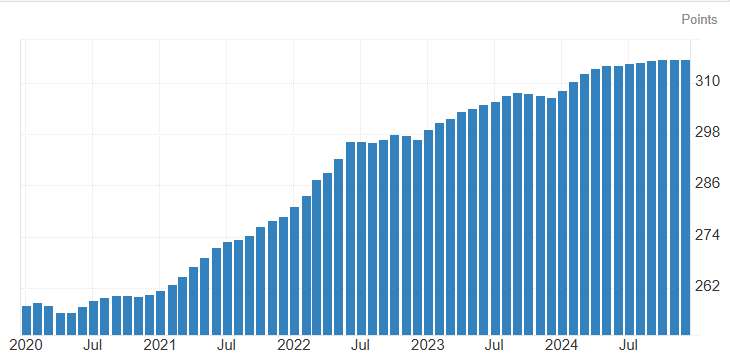
Therefore, during Biden's presidency, the average American family indeed failed to outpace inflation: the increase in prices exceeded the increase in income, which means that a typical salary could buy less at the end of the year than at the beginning.
In terms of purchasing power, inflation has divided Biden's presidential term into two stages, one is the collapse stage, and the other is the recovery stage.
From April 2021 to May 2023, the real income of American families was negative, which means that income growth was lower than the inflation rate. Real income growth did not turn positive until June 2023 and has remained in this state ever since.
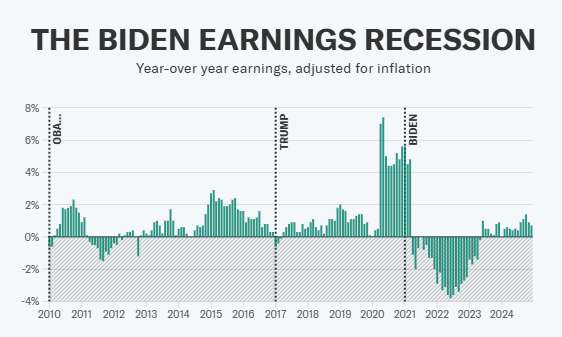
However, for Biden and his Democratic colleagues, this recovery process came too late. The voting results and related polls of the 2024 election clearly show that voters still feel the impact of inflation and blame Biden for it, and then blame Harris.
Voters trust Trump more on inflation - because their terms are connected, the data also supports this view of theirs and can provide an intuitive comparison.
In Trump's first presidential term, the growth of household income was actually lower than that during Biden's term, but the inflation rate was much lower, so the real income growth of ordinary families was very obvious.
During Trump's four-year term, the inflation rate rose by 7.9%, and income increased by 15.4%. Voters may not like Trump's handling of the COVID-19 pandemic in 2020, which was one of the main reasons they replaced Trump with Biden four years ago. But at least, the inflation rate in the Trump 1.0 era was moderate.
Biden's Four-year Is Struggling with Inflation
Some industry insiders have counted the inflation of 26 major categories in the US during Biden's presidency, which cover most of the things people spend money on. The final result shows that the prices of 12 categories have risen more than the growth of income - including housing, transportation, and food fields, which are the three places where American typical families spend the most.
And in Trump's first presidency, the price increase in each of these 26 categories did not exceed the growth of income.
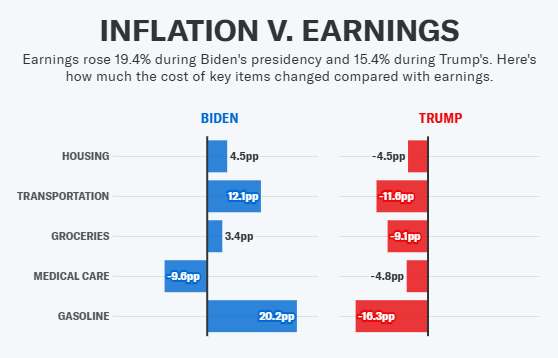
In a sense, Biden is actually quite unlucky: his four-year term is a history of struggle with inflation.
There are many factors that cause Bidenflation, including the shortage caused by supply chain disruptions during the COVID-19 pandemic, the huge shift in American people's consumption patterns during and after the pandemic, the huge stimulus policies of the government in 2020 and 2021, and the changes in the global supply chain brought by the Russia-Ukraine conflict in 2022.
As the Russia-Ukraine conflict broke out, the food inflation rate approached double digits, and the surge in oil prices also pushed the US gasoline price to the historically highest level of $5 per gallon. Since fuel is a necessity for production and transportation, the surge in energy costs further pushed up the prices of food and other goods.
Americans not only had to pay more and more for gasoline when driving but also had to pay more and more for buying cars. In 2022, the serious shortage of new car parts led to a 10% increase in the price of new cars and a 13% increase in the price of used cars. In January 2022, the year-on-year increase in used cars once reached an astonishing 41%.
For many years, there has actually been a housing shortage across the United States, which is mainly due to national and local regulations, making it difficult to build houses in areas where people want to live. This is superimposed with the shortage of wood and building materials in the COVID-19 era, leading to a 7.2% increase in housing costs in 2022, a 6.4% increase in 2023, and a 4.4% increase in 2024. During the same period, rents also rose by a similar magnitude.
Subsequently, due to the rise in car prices, increased maintenance costs, and more natural disasters destroying vehicles, car insurance fees also soared. In 2023, car insurance costs increased by 17.4%, and in 2024, they increased by 17.8%.
In fact, the Federal Reserve, which was reluctant to raise interest rates for a long time in 2021-2022 and attributed inflation to temporary factors, also bears a great deal of responsibility. But voters can't vote for the Federal Reserve chairman, and they will more likely blame Biden entirely for the rising prices, for a simple reason: when prices began to rise, Biden was the US President in the White House.
Trump May Not Escape Inflation As Well?
If it is said that high inflation has largely hit the support rate of Biden and the Democratic Party and helped Trump win the presidential throne in November last year, then the soon-to-be-inaugurated Trump should not feel any complacency at present.
A situation that is likely to be proved in the future is that: Trump's first presidential term (2016-2020) has already been the last presidential term of the low-inflation era in the United States over the past thirty years (1990-2020).
New shale fracturing technology has driven an energy boom, and drillers have competed for market share at the expense of profits, which greatly benefited Trump during his first term. This has led to a continuous decline in gasoline prices but also led to the industry massacre in 2020, and energy companies have vowed not to repeat the same mistake.
And as Trump and other government officials avoid cheap foreign products and try to rebuild the once-proud domestic industries, trade barriers are increasing, which will only push up prices.
The huge scale of US Treasury bonds may also lead the federal government to reduce welfare and increase taxes. And the increasingly severe climate change will definitely lead to more disasters, making insurance and other living costs more expensive.
Therefore, regarding this aspect, who knows if Trump's result will be any different than Biden...

Expert analysis on U.S. markets and macro trends, delivering clear perspectives behind major market moves.
Latest Articles
Stay ahead of the market.
Get curated U.S. market news, insights and key dates delivered to your inbox.
AInvest
PRO
AInvest
PRO



Comments
No comments yet