
Freshpet’s Gross Margin Timeline and E-Commerce Growth Claims Clash in 2026 Q2 Earnings Call
 Aime Summary
Date of Call: Aug 5, 2026
Financials Results
- Revenue: $305.6M, up 15.5% YOY
- Gross Margin: 48.6% adjusted, a 170 basis point improvement YOY
- Operating Margin: 17.1% adjusted EBITDA margin, up from 16.8% YOY
Guidance:
- Net sales growth expected to be 10% to 12% YOY (raised from 8% to 11%).
- Adjusted EBITDA expected to be $210 to $220M, a 7% to 12% YOY increase (raised from $205 to $215M).
- Adjusted gross margin expected to improve by 100 to 150 basis points YOY at the midpoint of sales guidance.
- Capital expenditures projected at ~$150M in 2026.
- 2027 adjusted gross margin floor raised to at least 49%.
- 2027 adjusted EBITDA margin target reiterated at 20% to 22%.
Business Commentary:
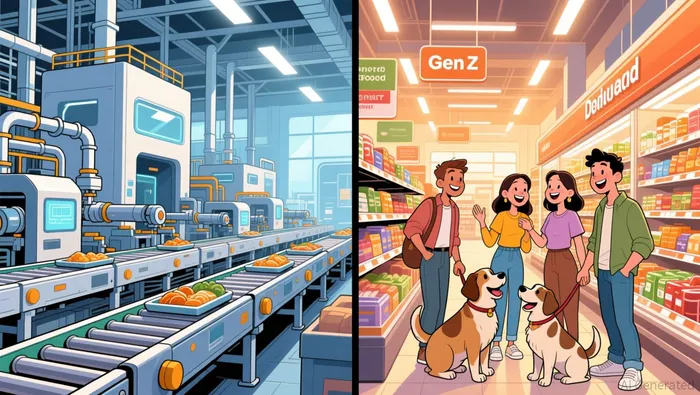
Strong Financial Performance and Guidance Increase:
- Freshpet reported
net salesof$305.6 millionfor Q2 2026,up 15.5%year-over-year. - The company increased its sales guidance for 2026 from
8%-11%to10%-12%and adjusted EBITDA guidance from$205-215 millionto$210-220 million. - This performance was driven by strong sales growth, improved adjusted gross margin, and effective cost management despite a challenging consumer backdrop.
Omnichannel Growth and E-commerce Expansion:
- Digital orders grew by
41%, accounting for16.7%of total business in Q2 2026. - Approximately
78%of e-commerce sales went through the bridge network, indicating strong retailer response to consumer demand for fresh pet food. - The expansion of omnichannel access, including over 30,000 stores and multiple fridge placements, contributed to this growth.
Manufacturing Advancements and Cost Efficiency:
- Freshpet's new bag product technology, implemented across three lines, is expected to deliver
over 100 basis pointsof gross margin improvement when fully optimized. - The technology is currently in the startup and optimization phase, with
25 basis pointsof improvement expected in 2026 and more in 2027. - These advancements are attributed to improvements in quality, throughput, yield, and unit economics, supporting future growth and innovation.
Market Position and Consumer Engagement:
- Freshpet's U.S. market share in dog food and treats is
4.3%, but it is the fastest-growing brand in the category. - The company is winning disproportionately among millennials and Gen Z, who represent the future pet parents driving market growth.
- Effective marketing campaigns and targeted consumer engagement strategies are enhancing brand relevance and deepening relationships with high-value households.
Sentiment Analysis:
Overall Tone: Positive
- "Our results and the number of competitors trying to emulate us continue to prove that fresh is the future of pet food, and we remain well-positioned to capture a meaningful share..." "We now expect net sales growth of 10% to 12% compared to 8% to 11% previously." "We are incredibly proud of our improved operating performance..." "We are cautiously optimistic with our outlook for the remainder of the year..."
Q&A:
- Question from Robert Moscow (TD Cowen): Regarding household penetration slowing, is growth expected to come from higher usage rates/MVPs? Does guidance assume penetration flattens?
Response: The low end of guidance assumes sequential household penetration roughly stable; anything beyond that moves up the range. The model is shifting from trial-based to a more durable franchise, balancing buy rate and household acquisition.
- Question from Peter Benedict (Baird): Update on Fridge Island test performance and decision tree for expansion?
Response: Encouraged by performance, but not banking on islands alone for growth; broader opportunities include multi-line expansions and new retail partnerships. Not expecting material expansion in 2026, discussions for 2027 underway.
- Question from Rupesh Parikh (Oppenheimer): Would you ramp advertising if EBITDA upside is seen to boost next year's sales?
Response: Always evaluate opportunities for advertising investment; strong balance sheet and supply network provide flexibility to invest for good returns if competitive environment allows.
- Question from Tom Palmer (J.P. Morgan): How much of the 2027 gross margin outlook is from new lines vs. other items?
Response: Very little contribution from new technology in 2027 outlook; the 100 bps floor for 2027 gross margin is raised based on strong existing operating performance (150 bps improvement YTD) and expected 25 bps from new tech in 2026.
- Question from John Anderson (William Blair): What's new from competition (freeze-dried, etc.) and where are you on leadership changes/team process?
Response: Competition has many entrants but none can match Freshpet's quality, cost, omnichannel reach, or scale. The company is evolving talent to higher specialization as it grows; leadership changes are part of ongoing evolution.
- Question from Eric Sirota (Morgan Stanley): Update on competition impact at club retailer and broader channel?
Response: Business at a key club retailer is up over 40% and Freshpet has >80% share of the fresh market there; competition is seen as validation of category demand, not a major drag on growth.
- Question from Michael Lavery (Piper Sandler): How incremental is e-commerce growth vs. brick-and-mortar shifts?
Response: Online purchases build more durable franchises (higher buy rates). 78% of e-commerce volume comes through existing fridge network (some shift), but D2C and new online retailers provide incremental new households.
- Question from Mark Torrent (Wells Fargo): Continued runway within Club channel given competition and expansion?
Response: Believe there is still significant opportunity for innovation and multi-line expansion in club retailers, with a long runway ahead.
- Question from Yasmin Deswadi (Bank of America): Gross margin improvement pace and whether full upgrade provides double the benefit of light lines?
Response: 25 bps of 2026 improvement from new tech; full version enables major product innovation and premiumness, light version focuses on efficiency. The ratio of full to light lines will vary based on capacity needs.
- Question from Todd Brooks (Benchmark Company): What game-changing product capabilities does new tech unlock, and what are retailers saying about growth strategies in fresh category?
Response: Full new tech enables superior product aesthetics, ingredients, and forms (e.g., beef versions). Retailers are not fully aligned on competition strategy, but Freshpet's proven track record, broad assortment, and deep pricing tiering position it as the best all-round solution.
Contradiction Point 1
Gross Margin Improvement Timeline and Contribution from New Technology
Contradiction on the 2026 gross margin contribution from new technology and the timeline for achieving the full 100 bps annual benefit.
Tom Palmer (J.P. Morgan) - Tom Palmer (J.P. Morgan)
2026Q2: For 2026, about 25 bps improvement is expected from the new technology, with the remaining 125 bps from operating leverage. This 25 bps is carried forward, raising the 2027 floor. Full realization of the 100 bps annualized benefit from new tech will come in 2027, pushing margins higher. - John O'Connor(CFO) and Billy Sear(CEO)
What is the breakdown of the increased 2027 adjusted gross margin target between new technology lines and other factors? - Yasmin Deswadi (Bank of America)
2026Q2: The company is delivering 100-150 bps of adjusted gross margin improvement in 2026, with only 25 bps coming from the new technology. The full 100 bps annual improvement from the new technology is a future target, expected to be reached in 2027 as lines continue ramping and optimization improves. - John O'Connor(CFO)
Contradiction Point 2
E-commerce Growth Channel Composition
Contradiction on the proportion of e-commerce volume that represents incremental new households versus a shift from brick-and-mortar.
Michael Lavery (Piper Sandler) - Michael Lavery (Piper Sandler)
2026Q2: 78% of e-commerce volume comes through the existing fridge network (a shift from in-store), while new opportunities like D2C and other online retailers represent incremental new households. - Nikki Beaty(COO) and Billy Sear(CEO)
How does the company assess the incremental growth of e-commerce versus shifts from brick-and-mortar, and what potential does it see for reaching new households through this channel? - Michael Lavery (Piper Sandler)
2026Q2: 78% of e-commerce volume goes through the existing fridge network, so some of that is not incremental household growth. However, new opportunities in D2C and other online retailers are delivering significant incremental gains. - Nicki Baty(COO) and Billy Cyr(CEO)
Contradiction Point 3
Gross Margin Improvement Timeline and Drivers
Contradiction on the contribution of new technology to 2026 gross margin.
What are your expectations for revenue growth in the upcoming quarter? - Tom Palmer (J.P. Morgan)
2026Q2: For 2026, about 25 bps improvement is expected from the new technology, with the remaining 125 bps from operating leverage. - John O'Connor(CFO) and Billy Sear(CEO)
What is the breakdown of the increased 2027 adjusted gross margin target, specifically how much is attributed to new technology lines versus other factors? - Brian Holland (D.A. Davidson)
2026Q1: The adjusted gross margin is expected to improve by 50-100 basis points at the midpoint of the sales range. - John O'Connor(CFO)
Contradiction Point 4
New Manufacturing Technology Rollout Strategy
Contradiction on the timing and capacity drivers for new technology line installation.
Michael Lavery (Piper Sandler) - Michael Lavery (Piper Sandler)
2026Q2: Strong performance on existing lines has reduced the immediate need for additional capacity... The company is focused on extracting maximum yield and efficiency from its current lines. - Nikki Beaty(COO) and Billy Sear(CEO)
How does the incremental growth of e-commerce versus shifts from brick-and-mortar, and its potential to reach new households, impact decisions regarding further upgrades or installations of new bag technology given strong throughput? - Tom Palmer (JPMorgan)
2026Q1: The decision balances having the right capacity with the right unit economics. - Billy Cyr(CEO)
Contradiction Point 5
Investment Strategy and Capacity Planning
Contradiction on the urgency and planning for new manufacturing technology capacity.
Michael Lavery (Piper Sandler) - Michael Lavery (Piper Sandler)
2026Q2: Strong performance on existing lines has reduced the immediate need for additional capacity (converting lines or new lines). The company is focused on extracting maximum yield and efficiency from its current lines. - Nikki Beaty(COO) and Billy Sear(CEO)
How is the company balancing the incremental growth of e-commerce versus brick-and-mortar shifts, potential to reach new households, and decisions on further upgrades to the new bag technology given strong throughput? - Thomas Palmer (JPMorgan Chase & Co.)
2025Q4: An expanded CapEx would include additional retrofits (cost ~single millions per line) and/or new full lines. A new full technology line is more expensive than a traditional line but has significantly higher throughput. Most CapEx for a new line would be in 2027, with startup in late 2027/2028. - William Cyr(CEO)

Discover what executives don't want to reveal in conference calls
Latest Articles
Stay ahead of the market.
Get curated U.S. market news, insights and key dates delivered to your inbox.


AInvest
PRO
AInvest
PRO




Comments
No comments yet