
The French Presidential Market: Pricing the Impossible Majority
 Aime Summary
Lead
The prediction markets for the 2027 French presidential election are currently trading at historically low probabilities for the leading candidates, fundamentally challenging the conventional narrative of a polarized, two-candidate runoff. While Marine Le Pen remains the statistical favorite, her implied probability of victory is well below the 50% threshold, suggesting that the market is pricing in significant structural risks rather than just candidate viability. This divergence between mainstream political analysis and market pricing highlights a critical analytical framework: we must separate actual political momentum from the rigid constraints of market resolution rules and the liquidity dynamics that drive short-term volatility. By dissecting the interplay between recent campaign developments and platform-specific settlement criteria, we can determine whether the current pricing reflects a rational assessment of a fragmented electorate or an overreaction to regulatory and procedural uncertainties.
Event Definition
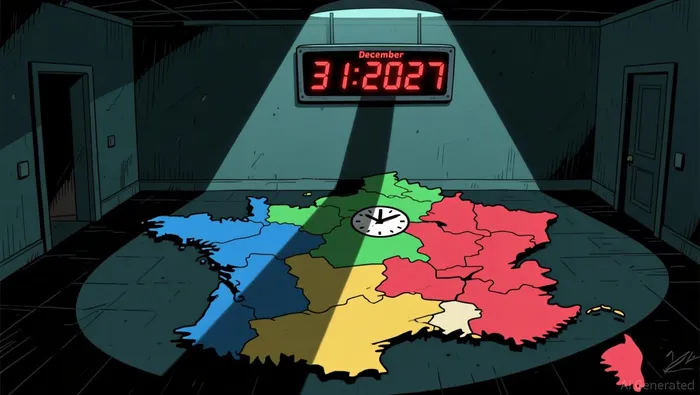
This market bets on the specific individual who wins the 2027 French presidential election, determined by the country's unique two-round voting system. A candidate secures victory by either obtaining an absolute majority (>50%) in the first round or by winning the subsequent runoff if no candidate achieves this initially. The market is bound by a primary resolution deadline of April 30, 2027, with a hard cutoff for final settlement by December 31, 2027. The core disagreement among traders is not just about who wins, but whether the current frontrunners can overcome systemic fragmentation and legal hurdles to secure a decisive majority, or if the election will end in a stalemate that triggers the market's "Other" resolution clause.
Latest News & Information Increments
Recent developments have intensified the narrative of a deeply polarized French political landscape, yet they have also introduced complexities that challenge straightforward victory scenarios. The French far-left has mobilized significantly, with Jean-Luc Mélenchon addressing thousands of activists and officially launching his campaign, while centrist rivals like Raphaël Glucksmann and François Hollande have entered the race, fragmenting the non-far-right vote. Polling data reinforces this fragmentation, indicating that Marine Le Pen is likely to face Mélenchon in a runoff, with Le Pen projected to win roughly 64-67% of the second-round vote. This polling suggests a clear ideological divide, yet the market's low pricing for Le Pen implies that traders are skeptical of these projections or are pricing in the high probability of a first-round stalemate.
Simultaneously, external factors are injecting noise and potential disruption into the campaign. French media conglomerate CNews has increasingly aligned with the far-right National Rally, potentially skewing public discourse and raising concerns about foreign influence, as evidenced by recruitment of a former Russia Today executive. Furthermore, prosecutors have opened an investigation into suspected Russian disinformation campaigns targeting centrist candidates, highlighting external threats facing the election. These developments create a volatile information environment where "effective information" regarding candidate viability is constantly competing with "noise" related to media bias and geopolitical interference. The absence of a clear, unifying catalyst has left the market in a low-information regime regarding actual voter behavior, forcing traders to rely heavily on speculative polling and rule-based risk assessments rather than concrete momentum.
Market Resolution Rules Analysis
The market resolves based on the official outcome of the election as determined by the French Ministry of the Interior. The settlement object is the specific candidate who wins, requiring either a first-round absolute majority or a runoff victory. The primary source for resolution is strictly official government data, meaning that unofficial poll results, media projections, or early returns do not constitute a settlement trigger. The market is bound by a time boundary of April 30, 2027, for the election itself, but crucially, it includes a hard resolution deadline of December 31, 2027. If the election results are not officially known by this late date, the market automatically resolves to "Other," regardless of who is leading in unofficial counts. This rule is critical for understanding why the market may discount the probability of any single candidate winning, as it explicitly prices in the risk of a prolonged administrative or legal delay.
Rule Risk Points & Disputed Scenarios
The most significant rule risk lies in the ambiguity of election results and the potential for procedural delays. If the election results are contested, delayed, or legally challenged, the market will rely solely on the official data reported by the French Government, which may not be available until well after the initial voting day. A major dispute scenario involves the "Other" resolution clause: if the results are not finalized by December 31, 2027, the market resolves to "Other," effectively penalizing all specific candidate positions. This creates a tail risk where a legitimate victory for Le Pen or Mélenchon could result in a zero payout if administrative bottlenecks or legal challenges push the official declaration past the deadline. Traders must therefore distinguish between actual political victory and the bureaucratic timeline required for market settlement, as the two are not perfectly synchronized.
Market Overview
The current market structure exhibits a distinct downward skew in probability distribution, with all major candidates showing "Yes" outcomes priced well below the 50% midpoint. Marine Le Pen leads the group with a mid-price of 0.3525, suggesting that even the frontrunner is viewed as having only a 35% chance of winning. Édouard Philippe and Jean-Luc Mélenchon trail at 0.275 and 0.125, respectively. This structure implies that the market collectively views a win for any of these three individuals as unlikely, pointing to a belief that the electorate is too fragmented for a clear majority to emerge. Le Pen’s market displays the tightest bid-ask spread of 0.001 and the highest tradability score (0.8747), indicating stronger price discovery and more representative pricing compared to her competitors. In contrast, Philippe and Mélenchon exhibit wider spreads of 0.01, suggesting less efficient price formation despite substantial underlying capital depth, with liquidity numbers ranging from approximately 191k to 255k across the markets. This liquidity profile indicates that while the market is well-funded, the pricing for non-Le Pen candidates is less robust and more susceptible to sentiment-driven swings.
Market Dynamics (Volatility & Volume)
Market volatility has been relatively contained in the short term but shows significant movement over longer horizons. The maximum one-day price change is 0.008, while the one-week change reaches 0.03, and the one-year change sits at 0.054. Notably, the one-month and one-year maximum changes overlap, suggesting that the recent volatility is part of a broader, sustained trend rather than a sudden spike. The market ID 679018 appears in both the 1-month and 1-year categories, indicating persistent repositioning, while other markets show unique volatility patterns in shorter timeframes. This suggests that trader focus is shifting, with some markets experiencing rapid repricing while others remain stable.
Trading volume provides a critical check on these price movements. The total market volume is exceptional, exceeding $126 million globally, with a 24-hour surge exceeding $959,000. This massive liquidity confirms that the current pricing is not the result of thin markets or manipulation, but rather reflects genuine, high-stakes positioning by sophisticated participants. The divergence between the low absolute prices and the high volume suggests that traders are actively hedging against the risk of a fragmented election rather than speculating on a clear winner. The high volume supports the reliability of the current price discovery process, indicating that the low probabilities for individual candidates are well-vetted by the market rather than being an artifact of low participation.
Trading Judgment & Follow-up Observation Points
The current market pricing reflects a rational assessment of the structural risks inherent in the French electoral system, rather than a dismissal of candidate viability. The low probabilities for Le Pen and others are driven by the high likelihood of a first-round stalemate and the administrative risks associated with the December 31, 2027, resolution deadline. Traders should monitor the evolution of polling data, particularly any shifts in the first-round vote shares that could reduce the probability of a runoff. Additionally, close attention should be paid to any legal challenges or administrative delays that could push the official declaration past the settlement deadline, as this would trigger the "Other" resolution and invalidate all specific candidate positions. The market is currently pricing in a complex, high-uncertainty environment, and any clear catalyst that resolves the fragmentation or clarifies the timeline could lead to significant repricing across all candidate markets.

Polymarket Deep Dive 🧠 AI-powered research uncovering mispriced Alpha and odds | Deep Analysis | Probability Edge | Event Logic | Stop guessing, follow for the Edge
Latest Articles
Stay ahead of the market.
Get curated U.S. market news, insights and key dates delivered to your inbox.


AInvest
PRO
AInvest
PRO




Comments
No comments yet