
French PPI Dips to -0.2% as Geopolitical Risks Loom
 Aime Summary
France’s Producer Price Index (PPI) fell by 0.2% month-over-month in March 2026, aligning with expectations but a sharp decline from the 0.5% increase in February. - The drop in PPI reflects weakening demand and cost pressures amid ongoing geopolitical tensions, particularly from the U.S.-Iran conflict and instability in the Middle East. - Investors are monitoring whether the decline is temporary or signals broader deflationary risks in the Eurozone, especially with rising energy prices and inflation forecasts. - The ECB remains cautious, with policymakers emphasizing patience before considering further rate hikes despite inflationary pressures.
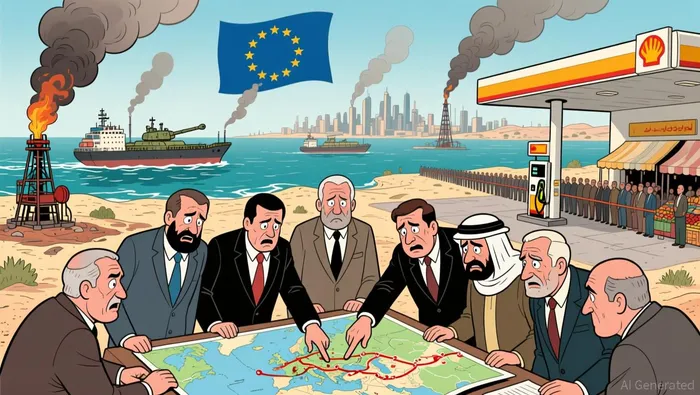
Global geopolitical tensions, particularly around the Strait of Hormuz, have created a high level of economic uncertainty in the Eurozone according to market analysis. The March 2026 French PPI data, released at -0.2% MoM, marks a notable decline from the previous month’s 0.5% increase. This drop aligns with forecasts and highlights the impact of external shocks on producer prices. While the headline number is in line with expectations, the broader context is concerning. Producer prices are a key indicator for central banks, as they often foreshadow movements in consumer inflation and overall price stability.
The drop in producer prices reflects a weakening in industrial861072-- demand and cost compression, particularly in energy-intensive sectors. The ongoing conflict in the Middle East has disrupted oil flows and raised energy prices, yet the PPI data does not yet reflect these inflationary pressures. This may suggest that firms are not immediately passing on higher input costs to final consumers. However, with energy prices continuing to rise and geopolitical tensions showing no signs of easing, this could change in coming months. The March flash data from the Eurozone also highlights a broader decline in economic sentiment, particularly in France and Germany, where businesses are increasingly factoring in the risks of higher inflation.
Investors and policymakers are closely monitoring this indicator for two key reasons. First, PPI data often serves as a precursor to CPI inflation, which is central to the ECB’s inflation-targeting framework. If input cost inflation continues to rise and flows through to the consumer price side, the ECB may face renewed pressure to raise interest rates in 2026. Second, the data is a barometer of the health of the manufacturing and industrial sectors. A persistent decline in producer prices could signal deeper structural weakness in the economy, especially in export-oriented regions like Germany.
Given the current economic climate, the ECB is likely to proceed with caution. Christine Lagarde has emphasized the need for patience and data-dependent decision-making, particularly in light of the recent spike in energy prices and the potential for spillover effects into core inflation. While the March PPI data does not immediately signal inflationary pressure, the broader context — including the ECB’s inflation forecasts and the potential for a rebound in harmonized inflation — suggests that monetary tightening could still be on the horizon. With core inflation expected to remain stable for now, the ECB has the luxury of time but not the certainty of conditions.
Investors should keep a close eye on upcoming inflation data for the Eurozone, particularly the March CPI and core CPI figures. If these readings confirm the expected rise in inflation, it could influence the ECB’s decision-making process. Additionally, developments in the Middle East and their impact on global oil prices will remain key variables to watch. Any significant escalation in the conflict could trigger renewed inflationary pressures, making it even more critical for the ECB to strike a delicate balance between price stability and supporting economic growth.
Overall, the March PPI data reflects a weaker-than-expected producer price environment, but the broader economic risks remain skewed to the upside. Investors should continue to assess the interplay between geopolitical events, energy prices, and inflationary pressures as they evaluate the potential path for monetary policy and asset allocation in 2026.

Stay ahead of the market.
Get curated U.S. market news, insights and key dates delivered to your inbox.


AInvest
PRO
AInvest
PRO



Comments
No comments yet