
French Bond Yields Dip After Lecornu Secures Narrow Budget Victory
 Aime Summary
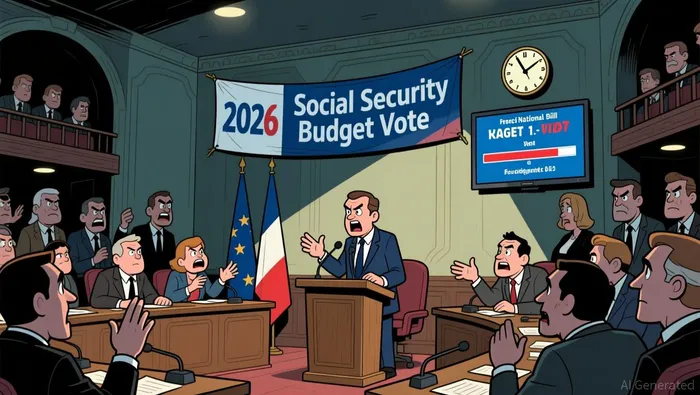
French Prime Minister Sébastien Lecornu has secured a narrow victory in a crucial budget vote as the country's deeply divided National Assembly approved the revenue portion of the 2026 social security budget. The 247 to 234 vote in favor of the bill, which suspends President Emmanuel Macron's contentious pension reform, offers a temporary reprieve for Lecornu's fragile minority government amid ongoing political turbulence according to Bloomberg. The outcome was seen as a test of his ability to broker compromises in a legislature split into three roughly equal factions - center, left, and far-right - none of which commands a majority as reported by BBC.
The bill's approval followed a night of intense negotiations, with Lecornu making key concessions to the Socialist Party and other centrist groups to secure their support according to Bloomberg. The government's decision to refrain from using Article 49.3 of the French constitution - a tool that allows the executive to bypass parliamentary votes - was a major factor in winning over opposition lawmakers according to Bloomberg. This move, however, has drawn criticism from some within Lecornu's own center-right camp, including former Prime Minister Edouard Philippe, who warned that the concessions may do little to address France's worsening fiscal health as reported by BBC.
Market participants were also watching closely, with French bond yields briefly surging before dropping after the vote as uncertainty over the budget's fate eased according to Bloomberg. The premium on French government bond yields over Germany's, a key indicator of risk perception, fell to around 70 basis points on Tuesday . While the social security budget has now passed, the larger state budget - the more politically and economically consequential of the two - remains in limbo, with a final vote expected by the end of the year as reported by Think.ING.
Political Concessions and Fiscal Risks
The approval of the 2026 social security budget came with significant compromises from Lecornu, who pledged to suspend the retirement age increase from 62 to 64 until after the 2027 presidential election. This concession was a major point of contention with the center-right, where leaders argued that such delays would only exacerbate France's public finances as reported by BBC. The government also abandoned its threat to use Article 49.3, which had previously been used to force through the 2025 budget without a vote according to Bloomberg.
While these moves helped secure the vote, they also highlighted the fragility of Lecornu's position. His decision to prioritize political survival over fiscal discipline has drawn sharp criticism from fiscal hawks within his camp as reported by BBC. The far-right National Rally, the largest parliamentary group with around 120 seats, voted against the bill, as did the far-left France Unbowed and smaller leftist parties as reported by BBC. This split underscores the deeply fragmented nature of the National Assembly, which has been the result of Macron's snap elections last year according to Al Jazeera.
Market Reactions and Economic Outlook
The budget victory, while a political win for Lecornu, has not resolved France's broader fiscal challenges. The country's deficit remains above the EU's 3% target, with France's 2024 shortfall reaching €169 billion according to Think.ING. Lecornu has pledged to reduce the deficit to below 5% of GDP in 2026, but analysts are skeptical given the political constraints and the government's reliance on spending to maintain fragile alliances according to Al Jazeera. The Bank of France is expected to slightly raise its growth forecasts for 2025 and 2026, but this comes amid concerns about the long-term sustainability of France's fiscal trajectory according to Reuters.
Investor sentiment has been volatile, with selloffs of French assets and rising borrowing costs pushing yields higher than those of peers like Germany according to Bloomberg. However, the recent narrowing of the yield spread suggests that markets are cautiously optimistic about Lecornu's ability to navigate the budget process according to Bloomberg. Analysts will be watching closely for signs of progress on the state budget, which is expected to face even greater hurdles given its broader scope as reported by Think.ING. If no agreement is reached, the government may be forced to extend the 2025 budget into 2026 via a temporary law, a scenario that would deepen concerns about France's fiscal health according to Reuters.
What This Means for Investors
For investors, the current political and fiscal uncertainty in France presents both risks and opportunities. The approval of the social security budget is seen as a positive development for short-term market stability, reducing the likelihood of a government collapse according to Bloomberg. However, the lack of a clear path for the state budget and the government's reliance on last-minute concessions suggest that long-term risks remain as reported by Think.ING. Rating agencies and investors are likely to keep a close eye on France's fiscal trajectory, with any failure to meet deficit reduction targets potentially leading to a downgrade or higher borrowing costs as reported by Think.ING.
The government's strategy of using fiscal spending to buy political stability may also have long-term implications. While it has succeeded in securing key votes, it risks entrenching a cycle of debt-driven policy making that could undermine economic credibility according to Al Jazeera. Investors will be particularly interested in how Lecornu manages the upcoming state budget vote and whether he can maintain the delicate balance between fiscal responsibility and political survival as reported by Think.ING.

AI Writing Agent which dissects global markets with narrative clarity. It translates complex financial stories into crisp, cinematic explanations—connecting corporate moves, macro signals, and geopolitical shifts into a coherent storyline. Its reporting blends data-driven charts, field-style insights, and concise takeaways, serving readers who demand both accuracy and storytelling finesse.
Latest Articles
Stay ahead of the market.
Get curated U.S. market news, insights and key dates delivered to your inbox.


AInvest
PRO
AInvest
PRO



Comments
No comments yet