
FreightCar's Q3 2025: Contradictions Emerge on Tank Car Conversions, CapEx Timing, and Market Resilience
 Aime Summary
Date of Call: November 10, 2025
Financials Results
- Revenue: $160.5M in Q3 2025 (up >42% YOY vs $113.3M in Q3 2024); deliveries 1,304 vs 961 prior year; revised FY revenue guidance $500M–$530M
- EPS: $0.24 per diluted share (adjusted) in Q3 2025 vs $0.08 in Q3 2024; reported net loss $0.23 per share including $17.6M noncash warrant liability
- Gross Margin: 15.1% in Q3 2025, compared to 14.3% in Q3 2024
Guidance:
- Reaffirmed full-year adjusted EBITDA and railcar delivery guidance ranges
- Lowered full-year revenue range to $500M–$530M to reflect higher mix of conversions
- Full-year capital expenditures expected $4M–$5M (timing of some spend moved into early 2026)
- Expect to close the year with positive free cash flow and strong margins
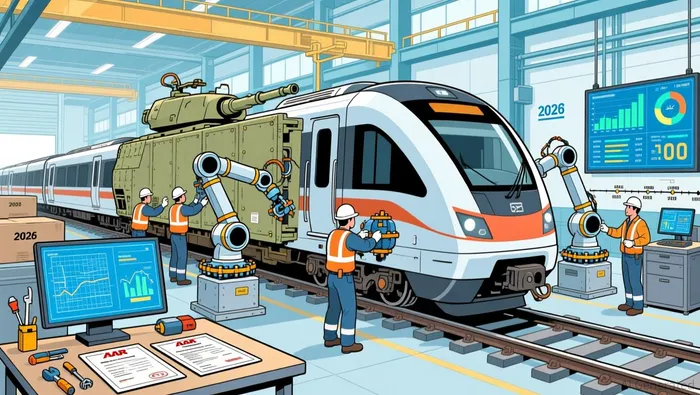
- Tank-car retrofit/convertibility activity to begin shipments in 2026 as AAR certifications and equipment readiness complete
Business Commentary:
* Exceptional Financial Performance: - FreightCar America reportedrevenue growth of over 42% and a record adjusted EBITDA of $17 million in Q3 2025. - This was driven by strong deliveries, a favorable product mix, and operational efficiencies at the Castanos facility.- Strategic Initiatives and Market Positioning:
- The company is advancing its TruTrack digital integration, vertical integration, and automation to enhance future growth and margin expansion.
- These initiatives are part of a broader strategy to strengthen its market position and prepare for future tank car conversions.
- Backlog and Market Dynamics:
- FreightCar America maintained a strong backlog of
2,750 unitsvalued at approximately$222 million. - While industry demand is temporarily muted, the company sees pent-up demand as the market normalizes, positioning itself for growth as industry order placement trends towards normalized replacement levels.
Sentiment Analysis:
Overall Tone: Positive
- Management called it an "exceptional third quarter" with "revenue growth of over 42%" and "record" adjusted EBITDA of $17.0M; highlighted margin expansion (gross margin 15.1%, adjusted EBITDA margin 10.6%) and said they "expect to maintain strong margins and close the year with solid positive cash generation."
Q&A:
- Question from Mark La Reichman (NOBLE Capital Markets): Can you walk through CapEx plans to prepare for the tank car conversions, how CapEx unfolds into 2026 and uses of the expenditures?
Response: Timing shift only—some CapEx moved from late Dec into early Jan (2026) for vertical integration and equipment; AAR certifications and capital equipment are on track and shipments begin in 2026.
- Question from Mark La Reichman (NOBLE Capital Markets): Given backlog ASP movement, would you expect Q4 margins to look like Q3?
Response: We are holding adjusted EBITDA and unit guidance but lowered revenue dollars due to a higher proportion of conversions; profitability and cash generation remain the priority, so revenue is a less meaningful metric.
- Question from Iva Prcela (Northcoast Research): Do you expect product mix to shift following the change in guidance; how will mix between rebuilds and new builds trend?
Response: Yes—a modest shift toward a higher proportion of conversions versus the original forecast, which reduces revenue dollars but preserves adjusted EBITDA.
- Question from Iva Prcela (Northcoast Research): How is demand for coal car repair trending and will it provide lift into 2026?
Response: Coal car repairs are in the aftermarket business and we expect continued, sustained demand for components given our large installed fleet and extensions of coal facility life.
- Question from Iva Prcela (Northcoast Research): Any disruptions or order delays tied to the government shutdown or related policy?
Response: No material disruptions observed; border crossing is the most sensitive area but automation has mitigated issues and we haven't seen impacts.
- Question from Brendan Michael McCarthy (Sidoti & Company): Q4 implied adjusted EBITDA margin looks lower (~8%) versus Q3 — what is driving the step down?
Response: Q4 is seasonally lower margin due to the annual December maintenance shutdown and a higher proportion of commoditized/covered-hopper work; Q3 benefited from specialty new cars.
- Question from Brendan Michael McCarthy (Sidoti & Company): Can you quantify the addressable market for tank car retrofits related to the 2029 deadline?
Response: Retrofits are meaningful but likely limited (maybe a couple hundred cars for us); the larger strategic benefit is AAR approvals and readiness to shift into new tank car production thereafter.
- Question from Brendan Michael McCarthy (Sidoti & Company): Are you confident replacement-level demand retraces toward ~40,000 units in 2026?
Response: Yes—management is confident demand will trend back toward normalized replacement levels in 2026, likely back-half loaded, driven by fundamentals, scrap rates and pent-up demand.
- Question from Brendan Michael McCarthy (Sidoti & Company): You achieved >20% addressable market share for new car orders this quarter — what explains that?
Response: Market share gains stem from scale and experience, product breadth and customization, strong execution (TruTrack) and deep customer relationships.
Contradiction Point 1
Tank Car Conversion Program and Market Addressability
It involves the company's strategic initiatives related to tank car retrofits and the addressable market for these conversions, which could impact the company's growth and revenue expectations.
How confident are you in an increase in replacement-level demand in 2026? - Brendan Michael McCarthy (Sidoti & Company, LLC)
2025Q3: The retrofit program is a stepping stone to new tank car production. The purpose is to gain AAR approvals and prepare the plant. Addressable market for tank cars might include a few hundred additional opportunities beyond the retrofit scope. - Nicholas Randall(CEO)
Can you provide more details on the tank car conversion pipeline and discussions with potential customers? - Brendan Michael McCarthy (Sidoti & Company, LLC)
2025Q2: We see a pipeline of conversions needed to meet federal mandates. We are working with customers on the best timeline for conversions. - Nicholas Randall(CEO)
Contradiction Point 2
Tank Car Conversion Start Date
It involves the timeline for starting the tank car conversion program, which impacts the company's operational planning and customer expectations.
CapEx guidance is now $4M–$5M. Can you explain plans for tank car conversions and new market entry, and how these expenditures are allocated through 2026? - Mark La Reichman (NOBLE Capital Markets, Inc., Research Division)
2025Q3: Conversions are expected to start in 2026, but the CapEx change reflects a timing shift across new years. - Nicholas Randall(CEO)
Can you clarify the timing of the $6 million EBITDA contribution from the tank line in 2026 and 2027? How might mergers among Class 1 rail carriers affect your operations? - Aaron Bruce Reed (Northcoast Research)
2025Q2: The tank car conversion program starts in Q2 of 2026 and continues into 2027. - Nicholas Randall(CEO)
Contradiction Point 3
CapEx Timing and Tank Car Conversions
It involves changes in capital expenditure plans, specifically regarding the timing of investments for tank car conversions, which could impact production scheduling and costs.
Can you outline your plans for tank car conversions and entering new markets, including how the $4M–$5M CapEx guidance will progress through 2026 and be allocated? - Mark La Reichman (NOBLE Capital Markets, Inc., Research Division)
2025Q3: The change in CapEx is not in scope but in timing. Investments for vertically integrated components for tank car retrofits originally scheduled for late December have moved into early January. - Nicholas Randall(CEO)
What factors are considered when adding a fifth production line? - Mark Reichman (Noble Capital Markets)
2025Q1: The fifth line is ready with minimal cost ($1 million, less than 90 days) and can produce an additional 1,000-1,200 units. The trigger for activation could be sustained demand over 5,200 units annually, including new railcars, conversions, or complex fabrications. - Nick Randall(CEO)
Contradiction Point 4
New Railcar Order Share and Market Demand
It involves differing perspectives on the company's market share and demand expectations, which are critical for understanding growth potential and competitive positioning.
How confident are you that replacement demand will increase in 2026? - Brendan Michael McCarthy (Sidoti & Company, LLC)
2025Q3: I am confident that demand will trend towards replacement levels in 2026, likely back-half loaded. Fundamentals remain solid, and pent-up demand persists. - Nicholas Randall(CEO)
How does your order flow compare to the broader industry's customer hesitation? - Brendan McCarthy (Sidoti)
2025Q1: The industry environment remains healthy with strong drivers like rail traffic and replacement cycles. Our order intake is strong with a focus on open top hoppers. Our market share grows due to product quality and reliability. - Nick Randall(CEO)
Contradiction Point 5
Demand for Railcars and Market Resilience
It involves differing perspectives on the demand for railcars and market resilience, which are crucial for understanding the company's growth and stability.
Have you experienced disruptions or order delays related to the government shutdown or policies? - Iva Prcela (Northcoast Research)
2025Q3: The nature of the rail industry makes it less susceptible to short-term impacts like government shutdowns. Border crossing is automated, and there have been no disruptions in car transfers between Mexico and the U.S. - Nicholas Randall(CEO)
How is FreightCar positioned vs. competitors to address potential tariffs by the US or other countries? - Mark Reichman (Noble Capital Markets)
2024Q4: While tariffs and supply chain uncertainties exist, U.S. demand for railcars remains stable and resilient. Despite current uncertainties, our agility and strong market position are advantages, allowing us to easily convert customer inquiries into orders as market conditions stabilize. - Mike Riordan(CFO)

Discover what executives don't want to reveal in conference calls
Latest Articles
Stay ahead of the market.
Get curated U.S. market news, insights and key dates delivered to your inbox.
AInvest
PRO
AInvest
PRO



Comments
No comments yet