

There is an obvious way to read Freeport-McMoRanFCX-- (FCX) at a record, and it goes like this: copper is at a record, so a major producer of it is at a record, and anyone who owned the commodity simply owned the stock too. The trouble is that the numbers refuse to behave the way commodity beta is supposed to behave. FCXFCX-- is up roughly 49% year to date while the copper price is up about 14%. Over the past five trading days the stock added about 14% while a copper proxy was essentially flat. A stock does not out-run its underlying commodity by triple the margin through pure beta. It does that when the market is buying something the commodity alone does not explain.
What the market is buying has a name, a mine, and a timeline: Grasberg, in Indonesia, and the earnings that mine is supposed to deliver in 2027. The record price is a pre-payment for that ramp on top of a copper market already near records. That combination explains this rally, and it explains why holders now face a different decision than new buyers.
1. The tell: a copper miner out-running copper by three times
Per Ainvest data, FreeportFCX-- closed at its record near $75.80 on August 21, 2026, touching $77.33 intraday, up 49.4% year to date, 74.8% over twelve months, and 14% in the last five trading days, with a 20-day gain near 21%. The copper proxy — the CPER fund, which tracks copper futures rather than miner equities — is up 14.3% year to date and 43.4% over a year, but was flat over the same five days.
That gap — the miner more than tripling copper's yearly gain, then running 14% in a week while copper sits still — is the fingerprint of a company-specific repricing, not a repricing of the commodity. The market is not paying more for the same cycle; it is assigning a premium to a specific future earnings stream that has not been earned yet, and it is doing so fast: most of the 20-day move landed in the final five sessions. A multiple-funded rally is only as safe as the future those earnings are priced against.
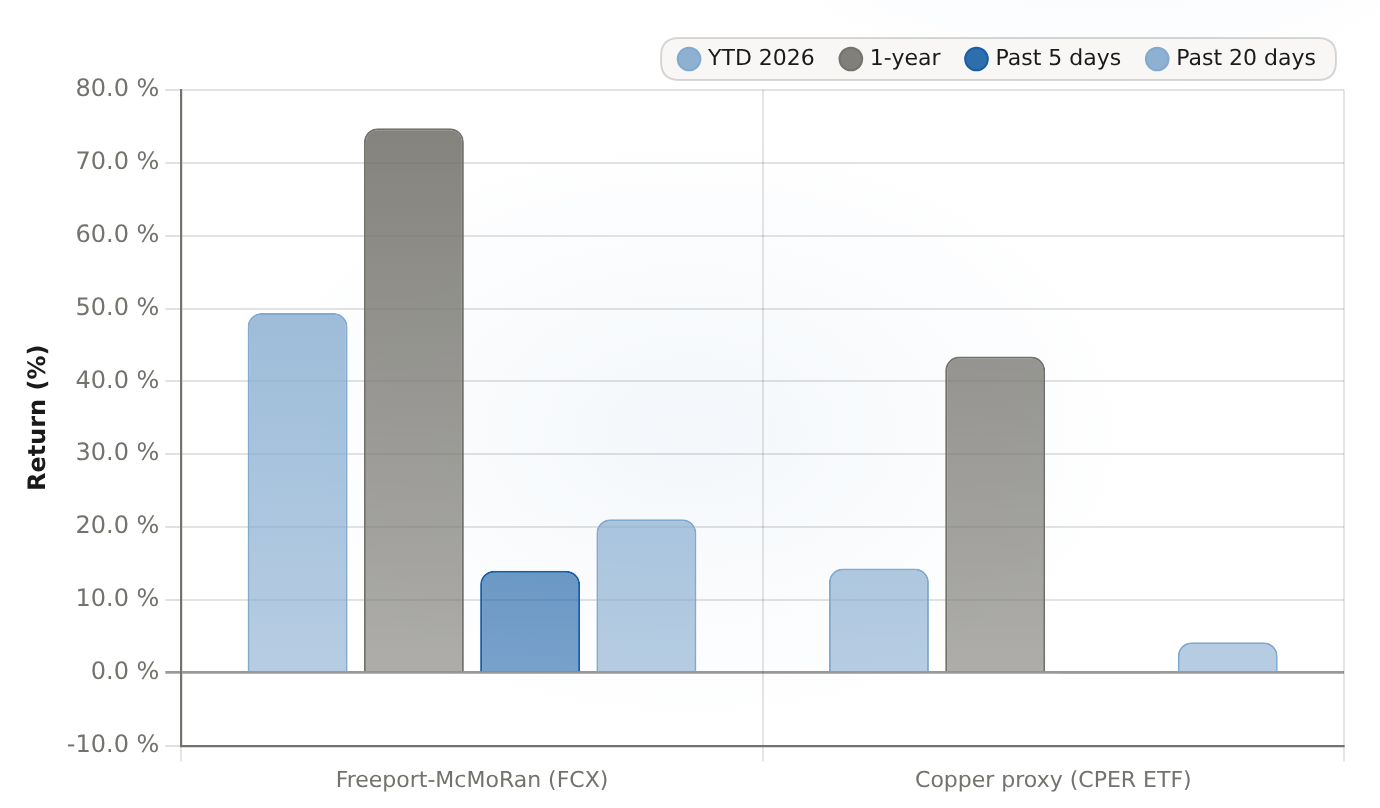
FCX roughly tripled copper's 2026 return and jumped ~14% in the last five sessions while the copper proxy was essentially flat — the 5-day and 20-day divergence is the smoking gun that this leg of the record rally is a company-specific re-rating, not copper beta.
| Entity | YTD 2026 (%) | 1-year (%) | Past 5 days (%) | Past 20 days (%) |
|---|---|---|---|---|
| Freeport-McMoRan (FCX) | 49.4 | 74.76 | 14 | 21.09 |
| Copper proxy (CPER ETF) | 14.32 | 43.4 | -0.13 | 4.2 |
2. What the market is actually buying: the Grasberg torque
The specific future is Grasberg's underground Block Cave operation — a high-volume, low-cost mining method in which ore is undercut and allowed to collapse under its own weight. The odometer here has been reset several times. A flood in 2025 disrupted the operation, and Freeport declared force majeure on contracted supplies from its Grasberg Block Cave mine — a legal notice that relieves a company of delivery obligations it cannot meet. Output then ran below capacity through 2026, and in April management cut full-year copper guidance to 3.1 billion pounds, with gold reduced to 650,000 ounces. The stock fell 12.6% the day that landed.
That disappointment, though, is what set up the mechanism the market is now paying for. Management guides to only about 65% of Grasberg capacity in the second half of 2026, with full capacity arriving only in late 2027, and to materially higher copper and gold sales into 2027. Lay a recovering mine on top of a near-record copper price and you get the point of maximum earnings torque — the year the company's volume and its price rise together, which is why the guided second half of 2026 and 2027 is where the inflection sits.
Because the market has begun pre-buying a successful 2027, the downside is asymmetric. The forward multiple has stretched not because current earnings are here but because the earnings glide-path is believed. The same mechanism cuts the other way: a copper pullback or another slip at Grasberg — or anywhere in the Indonesian operating chain — lands on a multiple that already embeds the happy ending. And there is a near-term check on the ramp: PT Smelting's Gresik plant, roughly 342,000 tonnes of annual cathode about 66% owned by Freeport Indonesia, has been shut since August 8 on furnace damage, with the restart of the nearby Manyar smelter rushed to the end of August. A restart that slips is the kind of failure that hurts more at 37-to-48 times earnings than at a normal multiple.
3. The copper backdrop is real — and mean-reverting
None of this works without copper holding up, and copper is near records for reasons that are structural more than speculative. LME three-month copper traded around $14,100 a tonne in mid-August after peaking near $14,527 a tonne in late January 2026 — the same metal had first crossed $12,000 a tonne only in December 2025. Underneath that price is a genuine squeeze: a DR Congo concentrate export ban, Chilean output stuck near 5.5 million tonnes against a 6 million-tonne target, record-low smelter treatment charges — the fees smelters earn for processing concentrate — with the 2026 annual benchmark settled at zero, exchange inventories drained for 42 consecutive days down to roughly 205,000 tonnes, and a cash-to-three-month spread at a five-year high — a structure called backwardation, where immediate metal is priced above future delivery and which is the classic signature of physical scarcity. Analysts project refined-market deficits through 2027, and the IEA sees a roughly 30% supply shortfall by 2035 on the announced pipeline.
Here is the counterweight: the market has already paid for a large part of that. BMI Research still forecasts a 2026 full-year average near $13,500 a tonne, below today's spot. Copper does not have to crash for FCX to deflate; a drift back toward that average rather than toward fresh records quietly compresses the multiple on which the record price rests.
4. The reported numbers are solid — and too small for the price
The second-quarter print, reported July 23, was a clean set of actuals on the company's own terms: revenue of $7.03 billion, net income of $984 million, earnings per share of $0.74, on sales of 710 million pounds of copper, 123,000 ounces of gold and 25 million pounds of molybdenum. I am deliberately not labeling it a beat or a miss: the data feeds disagree on what the pre-print consensus actually was, with one feed showing a forecast far above the reported figures while an earlier preview column had analysts near $0.60 adjusted EPS. The honest summary is the actuals, not a surprise label.
The financial profile underneath is genuinely good at any price. Net debt is modest at roughly $5.3 billion against about $4.1 billion of cash, trailing operating cash flow of about $5.9 billion against roughly $4.0 billion of capital expenditure leaves about $1.9 billion of free cash flow, dividends have run for seven consecutive years with a payout near 31.5% of TTM earnings, and the company has repurchased about 55.4 million shares for roughly $2.2 billion since late 2021. Management's own 2029 projection of $37.4 billion in revenue and $6.4 billion in net income requires roughly 12% annual revenue growth — exactly the ramp being pre-paid today.
This is a durable, well-run metals franchise, and I would not bet against the company. Durability, however, is not the same as value, and the two are being confused at this price.
5. The valuation has left the rest of the group behind
At a roughly $108.9 billion market cap, FCX trades near 37 times trailing earnings — and about 48 times forward earnings, meaning against the next twelve months of expected profit. Both figures are the kind of multiple a growth platform commands, not a cyclical miner. The peer comparison makes the point. On a trailing basis, BHP sits near 25 times earnings with a 7.5 times EV/EBITDA — enterprise value relative to earnings before interest, taxes, depreciation and amortization, a capital-structure-neutral multiple. Rio Tinto trades near 11 times earnings and 6.9 times EV/EBITDA while yielding 4.45%. Teck is near 19 times. Only pure-play Southern Copper carries an even more expensive EV/EBITDA, around 18 times. At 12.6 times, Freeport is the richest name in the group — rich on growth expectations, and conspicuously not rich on income.
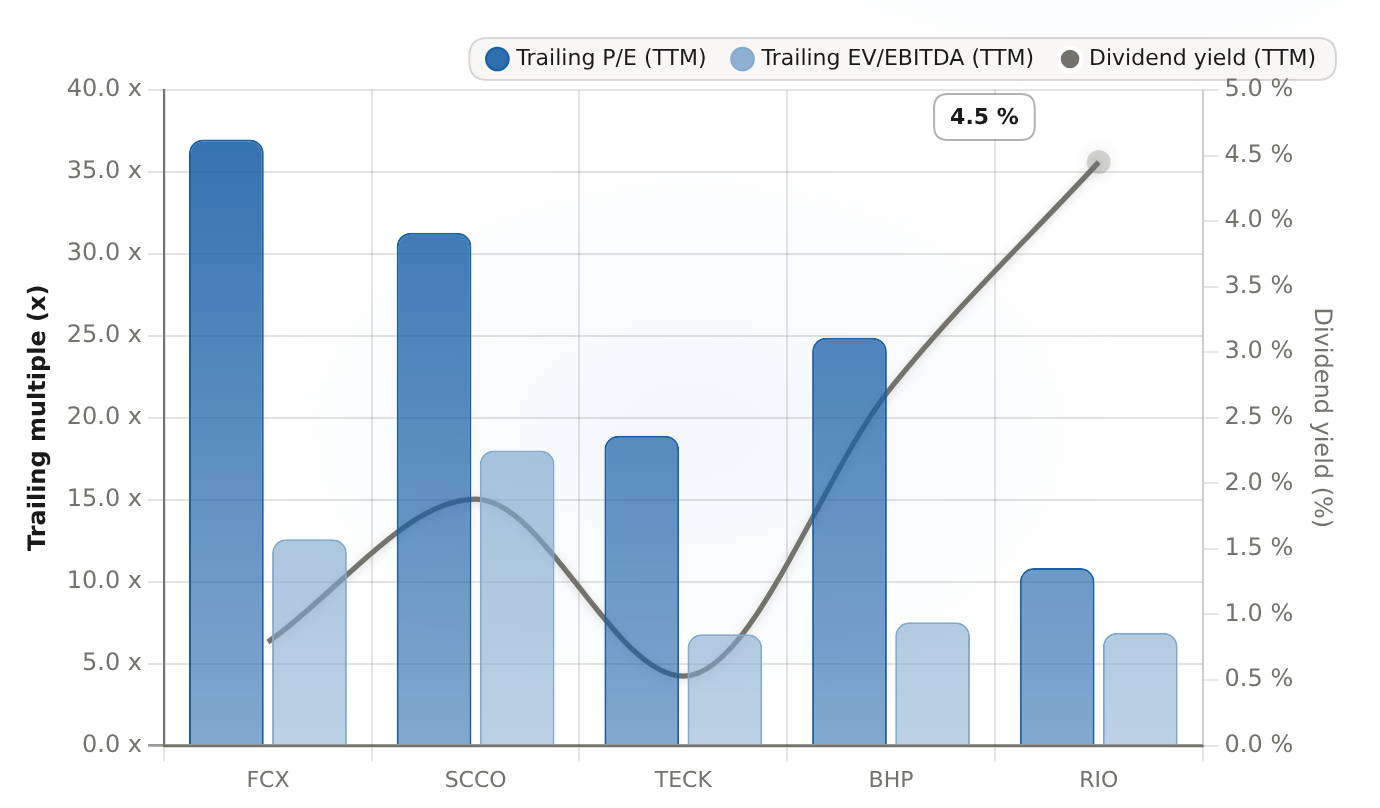
FCX carries the group's richest trailing P/E (~37x vs ~10.8x for Rio Tinto) while yielding only ~0.8% — barely a fifth of Rio's 4.45% — so the record price already capitalizes a successful 2027 earnings ramp.
| Ticker | Trailing P/E (TTM) (x) | Trailing EV/EBITDA (TTM) (x) | Dividend yield (TTM) (%) |
|---|---|---|---|
| FCX | 36.98 | 12.59 | 0.79 |
| SCCO | 31.29 | 18.01 | 1.88 |
| TECK | 18.91 | 6.79 | 0.53 |
| BHP | 24.89 | 7.52 | 2.73 |
| RIO | 10.83 | 6.89 | 4.45 |
The income ledger is the thinnest in the peer group. The dividend yields roughly 0.8% on a trailing basis and barely 0.4% on a forward basis at this price. For someone buying a miner for current income, FCX at a record does not solve the problem the way Rio Tinto's 4.45% yield does. The seven consecutive years of dividend payments are real, but on the equity yield curve — the relationship between dividend yield and dividend growth that decides whether compounding works for you — this is the wrong point to enter: the rally has compressed the yield instead of the downturn inflating it.
6. The verdict: trim into strength; new money is a torque bet
Holders have an honest decision in front of them, and I don't think "do nothing" is clearly the best answer. The record price already capitalizes a 2027 ramp that depends on flawless Grasberg execution and on copper staying tight. Trimming into the strength — not an exit, a trim — turns a multiple-funded gain into realized buying power and keeps meaningful exposure to the torque, which is still a real story. Holding the full position at roughly 48 times forward earnings means volunteering the downside of an execution or commodity slip without being paid extra for it now that the run-up has already happened.
New investors deserve the same honesty in reverse. At the record, this is not a value entry and it is not an income entry. It is an underwrite-the-torque bet: you are paying, today, for near-record copper plus a full Grasberg ramp plus flawless execution, all three held at once for a year and a half. If that is the exposure you want, it is a legitimate but narrow bet, and it should be sized like a bet, not like a core holding. If what you actually want is dividend growth bought at a fair price — the compounding engine of my framework — this is the opposite point of the cycle to be starting that engine.
7. The watchlist: the conditions that keep the thesis alive or kill it
- Copper mean reversion: any sustained drift toward the roughly $13,500 a tonne 2026 consensus average compresses the multiple.
- LME inventories and backwardation: after 42 straight days of draws, a rebuild would signal the squeeze is ending.
- Grasberg ramp progress: toward about 65% of capacity in the second half of 2026 and full capacity in late 2027.
- Indonesia's export permits, renewed in six-month windows tied to smelter progress, and the unresolved post-2041 operating rights — an extension was agreed, but reports flag reduced economic ownership.
- The Gresik furnace repair and the Manyar restart, both set against an end-August timeline after the August 8 shutdown.
- Valuation de-rating: with the next report likely late October, a miss or a guidance slip at 37-to-48 times earnings will hit far harder than at a normal multiple.
The honest conclusion is that the bull case is real and the price is the problem. Freeport is a high-quality, mission-critical metals franchise with a clean balance sheet and a genuine growth story that deserves a premium to the diversified miners. But at a record with a near-zero dividend, the market has already written the 2027 ending into the ticker. I believe the risk/reward from here favors trimming into strength for holders, and for new investors this is a deliberate torque bet, not a value or income proposition. The better entry — where the equity yield curve does the work for you — arrives when the market grows fearful enough about a copper pullback or a Grasberg slip to inflate the yield again. That moment will come. The discipline is to wait for it, or to keep the torque slice small enough that being early on the ramp cannot hurt the portfolio.








Comments
No comments yet