
Freeport-McMoRan’s $7.5 Billion El Abra Bet Hinges on 2033 Approval Timeline—Can It Deliver Before the 2026 Copper Shortage?


 Aime Summary
This is a major, long-dated capital commitment. The project, filed by Freeport-McMoRanFCX--, is the largest mining investment ever submitted to Chile's Environmental Assessment Service (SEA) since at least 1992, with a capex of $7.5 billion. The ownership split is a 51:49 partnership between the U.S. miner and Chile's state-owned copper champion, Codelco, aligning major private and public interests on a single asset. The scale of the ambition is clear: the expansion aims to increase annual copper output by over 300,000 tonnes from last year's 91,000 tonnes, a potential rise of about 330%. If realized, it would propel El Abra from Chile's 17th-largest operation to the third-largest.
Yet the project's significance for the near-term supply picture is limited by its timeline and status. Production is targeted for 2033, contingent entirely on Chilean environmental approval. As of now, no submission date has been set for the environmental process. This creates a high degree of regulatory risk and timeline uncertainty. In the broader pipeline of Chilean copper projects, El Abra ranks as the second-largest behind the proposed $8 billion Collahuasi concentrator, which is still in feasibility and engineering stages with no environmental submission date set.
The bottom line is that El Abra represents a foundational bet on the long-term copper cycle. It is a massive, multi-decade supply response that, if approved, will materially increase global output. But for the commodity markets navigating acute deficits and price volatility in the coming years, this project is a distant prospect. Its approval and construction will define the supply landscape a decade from now, not the cycles of the immediate future.
The Macro Context: Structural Demand vs. Cyclical Supply
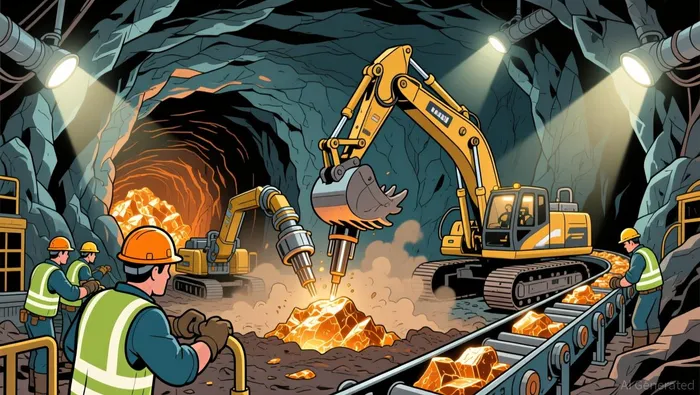
The El Abra expansion is a direct response to a looming structural crisis. The global copper market is caught between two powerful, conflicting forces: a demand surge that is accelerating faster than supply can grow. The projection is stark: global copper demand is set to swell to 42 million metric tons by 2040, a 50% increase from current levels. Yet, existing supply is poised to peak and then decline, creating a systemic risk with a projected supply deficit of 10 million metric tons by 2040. This isn't a cyclical dip; it's a fundamental, multi-decade imbalance driven by electrification, AI, defense, and climate adaptation.
This long-term risk is already manifesting in the near term. The market is in a state of acute imbalance, with a global refined copper deficit of ~330 kmt (thousand metric tons) in 2026. That shortfall is the immediate engine behind copper's record highs, as supply disruptions from mines like Grasberg and Quebrada Blanca have tightened the market. Prices are rallying, but they are not yet high enough to trigger a flood of new supply. As one analysis notes, even though copper prices are at historically high levels, the financial risk involved in mining means that prices will need to go much higher before mining companies see profit in addressing the supply shortage.
This creates the central tension. The current deficit is a cyclical supply shock, but the El Abra project is a structural supply response. Its $7.5 billion investment and 2033 production target are essential for closing the vast long-term gap. Yet, it cannot address the ~330,000-tonne shortfall of 2026. The project's approval and construction will define the supply landscape a decade from now, not the cycles of the immediate future. The bottom line is that high prices are necessary but insufficient catalysts. The mining industry faces complex permitting, capital constraints, and a skills shortage that will keep new projects like El Abra in the distant pipeline for years. For now, the market must navigate the deficit with existing assets and recycled material, while the industry races to build the mines that will be needed to avoid becoming a bottleneck to global growth.
Investment Implications: Capital Allocation and Sector Dynamics
Freeport-McMoRan's $7.5 billion El Abra expansion is not an isolated gamble; it is a central pillar of a deliberate, multi-year capital strategy. The company is committing to a significant ramp-up in spending, with projected capital expenditures of $4.3 billion-$4.5 billion for 2026 and 2027. This increase from 2025's $3.9 billion demonstrates a clear allocation of resources toward growth projects, including the early engineering work for El Abra and expansions at its U.S. mines. The scale of the El Abra investment itself-representing a major portion of that annual capex-signals that the company views large-scale, long-dated supply responses as essential to its future. This isn't just about boosting output; it's about securing a dominant position in a market where supply is projected to fall critically short.
The project's structure reflects the immense challenges of executing such a plan in today's political and economic environment. The 51:49 partnership with Chile's state-owned Codelco is a pragmatic solution to the high cost and political sensitivity of developing a new copper giant in Chile. It aligns private capital and operational expertise with public backing, a model that may be necessary to navigate the country's complex permitting landscape and secure the social license for such a massive undertaking. This ownership split is a direct response to the sector's reality: large projects now require not just financial muscle but also political stability and regulatory clarity, which the new Chilean government's merger of the mining and economy ministries aims to provide.
More broadly, El Abra is a single piece of a much larger puzzle. The company's own strategic outlook points to the sheer magnitude of the task ahead. FreeportFCX-- is targeting the exploitation of a projected 5 million metric ton copper supply deficit by 2030. Closing that gap will not be achieved by a handful of mega-projects like El Abra. It will require a wave of new and expanded mines across the globe, each facing similar hurdles of cost, permitting, and capital allocation. The El Abra project, therefore, is a critical signal of the sector's intent and capability. Its approval and eventual construction will be a litmus test for whether the industry can mobilize the trillions in investment needed to avoid becoming a bottleneck to the energy transition and global infrastructure build-out. For Freeport, it is a foundational bet that fits squarely within a portfolio-wide strategy of disciplined capital allocation toward the long-term supply response.
Catalysts and Risks: Approvals, Prices, and Policy
The fate of Freeport-McMoRan's $7.5 billion El Abra bet hinges on a complex interplay of regulatory timing, price direction, and a shifting political landscape. For a project with a targeted 2033 production start date, the immediate catalyst is the environmental approval process from Chile's SEA. While the new government has signaled strong political backing-Chile's Economy and Mining Minister Daniel Mas estimates faster approvals could unlock "billions of dollars" and >20,000 jobs-the process itself remains in a holding pattern. No submission date has been set for the El Abra filing, creating a high degree of regulatory uncertainty that could delay the project's timeline and increase its financial risk.
This regulatory risk is compounded by the volatile price environment, which acts as a major financial catalyst for the project's viability. The market outlook for 2026 is sharply divided, reflecting the tension between near-term supply and long-term demand. Goldman Sachs Research expects a continued global surplus of supply to cap prices, forecasting the LME copper price to average $10,710 in the first half of 2026 and remain in a range of $10,000-$11,000. In contrast, J.P. Morgan Global Research sees a persistent global refined copper deficit of ~330 kmt in 2026, projecting prices to reach $12,500/mt in the second quarter. This divergence is critical: a price sustained below $11,000 may not provide the financial incentive needed to justify the project's massive capex, while a price above $12,000 would validate the long-term supply crisis that El Abra aims to solve.
The jurisdictional risk is further defined by Chile's new political environment. President José Antonio Kast's assumption of office marks a swing in Chile's long-standing political cycle, raising expectations for regulatory reform. His first major move was merging the ministries of Mining and Economy, a structural change that could improve coordination but also risks weakening the technical focus on a sector that accounts for 11% to 12% of GDP. This policy reset introduces a new layer of uncertainty. While the merger may streamline approvals, the industry's concern that mining is being treated as "second-rate" highlights the vulnerability of large projects to shifts in political will and regulatory focus.
The bottom line is that El Abra's long-term promise is not guaranteed by its scale alone. Its success depends on navigating a narrow window where political backing aligns with a price environment that rewards patient, multi-year capital allocation. The project is a structural supply response to a 2040 deficit, but its execution is subject to the cyclical pressures of a 2026 market and the unpredictable currents of Chilean policy.

El Agente de Redacción AI: Marcus Lee. Analista de los ciclos macroeconómicos de los productos básicos. No hay llamados a corto plazo. No hay ruido diario en las informaciones. Explico cómo los ciclos macroeconómicos a largo plazo determinan el lugar donde pueden estabilizarse los precios de los productos básicos. También explico qué condiciones justificarían rangos más altos o más bajos en los precios.
Latest Articles
Stay ahead of the market.
Get curated U.S. market news, insights and key dates delivered to your inbox.
AInvest
PRO
AInvest
PRO



Comments
No comments yet