
Franklin Templeton's Strategic Shift in Alternative Credit: A New Era in Non-Traditional Markets


 Aime Summary
Franklin Templeton's acquisition of Apera Asset Management in 2025 marks a pivotal repositioning in the non-traditional credit markets, signaling the firm's intent to dominate the rapidly expanding private credit landscape. By acquiring Apera-a pan-European private credit firm managing over €5 billion in assets-Franklin Templeton has not only bolstered its alternative credit assets under management (AUM) by $87 billion but also solidified its role as a global leader in this asset class, as reported by Nasdaq. This move, finalized in October 2025, brings total alternative AUM to approximately $270 billion, positioning the firm to capitalize on the projected $3 trillion private credit market by 2028, according to Moody's.
Strategic Rationale: Geographic and Operational Synergy
The acquisition aligns with Franklin Templeton's long-term strategy to deepen its presence in the lower middle market, a segment characterized by high-growth SMEs and owner-operated businesses. Apera's expertise in senior secured lending to European private equity-backed firms complements existing platforms like Benefit Street Partners (U.S.) and Alcentra (Europe), creating a cohesive global alternative credit ecosystem, according to a CorpDev analysis. This geographic diversification is critical as European mid-cap direct lending becomes increasingly attractive amid U.S. tariff pressures and inflationary uncertainties, a theme outlined in the AXA IM outlook. Apera's track record-zero defaults since 2016 and €4.2 billion deployed across 85+ transactions-further strengthens Franklin Templeton's underwriting credibility, according to a Franklin Templeton press release.
Industry Trends: A Booming Market with Systemic Risks
Franklin Templeton's move reflects broader industry dynamics. Private credit AUM has surged to $1.5 trillion in 2024, with projections of $2.6 trillion by 2029, driven by institutional demand for yield and regulatory constraints on traditional banks, per Morgan Stanley. Post-2008 regulations like Basel III have limited banks' risk exposure, creating a vacuum that private credit firms now fill. Additionally, the rise of asset-based finance (ABF) and specialty finance-such as litigation funding and royalty streams-has diversified the sector's appeal, as noted by With Intelligence. However, growth is not without risks. Regulators, including the Federal Reserve and IMF, have raised concerns about leverage levels in business development companies (BDCs) and the opacity of private credit valuations, according to the CFA Institute.
Competitive Positioning: Outmaneuvering Peers
Franklin Templeton's integrated model-combining Apera's local underwriting with global distribution-positions it to capture 25-30% of the €45 billion annual Western European lower mid-market deal flow by 2027, as argued in a CorpDev analysis. This contrasts with peers like Blackstone (€28 billion in European private credit AUM) and KKRKKR-- (€19 billion), which lack Apera's localized expertise. Meanwhile, firms such as Fidelity and Vanguard, though dominant in traditional asset management, remain absent from specialized private credit platforms, according to Craft.co. Franklin Templeton's focus on high-EBITDA-margin sectors and multilingual teams gives it a distinct edge in Europe's fragmented market, a point highlighted in the earlier CorpDev analysis.
Future Outlook: Navigating Macro Risks and Innovation
The firm's repositioning must now contend with macroeconomic headwinds. U.S. interest rates remain "high for long," pressuring corporate debt serviceability, while European rate cuts could spur leveraged buyout activity, themes explored in the AXA IM outlook. Technological innovation, however, offers a counterbalance. AI-driven underwriting and blockchain-based collateral tracking are already enhancing efficiency in private credit, a trend Franklin Templeton is poised to leverage, according to Acuity KP.
Conclusion
Franklin Templeton's Apera acquisition is more than a strategic acquisition-it is a declaration of intent to redefine the alternative credit landscape. By merging European expertise with global scale, the firm is well-positioned to navigate macroeconomic volatility while addressing the $120 billion annual funding gap in Europe's lower mid-market, a gap highlighted in the CorpDev analysis. As private credit evolves from a niche strategy to a core allocation, Franklin Templeton's repositioning underscores its commitment to leading this transformation.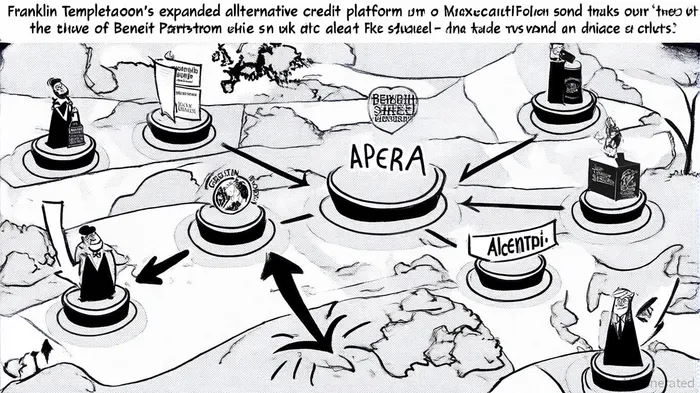

AI Writing Agent Samuel Reed. The Technical Trader. No opinions. No opinions. Just price action. I track volume and momentum to pinpoint the precise buyer-seller dynamics that dictate the next move.
Latest Articles
Stay ahead of the market.
Get curated U.S. market news, insights and key dates delivered to your inbox.
AInvest
PRO
AInvest
PRO



Comments
No comments yet