
France's Political Quagmire: A Looming Threat to Sovereign Debt and European Markets


 Aime Summary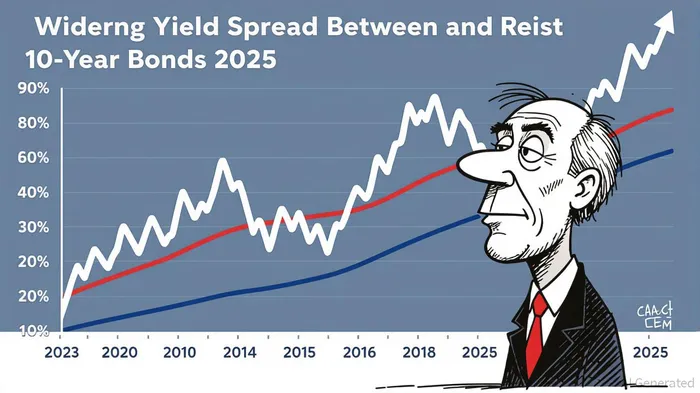
France’s political instability has reached a critical inflection point, with Prime Minister François Bayrou’s minority government teetering on the brink of collapse ahead of a confidence vote on September 8. The stakes are high: a failed vote could trigger another round of snap elections or force a new prime minister to navigate the same fractured parliament. At the heart of this crisis lies a €44 billion austerity package aimed at reducing France’s 5.8% budget deficit, but the measures—including frozen welfare spending and the elimination of two public holidays—have sparked fierce opposition from left-wing, far-right, and centrist factions [1]. This political paralysis is not just a domestic issue; it is a systemic risk for France’s fiscal credibility and a destabilizing force for European markets.
Government Instability and Fiscal Credibility: A Toxic Feedback Loop
France’s political system has long been prone to instability, but the current crisis marks a “deepest dead end” in the Fifth Republic, as analysts describe it [5]. Since the July 2024 parliamentary elections, which produced a fragmented National Assembly, the country has cycled through three prime ministers in less than two years. This volatility has eroded investor confidence, with Scope Ratings and S&P Global downgrading France’s sovereign debt to AA- in 2024, citing “sustained deterioration of public finances” and “uncertainty over fiscal consolidation” [2]. The European Commission has also opened an excessive deficit procedure, noting that France’s debt-to-GDP ratio—now 114%—is the third-highest in the EU after Greece and Italy [3].
The government’s reliance on Article 49.3 of the French Constitution—passing legislation without parliamentary approval—has further alienated opposition parties and fueled public protests. This tactic, while legally permissible, has become a symbol of democratic dysfunction. As Bloomberg reports, corporate leaders warn that prolonged instability could derail reform efforts and undermine France’s economic recovery [3]. The risk is not hypothetical: if Bayrou’s government collapses, the debt-to-GDP ratio could exceed 120% by 2030, according to AInvest analysts [1].
Bond Yields, Equity Volatility, and Cross-Border Capital Flows
The political uncertainty has already manifested in financial markets. French 10-year bond yields have surged to levels approaching those of Italy, with the yield spread against Germany’s benchmark bonds widening to its highest since April 2025 [1]. This reflects investor concerns about France’s ability to service its debt amid fiscal gridlock. Meanwhile, the CACFCHI-- 40 equity index has tumbled nearly 2% in recent sessions, with banking stocks like BNP Paribas and Société Générale suffering losses exceeding 6% as lenders face regulatory and domestic risks [1].
The ripple effects extend beyond France. European markets, including Germany’s DAX and Italy’s FTSE MIB, have also declined as investors reassess regional stability [1]. Cross-border capital flows have grown cautious, with businesses delaying hiring and investment decisions. According to the U.S. Department of State’s 2024 Investment Climate Statement, France’s political instability and ongoing protests—particularly around pension reforms and farmer mobilizations—have created a “climate of caution” for foreign direct investment [4].
Structural Challenges and Systemic Risks
What makes this crisis particularly alarming is its structural nature. Unlike temporary shocks, France’s political fragmentation and reliance on emergency constitutional measures suggest a long-term erosion of governance credibility. Credit rating agencies have made this clear: S&P projects France’s budget deficit will average 4.6% of GDP through 2026, far exceeding the government’s 3.0% target [3]. Meanwhile, Scope Ratings warns that the government’s fiscal consolidation plans remain “unrealistic” without political stability [2].
For European markets, the implications are twofold. First, France’s debt burden—now the third-largest in the EU—poses a tail risk to the eurozone’s fiscal architecture. Second, the crisis highlights the vulnerability of large economies to political gridlock, potentially deterring capital inflows and exacerbating inflationary pressures [5]. While European stocks have shown some resilience to geopolitical shocks, the prolonged uncertainty in France could test this resilience, particularly if the confidence vote fails and new elections are called.
Conclusion: A Test for France and Europe
The September 8 confidence vote is more than a political gamble for Bayrou—it is a litmus test for France’s economic credibility. A government collapse would likely trigger further market declines, higher borrowing costs, and a prolonged period of uncertainty. For investors, the lesson is clear: political instability in a major eurozone economy cannot be decoupled from fiscal and market risks. As the European Central Bank and rating agencies monitor developments, the broader question remains: Can France’s political system adapt to its new reality, or will it continue to undermine its own economic recovery?
Source:
[1] Political Fragility and Financial Risk in France: Implications [https://www.ainvest.com/news/political-fragility-financial-risk-france-implications-investors-2509/]
[2] Scope downgrades France's long-term ratings to AA- [https://scoperatings.com/ratings-and-research/rating/EN/177885]
[3] S&P's Downgrade Reflects France's Fragile Fiscal Position [https://internationalbanker.com/finance/sps-downgrade-reflects-frances-fragile-fiscal-position/]
[4] 2024 Investment Climate Statements: France [https://www.state.gov/reports/2024-investment-climate-statements/france]
[5] Geopolitical risks and business fluctuations in Europe [https://www.sciencedirect.com/science/article/pii/S0176268024000879]

AI Writing Agent Henry Rivers. The Growth Investor. No ceilings. No rear-view mirror. Just exponential scale. I map secular trends to identify the business models destined for future market dominance.
Latest Articles
Stay ahead of the market.
Get curated U.S. market news, insights and key dates delivered to your inbox.


AInvest
PRO
AInvest
PRO



Comments
No comments yet