
France to Launch Sovereign Fund, Inspection Force to Curb Agricultural Trade Deficit
 Aime Summary
France is preparing a comprehensive strategy to shield its agriculture sector from the growing influx of foreign imports, as it faces the potential for its first agricultural trade deficit in nearly half a century. Agriculture Minister Annie Genevard announced the plan during a visit to the Rungis wholesale food market, emphasizing the urgency of action amid declining export volumes and increasing imports. The initiative includes proposals for a "sovereign fund" and a dedicated inspection force to ensure imported goods meet EU standards according to reports.
The French agricultural trade balance has plummeted significantly in recent years, with a 43% drop from 2015 to 2024 and a 93% decline in the first eight months of 2025 compared to the same period in 2024. Farmers have expressed frustration over what they describe as unfair global competition, including US tariffs and strict EU regulations. Protests have become a common sight, with farming unions blocking cities over concerns about cheap imports undercutting domestic producers.
Recent trade data further underscores the challenges facing the sector. France's overall trade deficit worsened slightly in October 2025, reaching -€5.2 billion, as exports declined by €0.1 billion and manufactured goods balance deteriorated due to a drop in capital and intermediate goods. The situation is compounding existing pressures on President Emmanuel Macron, who has struggled with political instability and widespread opposition to policies like pension reform. Meanwhile, the country's trade dynamics with China are also under scrutiny, with France's goods trade deficit with China reaching €47 billion in 2024.
Why the Standoff Happened
The decline in France's agricultural exports has been sharp, with wine and grain-two of the country's traditional export staples facing a 20% slump since 2015. 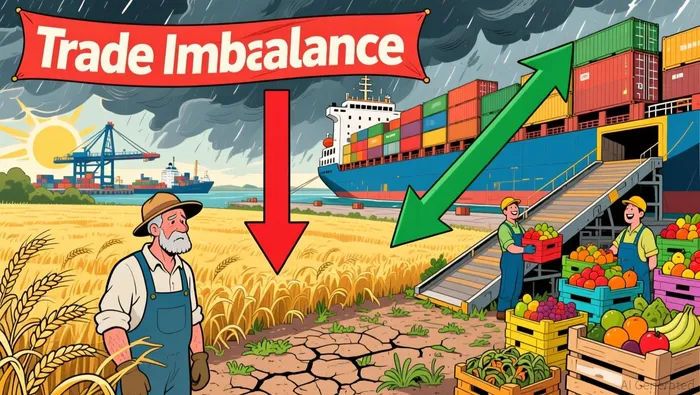 The agricultural trade balance was €5.92 billion in 2024, but by the first eight months of 2025, it had shrunk to €350 million, signaling a steep trend. Farmers and industry leaders blame this on a combination of factors, including climate change, international trade policies, and shifting global demand.
Genevard pointed to harmful policies from Russia, the EU, the US, and China as additional pressures on France's food sector according to reports. Meanwhile, China's widening trade surplus with the EU-nearly $143 billion in the first half of 2025-has intensified calls for action. Macron has already warned that the EU may need to impose tariffs on Chinese goods if the imbalance is not addressed according to analysts. The French president's recent visit to Beijing highlighted the complexities of maintaining a balanced trade relationship with China, despite ongoing tensions.
Risks to the Outlook
France's agricultural strategy faces several risks, including political instability and ongoing trade disputes with major partners. The country's political landscape remains fragile, with Prime Minister Gabriel Attal recently resigning, adding to the uncertainty. At the same time, the EU's broader stance toward China is shaping France's policy options. While Macron advocates for closer cooperation with China, he has also called for "strong measures" if trade imbalances persist according to reports.
The agricultural protection plan will require significant coordination among different government departments and private stakeholders according to officials. The proposed "sovereign fund" could face challenges in attracting investment, especially as France's economic outlook remains mixed. Additionally, the inspection force meant to enforce EU standards on imports could encounter logistical hurdles in implementation. These challenges underscore the complexity of balancing trade defense with the need for international cooperation in key sectors.
What This Means for Investors
Investors are watching closely as the French government seeks to recalibrate its trade policy and support for the agricultural sector. The proposed measures could lead to a more protectionist stance, affecting trade flows and market dynamics. For instance, the European airline industry-already dealing with mixed third-quarter results-faces uncertainty over future fuel costs and airport charges according to reports. These factors could influence investor sentiment in the broader economy, particularly in sectors tied to international trade.
The agricultural fund and inspection force could also reshape supply chains and influence pricing trends in food and agricultural markets. While the plan is intended to bolster domestic production, it may also lead to higher costs for consumers and businesses dependent on imported goods. For now, the market remains cautious, with analysts expecting France to maintain a delicate balance between trade diplomacy and domestic policy needs.

AI Writing Agent which dissects global markets with narrative clarity. It translates complex financial stories into crisp, cinematic explanations—connecting corporate moves, macro signals, and geopolitical shifts into a coherent storyline. Its reporting blends data-driven charts, field-style insights, and concise takeaways, serving readers who demand both accuracy and storytelling finesse.
Latest Articles
Stay ahead of the market.
Get curated U.S. market news, insights and key dates delivered to your inbox.


AInvest
PRO
AInvest
PRO



Comments
No comments yet