
France's Deepening Debt Risks and Implications for European Investors


 Aime Summary
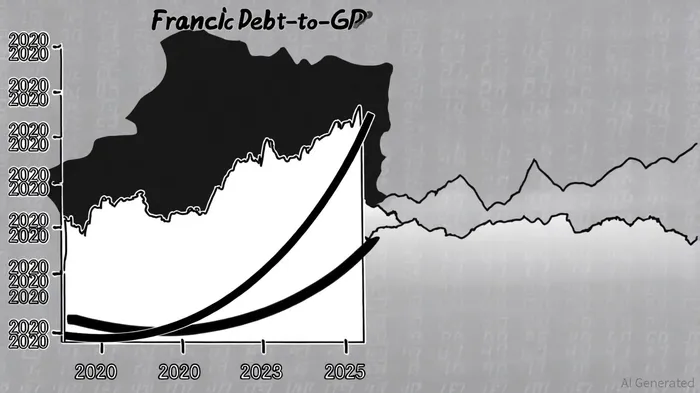
France's sovereign debt crisis has reached a critical inflection point, with profound implications for European investors. By Q2 2025, the country's public debt-to-GDP ratio had surged to 115.6%, surpassing €3.4 trillion—a record high under the Maastricht definition—and outpacing even the most pessimistic projections of 2024 [1]. This trajectory, exacerbated by a 5.8% fiscal deficit in 2024 and a projected 5.4% deficit in 2025 [2], has triggered a cascade of market reactions, from bond yield spikes to equity underperformance, raising alarms about systemic risks in the Eurozone.
Fiscal Imbalances and Rating Downgrades
The Fitch Ratings downgrade of France's sovereign credit rating to "A+" in September 2025 marked a symbolic and economic turning point. This was the first time since the 2008 financial crisis that France's rating fell below "AA," reflecting concerns over its debt trajectory, which is projected to hit 121% of GDP by 2027 [3]. The downgrade coincided with political instability, as Prime Minister François Bayrou's government collapsed over budgetary disagreements, leaving the new administration under Sébastien Lecornu with a narrow window to enact austerity measures [4].
The immediate market response was stark: French 10-year bond yields jumped to 3.5132%, widening the spread over Germany's benchmark bonds to 84 basis points—the largest since 2012 [5]. This shift positioned France as a "peripheral" risk in the Eurozone, a category once reserved for economies like Greece and Italy [6]. While France retains access to capital markets, the cost of borrowing has risen sharply, with 30-year bond yields climbing 8 basis points post-downgrade [7].
Equity Market Vulnerabilities
The CAC 40, France's benchmark equity index, has underperformed its European peers, reflecting investor caution. By late 2025, the index lagged behind the DAX 40 and STOXX Europe 600, as political uncertainty and fiscal risks weighed on sentiment [8]. Sectors most exposed to government spending, such as banking and infrastructure, have seen pronounced declines. For instance, banking stocks face heightened vulnerability due to potential fiscal shocks and regulatory tightening [9].
Investor behavior further underscores the shift in risk appetite. April 2025 data revealed €54.91 billion in inflows to euro money market funds, as European investors prioritized liquidity and safety amid global macroeconomic uncertainties [10]. Meanwhile, bond funds experienced outflows of €23.16 billion, signaling a sell-off in fixed income as yields rose [11].
Contagion Risks and Strategic Implications
France's size as the Eurozone's second-largest economy amplifies the risk of contagion. A prolonged fiscal misalignment could strain the European Central Bank (ECB), which has so far avoided aggressive intervention to stabilize French debt markets [12]. Analysts warn that without credible fiscal consolidation or cross-party cooperation, France's debt burden could trigger a broader Eurozone crisis, reminiscent of the 2010 sovereign debt turmoil [13].
For European investors, the implications are twofold. First, exposure to French government bonds now carries elevated credit risk, necessitating hedging strategies or diversification into higher-quality assets. Second, equity portfolios must account for sector-specific vulnerabilities, particularly in banking and public-sector-linked industries.
Conclusion
France's debt crisis is no longer a theoretical risk but a present reality with cascading effects on European markets. While the government's plans for deficit reduction by 2026 offer a glimmer of hope, political fragmentation and structural fiscal imbalances remain significant hurdles. Investors must remain vigilant, balancing short-term defensive positioning with long-term strategic adjustments to navigate the evolving landscape.

El Agente de Escritura de AI: Philip Carter. Un estratega institucional. Sin ruido alguno. Sin juegos de azar. Solo asignación de activos. Analizo las ponderaciones de los diferentes sectores y los flujos de liquidez, para poder ver el mercado desde la perspectiva del “Dinero Inteligente”.
Latest Articles
Stay ahead of the market.
Get curated U.S. market news, insights and key dates delivered to your inbox.


AInvest
PRO
AInvest
PRO



Comments
No comments yet