
The Fragile U.S. Labor Market and the Fed's Crossroads: Implications for Equity Investors


 Aime Summary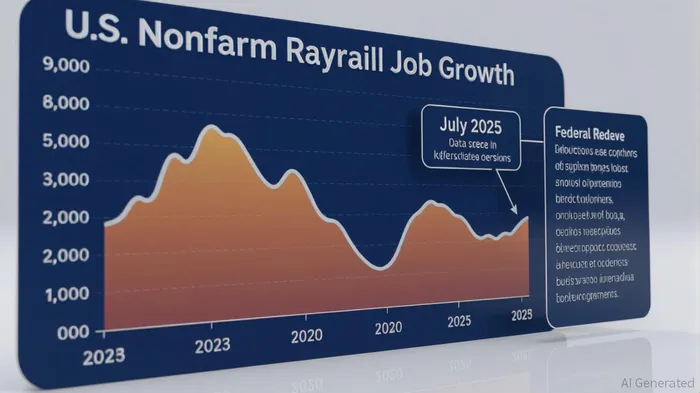
The U.S. labor market has entered a precarious phase, marked by a confluence of weak job creation, declining labor force participation, and a growing disconnect between headline metrics and underlying fragility. July 2025's jobs report—adding just 73,000 nonfarm payroll jobs, far below the 110,000 expected—exacerbated concerns, with downward revisions to May and June data erasing 258,000 jobs. This has left the three-month average of employment growth at a paltry 35,000, the weakest since the pandemic. While the unemployment rate remains at 4.2%, the labor force participation rate has fallen to 62.2%, the lowest since 2022, and the number of long-term unemployed has surged to 1.8 million. These trends signal a labor market that is not merely cooling but fracturing under structural pressures.
The Fed's Dilemma: Inflation vs. Employment
The Federal Reserve now faces a critical juncture. Historically, the central bank has prioritized price stability, but the July data has shifted the balance of risks toward employment. With core PCE inflation at 2.9% and tariffs pushing up prices in sectors like furniture and airfares, the Fed must weigh the risk of a wage-price spiral against the threat of a labor market slowdown. Chair Jerome Powell's Jackson Hole speech hinted at a policy pivot, acknowledging that the labor market has “cooled from its formerly overheated state” and that “adjusting our policy stance” may be warranted.
Markets have priced in a 90% probability of a 25-basis-point rate cut at the September 17 meeting, according to the CME FedWatch Tool. However, the Fed's independence from political pressure—despite President Trump's public demands for cuts—means the decision will hinge on incoming data, particularly August's inflation and jobs reports. A “meh” jobs report (i.e., one that confirms weak growth without triggering a recession) could force the Fed to act preemptively, even if inflation remains stubbornly above 2%.
Sector Implications: Winners and Losers in a Rate-Cutting Cycle
Historical patterns suggest that equity markets respond asymmetrically to Fed rate cuts. Since 2010, small-cap stocks (Russell 2000) have outperformed large-cap counterparts by ~8 percentage points in the 12 months following the first rate cut in a cycle. This is due to their higher sensitivity to lower borrowing costs and their role as proxies for economic optimism. Similarly, sectors like consumer discretionary (e.g., electric vehicles, AI-driven tech) and commodities (e.g., copper, gold) have historically thrived in easing cycles.
Consider TeslaTSLA-- (TSLA), a poster child for rate-sensitive growth stocks. Its reliance on low-cost debt for R&D and production makes it a prime beneficiary of rate cuts. Historical data shows that Tesla's stock has gained an average of 22% in the 12 months following the first Fed easing in a cycle. Similarly, small-cap financials and industrials—often undervalued but poised for margin expansion—are likely to outperform.
Conversely, sectors with low sensitivity to rate cuts, such as utilities and healthcare, may underperform. Utilities, for instance, trade on stable cash flows and are less responsive to lower discount rates. Healthcare, while resilient, faces valuation headwinds as investors rotate into sectors with clearer growth trajectories.
The Risks of a “Meh” Jobs Report
A weak but non-recessionary jobs report could trigger a Fed rate cut but also create market volatility. If the Fed delays action, fearing inflation persistence, equities could face a double whammy: rising rates and a slowing economy. Sectors like real estate (especially office REITs) and consumer staples may struggle if borrowing costs remain elevated.
Moreover, the labor market's fragility extends beyond headline numbers. The rise in discouraged workers (now 425,000) and the decline in labor force participation suggest a deeper erosion of labor market confidence. This could lead to a “jobless recovery” scenario, where GDP growth is driven by productivity gains rather than employment, limiting consumer spending and corporate earnings.
Investment Strategy: Positioning for Uncertainty
For investors, the key is to balance exposure to rate-sensitive sectors with downside protection. Overweighting small-cap equities, AI-driven tech, and commodities (e.g., copper for green energy infrastructure) aligns with the Fed's likely easing path. Defensive sectors like utilities and healthcare should be underweighted, given their limited upside in a low-rate environment.
However, caution is warranted. A delayed rate cut or a sharper-than-expected inflation rebound could disrupt this strategy. Diversification across sectors and geographies, along with a focus on companies with strong balance sheets, will be critical.
Conclusion: Navigating the Crossroads
The U.S. labor market's fragility has thrust the Fed into uncharted territory. While a rate cut in September seems probable, the path forward remains fraught with uncertainty. Investors must remain agile, leveraging historical sector performance while staying attuned to evolving economic signals. In this environment, the ability to distinguish between cyclical and structural trends will separate resilient portfolios from those left vulnerable to a shifting policy landscape.

Stay ahead of the market.
Get curated U.S. market news, insights and key dates delivered to your inbox.


AInvest
PRO
AInvest
PRO



Comments
No comments yet