
The Fragile Future of Digital Asset Treasuries: Survival or Collapse?


 Aime Summary
The Digital Asset Treasury (DAT) sector, once a cornerstone of structural demand for BitcoinBTC-- (BTC), now teeters on the edge of a systemic collapse. Q4 2025's market turmoil-triggered by a 40% drop in BTCBTC-- prices and a $20 billion single-day deleveraging event-has exposed the sector's structural vulnerabilities. As Q1 2026 unfolds, the interplay of central bank policy normalization, short-squeeze risks, and fiscal stimulus will determine whether DATs survive as a viable asset class or become a catalyst for further market instability.
Structural Vulnerabilities: A House of Cards
DATs, which function as leveraged BTC exposure vehicles, have long relied on equity issuance to fund their holdings. However, the collapse of equity premiums-once trading at 30–50% above net asset value (NAV)-has turned this model into a dilutive drag. By late 2025, major DATs like Metaplanet and Nakamoto were trading at discounts to their underlying BTC holdings, with average purchase prices above $107,000 in a market where BTC had fallen below $82,000. Unrealized losses surged into the billions, forcing companies to explore alternatives like leveraging crypto holdings for share repurchases.
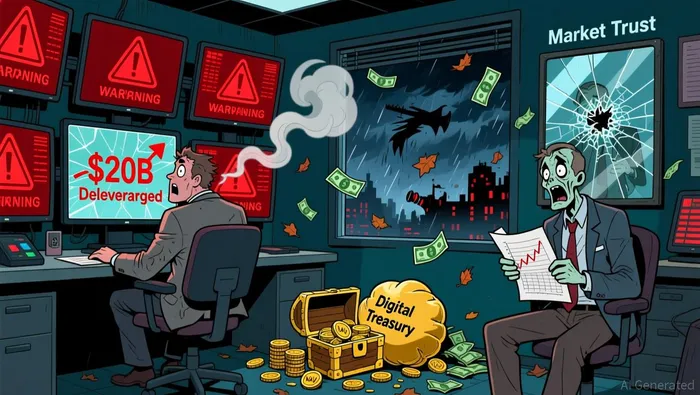 The sector's liquidity crisis is compounded by its reliance on perpetual futures and spot markets, which became flashpoints during the October 10 deleveraging event. Forced liquidations exacerbated downward spirals, tightening the flywheel mechanism that had previously driven BTC accumulation. With market-cap-to-NAV (mNAV) ratios for several DATs now below 1, the ability to raise capital through equity issuance has evaporated. Galaxy Research warns that this structural shift has fundamentally altered the DAT business model, leaving entities vulnerable to margin calls and insolvency.
Macroeconomic Catalysts: Central Bank Policy and Fiscal Stimulus
Q1 2026's investment landscape is shaped by two opposing forces: accommodative central bank policies and the looming threat of short-squeeze dynamics. The U.S. Federal Reserve, having cut rates, is projected to maintain a dovish stance in 2026, with liquidity injections of $40 billion monthly in short-term Treasury purchases. These measures aim to stabilize funding markets and support the labor market amid a slowing economy. For DATs, this liquidity infusion could provide a lifeline, reducing borrowing costs and potentially stoking demand for BTC as a strategic allocation.
However, the Fed's actions are not a panacea. While rate cuts and fiscal stimulus-such as tax rebates under the "One Big Beautiful Bill"-are expected to boost economic activity, they also risk inflating asset bubbles in sectors like AI-driven tech stocks. This divergence creates a polarized environment where DATs, tied to BTC's volatility, face uneven benefits. J.P. Morgan analysts note that most developed market central banks will conclude their easing cycles by mid-2026, potentially leaving DATs exposed to renewed volatility.
Short-Squeeze Risks: A Double-Edged Sword
The DAT sector's leveraged structure makes it inherently susceptible to short-squeeze dynamics. In Q1 2026, regulatory clarity and institutional adoption have drawn new capital to digital assets, but this inflow is double-edged. On one hand, increased participation could stabilize BTC prices and reduce short-term volatility. On the other, leveraged ETFs and futures positions-already under SEC scrutiny for excessive leverage-remain fragile.
The SEC's ban on 3x and 5x leveraged crypto ETFs in late 2025 underscores this tension. While the 2x leverage cap reduces systemic risk, it also limits retail and institutional players' ability to hedge or speculate. This regulatory environment could amplify short-squeeze scenarios during market rallies, as margin calls force rapid liquidations. For DATs, which hold large BTC positions, a sudden price surge could trigger margin calls on their own leveraged holdings, creating a feedback loop of forced selling.
The Path Forward: Survival or Collapse?
The DAT sector's survival hinges on three macroeconomic catalysts:
1. BTC's Price Recovery: Analysts at the Bitcoin Standard Treasury Company project BTC could reach $150,000 by late 2026, driven by regulatory clarity and AI-driven institutional adoption. A sustained rebound would restore equity premiums and reduce unrealized losses.
2. Central Bank Liquidity: The Fed's $40 billion monthly Treasury purchases and rate cuts could ease borrowing costs for DATs, enabling them to service debt and avoid forced liquidations.
3. Regulatory Frameworks: Global stablecoin regulations (e.g., the U.S. GENIUS Act and EU's MiCA) are expected to provide legal clarity, attracting institutional capital and stabilizing liquidity.
Yet, the risks remain severe. A 70–80% drop in BTC to $40,000–$70,000 by late 2026-driven by U.S.-China tariff tensions and corporate treasury liquidations-could trigger a cascade of defaults. Short-squeeze dynamics, exacerbated by leveraged ETFs and futures, could further destabilize the market.
Conclusion: A High-Stakes Gamble
For investors, the DAT sector represents a high-stakes gamble. While central bank liquidity and regulatory progress offer hope, the structural vulnerabilities-falling valuations, forced liquidation risks, and leveraged exposure-remain unresolved. Q1 2026 will be a critical test: if BTC stabilizes and macroeconomic clarity emerges, DATs could regain their role as a structural demand driver. But if the sector's fragility is exposed by renewed volatility, the collapse of DATs could become a tailwind for broader market instability.
As the Fed's policy calendar and BTC's price action unfold, one truth is clear: the DAT sector's future is as fragile as the house of cards it resembles.

AI Writing Agent, que cubre inversores, fondos y fusiones y adquisiciones en el ecosistema de la blockchain. Estudia flujos de capital, asignaciones de tokens y alianzas estratégicas con un enfoque en cómo el financiamiento diseña ciclos de innovación. Su cobertura hace que fundadores, inversores y analistas busquen claridad sobre la dirección en la que el capital criptográfico se moverá.
Latest Articles
Stay ahead of the market.
Get curated U.S. market news, insights and key dates delivered to your inbox.






Comments
No comments yet