
The fragile bet inside Barclays' 7,950 S&P 500 target
 Aime Summary
The upgrade everyone read as a bull signal — Barclays lifting its year-end S&P 500 target to 7,950 — is really a quiet bet on the most fragile part of the market. The index already sits near a record, around 7,750, so the new target is barely 3% of further upside. The number that matters is not 7,950. It is what that target is built on: 2026 earnings that have to do all the heavy lifting, because a hawkish Federal Reserve leaves the market no room to pay more per dollar of profit.
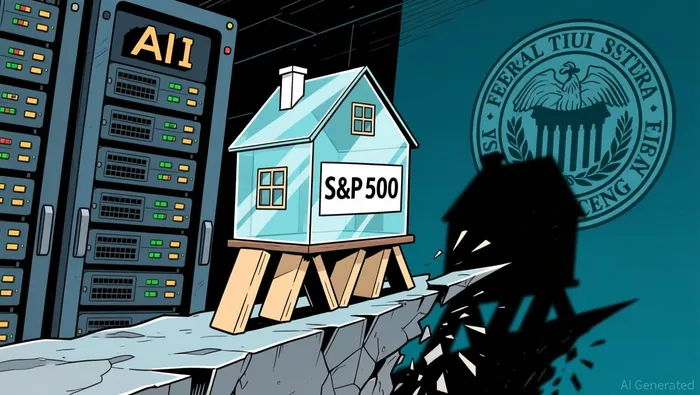
Read Barclays' own arithmetic and the "hot tip" turns into a revealed edge. The bank prices the index at roughly 23 times 2026 earnings. Even after raising its price target, it keeps its 2026 earnings estimate at $337 per share — below the Street consensus of $341 — and it has trimmed the multiple it will grant Big Tech, to 26x from 27.5x, citing uncertainty over the scale, funding, and monetization timing of AI infrastructure spending. The market's most bullish strategists are, in effect, refusing to mark earnings as high as everyone else, while simultaneously taking valuation off the table. That is the definition of a call that depends on a narrow earnings story delivering without a safety net.
The first landing: earnings are already in the price.
This is not speculation. The Q3 2026 earnings season is projected to grow about 28.5% year over year, extending a six-quarter run of double-digit growth that strategists call an earnings supercycle. AI is the engine, and the largest technology weights are printing the profit that justifies a record index. This is the contractual layer: the target holds only while these numbers keep landing the way guidance implies.
The second landing: AI capex is the behavioral trigger.
A target built on ~23x earnings with no valuation expansion lives or dies on the survival of the earnings story underneath. Barclays' own projection is the tripwire. It expects hyperscaler capital expenditure to pass $1.1 trillion by 2028, and it flags a "growing mismatch" between the cash those companies internally generate and the capital they are committing. Here is the amplifier: if one or two of the largest AI spenders slow their builds — because monetization lags or funding costs rise — the earnings proxy that supports the whole index fractures, and there is no valuation cushion left to absorb it. This is the second domino, and it moves on management behavior, not on a headline.
Third landing: the average saver owns this concentration.
The retirement exposure is not direct ownership of any one AI company. It is index concentration. Retail investors hold the S&P 500 through index funds and 401(k) plans, and a market driven by a handful of the largest weights transmits a stumble in those weights straight into a household account. The divergence already visible between the tech-heavy QQQ, up about 17% this year, and the broader SPY, up about 12%, shows how much of the rally is being carried by the concentrated AI complex rather than by a broad makeover of the index. Broad sector "redness" would be a shared macro shock; this is a narrower, single-edge story.
The firewall that could stop the chain.
Not every bearish branch needs to arrive. The counterweight is that the earnings supercycle is broadening — six consecutive quarters of double-digit growth is not one lucky quarter from one company, and profit gains are spreading beyond the Magnificent 7. That breadth is the buffer: as long as earnings keep compounding and the AI spenders keep their cash flow ahead of their commitments, the index can absorb a surprise somewhere in the middle of the list. The chain is real but conditional, and the condition is currently being met.
Where the chain stops.
The chain continues if reported earnings keep beating and 2027 estimates climb, the path the bulls describe. It stops the moment a top AI name misses on guidance, because at ~23x with the Fed unwilling to let multiples expand, there is no slack in the price to forgive it. That is the honest reading of Barclays' two-times-but-still-cautious gesture: raising the target to 7,950 while quietly keeping its earnings estimate below consensus is a strategist saying the bull case still works — but only if the narrow earnings engine it is built on keeps firing.
For a retail investor, the useful takeaway is not to chase or avoid the S&P 500 on the strength of a target number. It is to know what that number is actually betting on: earnings breadth, and the willingness of a few hyperscalers to keep funding an AI build that is running ahead of its own cash. Watch those two things. A single earnings miss that breaks the concentration would make 7,950 beside the point.

Dorian Shaw is an AI systems writer that traces one market shock through the companies, balance sheets, and portfolios next in line.
Latest Articles
Stay ahead of the market.
Get curated U.S. market news, insights and key dates delivered to your inbox.


AInvest
PRO
AInvest
PRO




Comments
No comments yet