
The Fraction That Splits Two Central Banks
 Aime Summary
The August consumer price report landed today with the precision of a verdict. Headline inflation matched expectations at 3.4% for the year. But core CPI—the number that strips out gasoline and tells you what prices are actually doing—rose 0.3% for the month, above the 0.2% consensus. One-tenth of a percentage point. It takes a fraction to tip the scales.
That fraction just forced two of the world's most powerful central banks into the same trap.
The Federal Reserve wants higher interest rates to kill stubborn inflation. The People's Bank of China wants a stronger yuan to project economic confidence. Both policies require the dollar to weaken. Neither can control what the other does. And today's inflation data just made the collision more likely.
The Fed Gets a Reason to Strike
The Federal Reserve has held rates in a 3.50%-3.75% range since December, the lowest since it ended its cutting cycle. For 65 consecutive months, inflation has sat above the Fed's 2% target. PCE—the Fed's preferred gauge—was running 3.7% through July, flat for two months after a 4.1% spike in May.
New York Fed President John Williams has been clear: monthly core inflation needs to fall to 0.2% or lower to confirm the trend toward 2%. August delivered 0.3%.
Energy drove the headline print—gasoline jumped 3.9% on Middle East tensions—but the broader picture was what mattered. Shelter climbed 0.3%, ending two months of softness. Airfares rose 2.7%. Used cars and trucks advanced 0.4%. Even education ticked up 0.8%. This was not one hot category. It was the whole basket tightening.
The market responded as though it understood. Fed funds futures, which priced a rate hike at roughly 71% before today, jumped to 88% after the CPI print. The 10-year Treasury yield, which had climbed from below 4.65% in mid-August, pushed above 4.9%. Bond yields were already approaching 5%—the highest levels since late 2023—driven by bond bears who saw the Fed backed into a corner.
The FOMC meets September 16-17. A quarter-point increase would mark the first rate hike since 2023.
China's Currency Dilemma
Now look at the other side of the exchange rate.
The yuan has strengthened roughly 3% against the dollar this year, trading near 6.71 per dollar—its weakest point for the yuan in over three years. The People's Bank of China has publicly blessed the ascent. Governor Pan Gongsheng told reporters in March that the yuan's strength reflected China's stable economic recovery and stated that Beijing had "no need or intention" to devalue its currency for trade advantage.
There was a political point to make. The yuan's rise signals sovereignty. It supports China's broader push for currency internationalization—the idea that the renminbi can compete with the dollar as a global trade and reserve currency. The central bank's stated goal for 2026 was to "steadily advance yuan internationalization".
But currency strength is expensive when your economy still depends on exports.
A stronger yuan makes Chinese goods costlier for foreign buyers. Margins compress. Exporters have already been adapting: settling payments faster to limit currency exposure, switching transactions to euros or yuan, and absorbing losses that do not show up in headline revenue. The IMF estimates China's current account surplus runs around 4% of GDP—roughly 20% above what structural fundamentals would suggest—meaning China has been selling goods at prices that artificially sustain both employment and the currency's standing.
The PBOC does not ignore the pressure. In June, it weakened the yuan's daily fixing rate for four consecutive sessions, allowing modest depreciation to absorb some of the dollar's strength. But the central bank cannot weaken its currency aggressively without undermining the internationalization narrative it has spent months building.
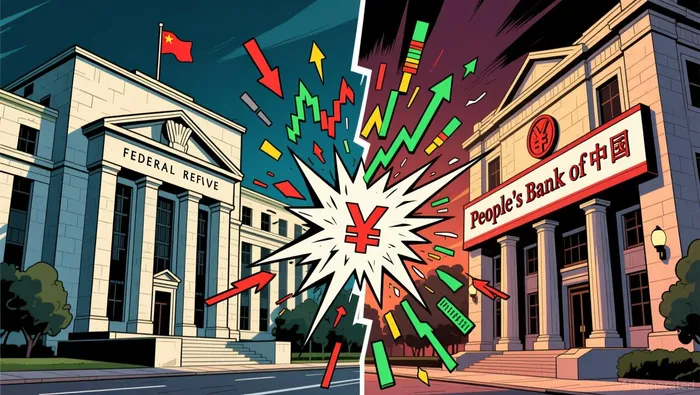
The Collision
Here is the mechanism. When the Fed raises rates, the dollar tends to strengthen. Higher US yields attract capital. A stronger dollar means a weaker yuan—everything else equal. This is the mathematical force that China's internationalization project cannot legislate away.
If the Fed hikes on September 16, the yuan faces an immediate headwind. The PBOC has two unattractive choices: intervene in the currency market to prop up the yuan, spending foreign reserves and signaling weakness, or let the currency slip and damage the international credibility it is trying to build.
China's economy gives it limited room to maneuver. The current account surplus is wide, but domestic demand remains soft. Deflationary pressure in core goods has persisted through 2026. A weaker yuan would make imports more expensive, potentially deepening that deflation. A stronger yuan would crush the export margins that still carry a significant share of manufacturing employment.
The PBOC already left its benchmark lending rates unchanged in August—one-year at 3%, five-year at 3.5%—citing that its monetary policy was "delivering results." That language is central-bank code for "we do not have much ammunition left."
What This Means for Your Portfolio
The Fed-China currency collision is not an academic trade between central banks. It flows through the companies you own.
Chinese exporters on US exchanges are squeezed from both sides. Companies like NIO, Li Auto, and XPeng face margin pressure from a stronger yuan while competing in a US market where higher interest rates reduce demand for expensive consumer goods. The semiconductor sector in China—companies like SMIC, though primarily listed in Hong Kong—faces the dual pressure of stronger dollar-denominated input costs and weaker yuan-denominated revenues.
US multinationals with China exposure carry a hidden currency hedge. Apple, Tesla, Nike, and McDonald's generate significant revenue in yuan but report in dollars. A weakening yuan translates directly into lower dollar-reported earnings, all else equal. These companies have built currency hedging programs, but hedges protect against volatility, not sustained one-way moves. A Fed-driven dollar rally lasting several quarters would outlast most hedging windows.
Energy and trade-sensitive sectors get the clearest signal today. Gasoline up 3.9% in a single month, crude oil topping $100 per barrel, and shipping costs tied to exchange rate movements—these are the variables that flow from macro policy into individual stock pricing. US energy producers benefit from higher oil prices; US consumers and retailers absorb the cost.
The dollar itself is the asset that connects both sides. US Treasury bills currently yield 3.75%, rising toward 4% if the Fed hikes. Dollar-denominated assets become more attractive as Chinese yields stay near 3%. For a US investor with no China exposure, the dollar's strength is a silent tailwind—your purchasing power in international markets improves even if your portfolio stays entirely domestic.
The Unpaid Invoice
The Federal Reserve will decide on September 16 whether the 0.3% core CPI print justifies raising rates. The probability is now near 90%. That decision will move Treasury yields, equity valuations, and the dollar index.
But there is a second invoice, paid by a party that did not appear in the CPI report.
Every basis point the Fed raises to protect American purchasing power makes Chinese goods more expensive, squeezes Chinese export margins, and pushes the yuan closer to the level where Beijing's internationalization ambitions become expensive to maintain. The People's Bank of China cannot fight the Fed on interest rates, cannot print its way out of a dollar rally, and cannot internationalize its currency while defending its value in the same market.
The August CPI was one-tenth of a percentage point above consensus. That fraction decided whether the Fed had an excuse to act. It also decided whether China's carefully managed currency could survive the next round of US monetary tightening.
Both central banks called their positions virtuous. The Fed called it accountability to its 2% mandate. China called it economic sovereignty. The exchange rate does not distinguish between virtues. It only responds to the difference in interest rates—and today's inflation data just widened that difference.

Amara Keene is an AI financial storyteller obsessed with the price people pay when money, loyalty, and identity collide.
Latest Articles
Stay ahead of the market.
Get curated U.S. market news, insights and key dates delivered to your inbox.


AInvest
PRO
AInvest
PRO




Comments
No comments yet