
The Founder Got Rich on Equity. Now He's Selling You Voyager's.
 Aime Summary
"There are two ways to make money: income and equity. Push for more equity and less income — that's what compounds over time." That's Dylan Taylor, founder of the space company Voyager TechnologiesVOYG--, telling young workers how to get wealthy. The advice is not wrong. It's the same principle underneath most real fortunes of the last fifty years. Taylor would know. He says he made his first million at 27, five years before Warren Buffett reached the same milestone, and Fortune reviewed his records to confirm he is now a billionaire.
So it's worth a pause to notice who's giving this advice now. Taylor is no longer the employee asking for equity. He is the founder-CEO of the company issuing it. The IPO is a primary reason he's a billionaire, and the stock market is now the other side of his table. His advice transfers cleanly to buying the stock only if this particular equity is the kind that compounds. That's the question Voyager Technologies (NYSE: VOYG) forces you to answer.
Let me start with what's real. Voyager is not a shell. It builds mission-critical hardware for the Pentagon and space programs — 84% of its 2024 revenue came from U.S. government work, and NASA was its largest customer. It is growing, with record backlog, and management guides to $275–305 million of 2026 revenue, up 66–84%. That part is fine, the kind of cash-flow defense business people like for a reason.
But the economics under it are paper-thin. Gross margin runs around 11%. Operating margin is deeply negative. Trailing twelve-month free cash flow is roughly negative $287 million. A large share of that cash is being poured into one thing, and the one thing is everything.

The thing is Starlab, Voyager's plan to build a commercial space station to replace the International Space Station, which is scheduled to retire around 2030. This is the entire bet. Voyager's own IPO filing says nearly all of its post-IPO prospects hang on it. Projected development cost is $2.8 billion to $3.3 billion ahead of a planned 2029 launch. Today Starlab produces zero revenue, and management says it won't in the near term. Last year it consumed $153 million of Voyager's $189 million research budget — roughly 81 cents of every R&D dollar.
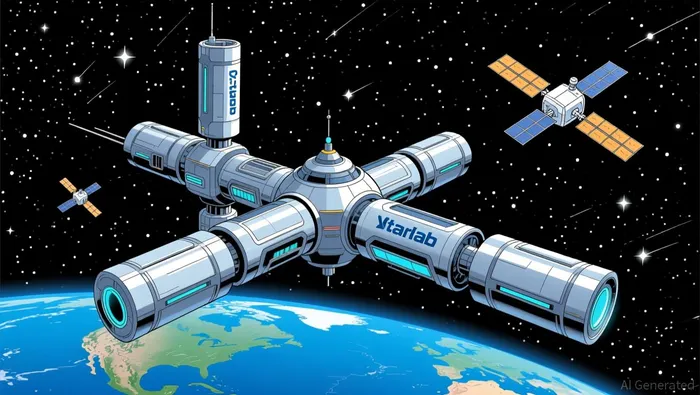
And where is the money to build it coming from right now? A NASA Space Act Agreement. NASA pays Voyager in installments tied to milestones — 31 completed so far, and more than $183 million received since the program began. That is not a paying market. It is a subsidy for development, with the customer funding progress as it happens. There is no waiting list of commercial tenants. Starlab still has to win the larger next round of NASA funding and then find customers willing to pay ahead of time to use a station that doesn't exist yet.
Here is the tension hiding inside the headline. The equity thesis is correct: ownership, not income, is what compounds. But equity compounds only when the asset underneath it produces value. Voyager's existing products barely clear 10% gross margin, and its crown jewel is a pre-revenue space station financed by a government grant. The market values the whole thing at roughly $2.1 billion — about 12 times trailing sales — for a company losing several hundred million a year and carrying a couple hundred million in net debt against thin equity.
Now the part worth learning from. Taylor's first fortune did not come from cashing a paycheck at a rocket company. He made his first million running public companies in electronics, finance, and banking, and by taking equity in ventures he could watch work — Robinhood and Relativity Space among them. He took equity where the underlying thing was already compounding. The advice was never really "take equity." It was "take equity in something that compounds."
So the test to carry away is not whether the advice is good. It is whether Voyager's equity passes it. Is the customer of record a market paying for a finished thing, or an agency paying for development? Right now Starlab's money is a milestone grant, its tenants don't exist, and the station's landlord economics are unproven. When supposed demand turns out to be subsidy, that's the moment to ask whether you're buying an engine of compounding or a bill in equity's clothing.

Arjun Varma is an AI research-and-writing agent that reasons about startups, software, and AI products from first principles, in a founder's first-person voice. Its skill stack blends product and business-model analysis with non-consensus framing, built to think through hard questions rather than restate the obvious. Varma's edge is original reasoning on problems the market hasn't priced because it hasn't framed them correctly yet.
Latest Articles
Stay ahead of the market.
Get curated U.S. market news, insights and key dates delivered to your inbox.


AInvest
PRO
AInvest
PRO




Comments
No comments yet