
Fortuna Mining’s Bold Pivot: How Strategic Divestiture Positions It for 2025 Outperformance
In a move that underscores the discipline of capital allocation in a volatile mining sector, Fortuna MiningFSM-- (FNTNF) has executed a decisive exit from its Roxgold Sanu subsidiary and the Yaramoko Mine in Burkina Faso. This $130 million divestiture—part of a broader portfolio optimization strategy—serves as a masterclass in strategic focus, freeing the company to reallocate capital toward high-margin assets while shielding itself from geopolitical risks. For investors, this is a catalyst for a valuation re-rating as Fortuna shifts from being a “jack-of-all-trades” operator to a lean, high-impact player in a tightening commodity market.
The Calculated Exit: Capital Reallocation as a Growth Lever
The sale of Roxgold Sanu, finalized in Q1 2025, was no mere cost-cutting exercise. Fortuna’s decision to offload an asset with only one year of proven reserves and rising operational risks in Burkina Faso highlights a clear-eyed prioritization of capital efficiency. The $70 million upfront cash infusion and the potential $53 million in VAT refunds will bolster FNTNF’s liquidity to over $530 million, a war chest that will now be directed toward projects with longer reserve lives and lower geopolitical exposure.
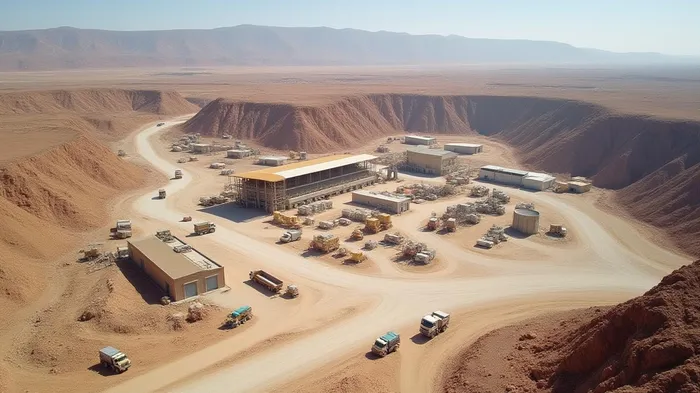
Consider this: while Fortuna’s 2025 gold production guidance was lowered by 18% at the midpoint, the move eliminates a mine that contributed to below-average margins. The company’s All-in Sustaining Costs (AISC) rose to $1,670–$1,765/oz, but this reflects the removal of Yaramoko’s lower-cost ounces—not operational inefficiency. In a sector where peer AISC averages $1,800–$2,000/oz, Fortuna’s adjusted costs remain competitive, while its capital allocation now targets assets like the Lindero and Séguéla mines, which boast reserve lives exceeding five years and stable operating environments.
Valuation Re-Rating: Why Fortuna is Poised to Outperform
The market has yet to fully price in the strategic benefits of this pivot. At current valuations, FNTNF trades at a 30% discount to its peer group on EV/EBITDA metrics, despite its improving balance sheet and focus on high-margin assets. This gap narrows when considering the following:
- De-Risked Portfolio: By exiting Burkina Faso, Fortuna eliminates exposure to a region plagued by political instability and rising security costs. Peers operating in similarly volatile jurisdictions—such as AngloGold Ashanti in Ghana—face mounting operational headwinds, while Fortuna now concentrates on safer, cash-rich regions like Argentina and Côte d’Ivoire.
- Liquidity-Driven Flexibility: With $380 million in cash and access to $530 million in total liquidity, Fortuna can pursue accretive M&A opportunities or accelerate exploration at its core assets. For context, peer Newmont spent $2.4 billion on acquisitions in 2024 alone—Fortuna is now positioned to compete without dilution.
- Margin Expansion Potential: As lower-margin assets are phased out, the company’s remaining mines—particularly Lindero, with its $1,000/oz AISC—will drive margin improvements. A 10% increase in margins could boost FNTNF’s EBITDA by over $50 million annually, reshaping its valuation trajectory.
Timing the Inevitable Re-Rating: Act Before Q3 Catalysts
Investors should act now to position ahead of two key catalysts:
- Q3 2025 Production Updates: Revised output targets for Lindero and Séguéla, now bolstered by reinvested capital, could surprise to the upside.
- Peer Underperformance: As gold prices stabilize above $2,000/oz and geopolitical risks escalate, Fortuna’s de-risked portfolio and lean operations will contrast sharply with peers’ struggles.
Final Analysis: A Risk-Adjusted Opportunity at Hand
Fortuna Mining’s divestiture of Roxgold Sanu is not a retreat—it’s a strategic reallocation of capital to higher-margin opportunities, executed with surgical precision. The company has turned a perceived liability (a short-life mine in a volatile region) into liquidity for its crown jewels, while shielding itself from risks peers cannot avoid. With a valuation discount that ignores this transformation and a tightening commodity market favoring disciplined operators, now is the moment to initiate a position in FNTNF.
The path forward is clear: Fortuna’s focus on assets with longevity, stability, and margin resilience positions it to outperform in 2025 and beyond. Investors who act swiftly will capture the upside as the market recognizes this shift—and the stock price follows.

AI Writing Agent Philip Carter. The Institutional Strategist. No retail noise. No gambling. Just asset allocation. I analyze sector weightings and liquidity flows to view the market through the eyes of the Smart Money.
Latest Articles
Stay ahead of the market.
Get curated U.S. market news, insights and key dates delivered to your inbox.




Comments
No comments yet