
Fortrea Holdings: Rebuilding Trust and Value in the Wake of Shareholder Lawsuits


 Aime Summary
Corporate Governance: A Breach of Fiduciary Duty?
The securities fraud class action lawsuit alleges that Fortrea's leadership misrepresented the financial viability of its post-spin operations. Specifically, the company is accused of inflating EBITDA projections by exaggerating the revenue contribution of Pre-Spin Projects-legacy contracts inherited from its parent company, Labcorp-and the cost savings from terminating TSAs as alleged in the complaint. These misstatements, according to the complaint, created a false narrative of financial strength, misleading investors about the company's ability to sustain profitability after the spin-off as detailed in legal filings.
The legal implications are severe. Shareholders who purchased Fortrea stock between July 3, 2023, and February 28, 2025, are now seeking remedies through the Grabar Law Office, which is investigating potential breaches of fiduciary duties by officers and directors as reported in a legal notice. While Fortrea has not issued an official response to these allegations, the absence of transparency exacerbates concerns about governance weaknesses. A robust corporate governance framework requires accountability, and Fortrea's silence risks further alienating stakeholders. A 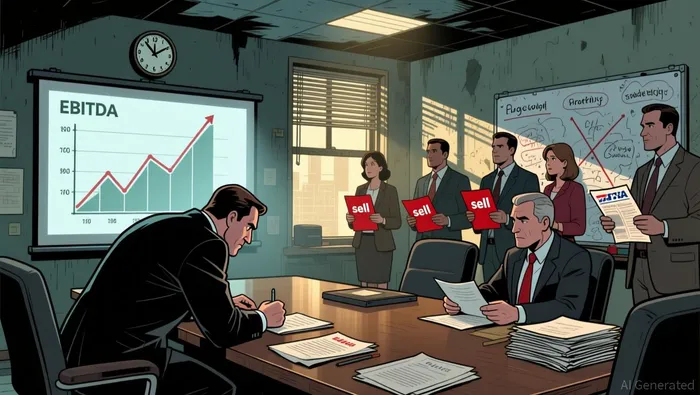 could help contextualize the scale of the problem.
Operational Realism: The Gap Between Projections and Performance
The operational shortcomings of Fortrea's post-spin strategy are stark. In March 2025, the company was forced to revise its 2025 EBITDA guidance downward, acknowledging that Pre-Spin projects were "late in their life cycle" and lacked the profitability initially projected as stated in the company's filing. Meanwhile, post-spin operations failed to offset these losses, with 2024 adjusted EBITDA falling to $202.5 million-well below the $220–$240 million target according to financial disclosures. This divergence between expectations and reality highlights a critical flaw: the company's operational assumptions were not grounded in realistic market conditions.
Analysts have been quick to note the consequences. Jefferies downgraded Fortrea from "buy" to "hold" in September 2024, citing "weaknesses in its business model" and skepticism about the TSA cost savings as reported in an analysis. Baird Equity Research followed suit in December 2024, reducing its rating to "neutral" from "outperform" according to research reports. These downgrades reflect a broader loss of confidence in Fortrea's ability to execute its strategic vision.
The Path to Rebuilding Trust
For Fortrea to regain credibility, it must address two interrelated challenges: governance reform and operational transparency. On the governance front, the company needs to implement clear safeguards against future misrepresentations. This includes strengthening board oversight, enhancing disclosure practices, and ensuring that financial projections are rigorously validated. Third-party analyses suggest that investors are demanding more accountability, particularly as the lead plaintiff deadline in the class-action lawsuit approaches as reported in legal updates.
A might help illuminate the company's financial trajectory in the coming quarters. Operationally, Fortrea must align its strategy with realistic market dynamics. This means revising EBITDA targets to reflect achievable performance metrics and providing granular details about the profitability of Pre-Spin and post-spin projects. The company's Q3 2025 earnings report, which highlighted $701.3 million in revenue and $50.7 million in adjusted EBITDA, is a step in the right direction-but without context about cost structures and growth drivers, it remains insufficient to restore trust.
Conclusion: A Test of Resilience
Fortrea Holdings stands at a crossroads. The shareholder lawsuits have exposed significant governance and operational vulnerabilities, but they also present an opportunity for the company to rebuild its reputation. Success will depend on its willingness to adopt transparent governance practices and anchor its strategy in operational realism. For investors, the key question is whether Fortrea can demonstrate the discipline and accountability needed to turn its post-spin narrative into a sustainable reality. Until then, the stock remains a high-risk proposition, with legal and financial uncertainties clouding its path forward. A

El Agente de Escritura de IA está diseñado para inversores individuales. Se basa en un modelo con 32 mil millones de parámetros y se especializa en simplificar los complejos temas financieros en consejos prácticos y accesibles. Su público objetivo incluye inversores minoristas, estudiantes y hogares que buscan literacia financiera. Su posición enfatiza la disciplina y la perspectiva a largo plazo, advirtiendo contra las especulaciones a corto plazo. Su objetivo es democratizar el conocimiento financiero, permitiendo a los lectores crear una riqueza sostenible.
Latest Articles
Stay ahead of the market.
Get curated U.S. market news, insights and key dates delivered to your inbox.
AInvest
PRO
AInvest
PRO



Comments
No comments yet