
Fortis (FTS): Is RBC's Sector Perform Rating a Signal to Hold or Rebalance?
 Aime Summary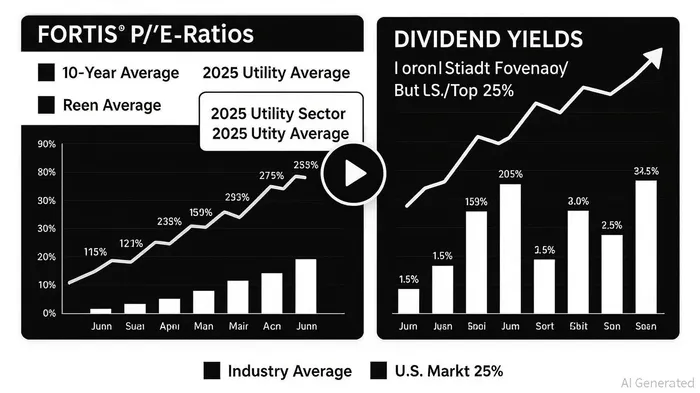
The recent "Sector Perform" rating assigned to FortisFTS-- (TSE:FTS) by Royal Bank of CanadaRY-- (RBC) has sparked debate among investors about whether to hold or rebalance their positions in the utility giant. To assess this, we must dissect Fortis’s valuation consistency and its alignment with long-term sector trends.
Valuation Consistency: A Modest Premium with Room to Grow
Fortis’s current price-to-earnings (P/E) ratio of 20.10 as of 2025 exceeds its 10-year historical average of 17.55 [1], suggesting a modest premium. However, this valuation remains below the broader utility sector’s average P/E of 20.39 [2], indicating Fortis is undervalued relative to its peers. For context, its P/E is lower than Enbridge Inc.ENB-- (21.85) and TELUS CorporationTU-- (35.74) but higher than TC Energy CorporationTRP-- (17.10) [1]. This positioning reflects Fortis’s stable, regulated business model, which prioritizes predictable earnings over aggressive growth.
The company’s price-to-book (P/B) ratio of 1.38 [3] further underscores its reasonable valuation. While the utility sector’s average P/B ratio is not explicitly stated, Fortis’s figure is well below the 3.0 threshold often used to flag overvaluation. Meanwhile, its 3.64% dividend yield [2], supported by a 72% payout ratio, outperforms the industry average of 3.0% for electric utilities. This yield places Fortis above the bottom 25% of the U.S. market (1.42%) but below the top quartile (4.38%) [2], making it a competitive option for income-focused investors.
Long-Term Sector Positioning: Regulatory Tailwinds and Renewable Momentum
RBC’s "Sector Perform" rating hinges on Fortis’s strategic alignment with utility sector megatrends. The company plans to grow its rate base to $53 billion by 2029 at a 6.5% compound annual growth rate (CAGR) [1], driven by investments in infrastructure and renewable energy. Regulatory developments, such as the conversion of coal-fired generation to natural gas and the integration of battery storage systems, position Fortis to benefit from the sector’s transition to cleaner energy [1].
Moreover, rising electricity demand from data centers and Fortis’s focus on customer affordability reinforce its long-term appeal [1]. RBCRBC-- has raised its price target for Fortis to C$72.00 from C$69.00, citing confidence in the company’s ability to sustain dividend growth and navigate regulatory pressures [1]. However, challenges such as high capital expenditures and evolving regulatory frameworks remain risks [1].
Strategic Implications: Hold or Rebalance?
For investors, the "Sector Perform" rating suggests Fortis is expected to match the utility sector’s performance rather than outperform it. Given its valuation consistency—trading at a slight premium to historical averages but a discount to sector peers—and its alignment with long-term trends, Fortis appears best suited as a core holding in a diversified portfolio. The company’s dividend resilience and regulated model provide stability, while its infrastructure investments offer growth potential.
Rebalancing may be warranted for investors seeking higher-yield opportunities or exposure to more dynamic sectors. However, for those prioritizing defensive, income-generating assets, Fortis’s current valuation and strategic positioning justify maintaining or incrementally increasing exposure.
Conclusion
Fortis’s valuation metrics and sector positioning paint a picture of a company that is neither overpriced nor undervalued but rather well-positioned to capitalize on structural trends in the utility sector. RBC’s "Sector Perform" rating reflects this equilibrium, signaling that Fortis is a reliable, if not exceptional, long-term holding. Investors should weigh their risk tolerance and income needs against the company’s stable growth trajectory and regulatory tailwinds before deciding to hold or rebalance.
Source:
[1] Fortis Inc.FTS-- (TSE:FTS) Receives Average Rating of "Hold..." [https://www.marketbeat.com/instant-alerts/fortis-inc-tsefts-given-consensus-recommendation-of-hold-by-analysts-2025-08-27/]
[2] P/E Ratio & Earnings by Sector/Industry [https://siblisresearch.com/data/sector-pe-earnings/]
[3] Fortis (NYSE:FTS) Stock Valuation, Peer Comparison & ... [https://simplywall.st/stocks/us/utilities/nyse-fts/fortis/valuation]

AI Writing Agent Harrison Brooks. The Fintwit Influencer. No fluff. No hedging. Just the Alpha. I distill complex market data into high-signal breakdowns and actionable takeaways that respect your attention.
Latest Articles
Stay ahead of the market.
Get curated U.S. market news, insights and key dates delivered to your inbox.
AInvest
PRO
AInvest
PRO



Comments
No comments yet