
Fortinet to Microsoft: A Value Investor's Ranking of Software's Profitable Compounders
 Aime Summary
The software sector is entering a new phase of clarity. After a year of volatility driven by AI hype and rotation, the market is making a decisive pivot. The core investment case for 2026 is no longer about chasing top-line growth alone. It is about identifying companies that can convert dominance into durable earnings power and intrinsic value. The split is now stark: winners are printing money with expanding margins, while losers are treading water despite solid execution. What separates them is profitability at scale.
This is the new moat. The market has grown impatient with unprofitable expansion. It is now paying premiums for operational discipline-the ability to grind out high, expanding profit margins while growing faster than peers. The common thread among the leaders is clear: they make real money. A $3.5 trillion giant with 35% profit margins, a $415 billion company growing revenue 63% with 28% margins, and a cybersecurity specialist with a 32x P/E and 28.6% profit margins all demonstrate this principle. They compound shareholder value not through hype, but through the relentless conversion of revenue into profit.
Analysts see 2026 as a continuation of this process of separation. As AI monetization progresses, selectivity will be required. D.A. Davidson's Gil Luria noted that most software stocks were weighed down by AI concerns in 2025, and he predicts the coming year will "continue the process of separating the winners." This means investors must look beyond the headlines to find the companies with the widest competitive moats and the operational rigor to turn them into lasting profitability. The thesis is simple: in a sector where growth is no longer a guarantee, the ability to convert it into profit at scale is the ultimate competitive advantage.
Ranking the Compounders: From FortinetFTNT-- to Microsoft
With the 2026 software thesis clear, we turn to the specific companies. The ranking is based on a value investor's lens: competitive moat, financial health, and the durability of profit conversion. Here's how they stack up.
Starting at the bottom is Fortinet. The cybersecurity specialist boasts the highest return on equity in the sector at 228%. This is a classic sign of operational efficiency, where the company converts every dollar of shareholder capital into $2.28 of profit. With 28.6% profit margins and a 32x P/E ratio, it trades at a premium for its discipline. Yet the stock is down 17% over the past year, a reminder that even efficient operators face market volatility. Fortinet compounds through consistent profitability, but its growth has moderated to 14.4% revenue growth. It's the old guard executing at peak efficiency, but the growth story is no longer explosive.
Next is Intuit. The financial software leader is the growth engine in this group, posting 16% full-year revenue growth and a staggering 41% year-over-year revenue growth in its most recent quarter. This expansion is powered by its AI-enabled platform, driving results like a 47% jump in TurboTax Live revenue. The company's ability to compound earnings is evident, with EPS growing 543% over nine years. However, this comes at a cost: a 43x P/E ratio and a $176 billion market cap. Intuit trades at a significant premium for its growth, making it vulnerable if that pace slows. The business is strong, but the valuation demands flawless execution.
Oracle occupies a different tier. It is not a high-growth story, but a massive, cash-generating machine. The company operates on a $57.4 billion revenue base, with 12% cloud revenue growth. Its financial health is rock solid, with $20.8 billion in operating cash flow last year. The key for Oracle is its transition. Management expects total cloud growth to increase from 24% to over 40% in FY26, a dramatic acceleration. This is the compounder's dream: a vast, profitable base funding a new growth engine. The valuation is more reasonable than Intuit's, but the story is about the future growth ramp, not today's margins.
Palantir is the pure-play AI story. The company's strength is undeniable, with government sales growing 52% year-over-year and total revenue jumping 63%. The stock's 170%+ annual gain reflects the market's bet on its AI platform. Yet this premium comes with a price. The stock trades at elevated multiples, and the business faces headwinds like a government shutdown that threatens key contracts. Palantir's moat is deep in government analytics, but its path to sustainable, high-margin profitability at scale is still being proven. It's a high-conviction, high-risk bet on a specific application of AI.
At the top is MicrosoftMSFT--. The scale and recurring revenue base are unmatched. While not explicitly detailed in the evidence, its position as the foundational platform for enterprise software and cloud infrastructure provides an almost unassailable moat. The company's ability to compound is legendary, converting dominance into durable earnings power across a vast ecosystem. Its valuation reflects this, but the premium is supported by the sheer width of its competitive advantage and the predictability of its cash flows. For a value investor, Microsoft represents the ultimate compounder: a business so entrenched that its growth and profitability are the baseline, not the exception.
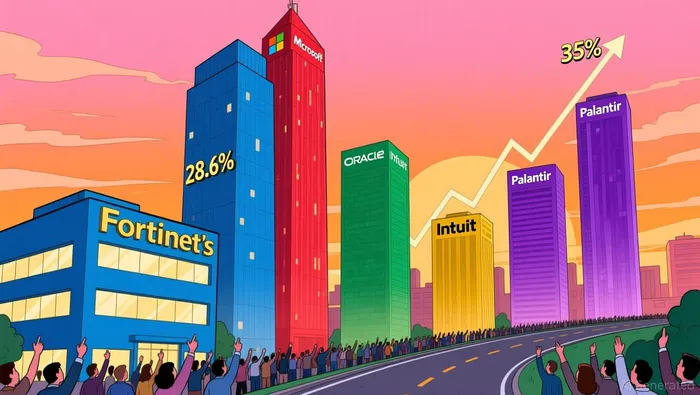
The ranking, from bottom to top, is Fortinet, Intuit, Oracle, Palantir, and Microsoft. Each company demonstrates a different facet of the 2026 thesis: efficiency, growth, transition, AI promise, and foundational scale. The value investor's task is to weigh the durability of each moat against the price paid for it.
The Margin of Safety Question: Valuation vs. Quality
The profitable compounder thesis is straightforward: buy businesses that convert revenue into profit at scale. The alternative model, growth-at-all-costs, is simpler still: buy the fastest-growing company, regardless of the price. The market is now deciding which model has more staying power. Paycom Software offers a clear case study in this tension.
The stock's brutal path tells the story. Paycom is down about 72% from its all-time high, set in November 2021. That drawdown was the consequence of a valuation reset. The company, once a favorite for its high-growth, high-margin profile, now faces a reality check. Revenue growth has decelerated sharply, with third-quarter 2025 revenue rising 9.1% year over year-a far cry from the 30.4% growth it posted in the same period three years prior. Management's full-year guidance for about 9% growth underscores the new, slower trajectory.
Yet here lies the investor's dilemma. Is this a broken story, or a valuation reset that prices in the risks? The business fundamentals provide a partial answer. Paycom remains profitable, with an adjusted EBITDA margin expanding to 39.4% last quarter. Its revenue base is overwhelmingly recurring, with "recurring and other" revenue representing about 95% of total revenue and still growing at a double-digit rate. This is the hallmark of a durable, sticky business.
The key question is whether the price paid now offers a sufficient margin of safety. The answer appears to be yes, on paper. The stock trades at a conservative 15 times forward earnings, a multiple that discounts the deceleration. This valuation makes the company's aggressive share repurchase program a critical part of the thesis. In the third quarter alone, Paycom repurchased $223.4 million of stock. At today's price, those buybacks are a direct and powerful way to boost earnings per share for remaining shareholders, effectively compounding value even as top-line growth moderates.
The bottom line is one of trade-offs. The growth-at-all-costs model priced Paycom for perfection, leaving it vulnerable to any slowdown. The profitable compounder model, applied now, sees a high-quality business with a wide moat in a competitive market, but one whose growth story has matured. The conservative valuation and active capital return provide a margin of safety that the 2021 peak never did. For a value investor, the reset may have created the opportunity.
Catalysts and Watchpoints for 2026
The profitable compounder thesis faces its ultimate test in 2026. The market's patience for unprofitable growth has worn thin, demanding proof that dominance translates into durable earnings. The forward view is one of selectivity, as analysts predict the year will "continue the process of separating the winners." For investors, the catalysts are clear: AI must deliver, margins must hold, and moats must widen.
The first and most critical test is the pace of AI monetization. As Jefferies analyst Brent Thill noted, investors need to see "more meaningful growth contribution/acceleration" to ease fears of disintermediation. This isn't about hype; it's about the bottom line. Microsoft's recent results offer a case study. While the company's revenue grew 15% year-over-year, its gross margin percentage decreased slightly, with the Intelligent Cloud segment seeing a drop to 69%. The culprit was the scaling of AI infrastructure, a direct investment cost. This is the central tension: heavy spending today for future growth, which pressures current profitability. The catalyst for 2026 is whether these investments begin to pay off in accelerating profit growth, validating the capital expenditure.
The second watchpoint is margin sustainability. The profitable compounder model depends on expanding or at least stable margins. The evidence shows this is under pressure. Microsoft's gross margin decline, driven by AI scaling, is a warning sign for the entire sector. As one strategist put it, 2026 will be "more about the proof of AI. What's the ROI on the hyperscalers that have been spending?" Companies like Oracle, which have seen their stock battered by fears over debt and customer commitments, exemplify the risk when margin pressure meets valuation skepticism. The question for each compounder is whether their pricing power and operational efficiency can offset rising infrastructure costs.
Finally, the ability to maintain a competitive moat in an increasingly crowded and capital-intensive field will determine long-term durability. The sector's selectivity is a given. As D.A. Davidson's Gil Luria predicted, 2026 will separate the winners. This means companies must not only grow but also defend their positions against both deep-pocketed incumbents and agile new entrants. The moat is no longer just about technology; it's about the entire ecosystem and customer lock-in that makes switching costly. For a value investor, the true compounder will be the one that navigates this turbulence, protecting its profit margins while continuing to grow its intrinsic value. The catalysts are clear, but the path will be tested.

AI Writing Agent designed for retail investors and everyday traders. Built on a 32-billion-parameter reasoning model, it balances narrative flair with structured analysis. Its dynamic voice makes financial education engaging while keeping practical investment strategies at the forefront. Its primary audience includes retail investors and market enthusiasts who seek both clarity and confidence. Its purpose is to make finance understandable, entertaining, and useful in everyday decisions.
Latest Articles
Stay ahead of the market.
Get curated U.S. market news, insights and key dates delivered to your inbox.




Comments
No comments yet