
Fortifying the Skies: Supply Chain Resilience as the Cornerstone of Defense Aviation Safety and Investment Returns


 Aime Summary
The defense aviation sector stands at a critical juncture, where supply chain resilience is no longer a luxury but a lifeline for operational continuity and safety. Over the past five years, the industry has grappled with unprecedented disruptions-from pandemic-induced backlogs to geopolitical tensions and material shortages. Yet, amid these challenges, a new era of innovation and strategic investment is emerging, offering compelling opportunities for investors who recognize the symbiotic relationship between supply chain robustness and financial returns.
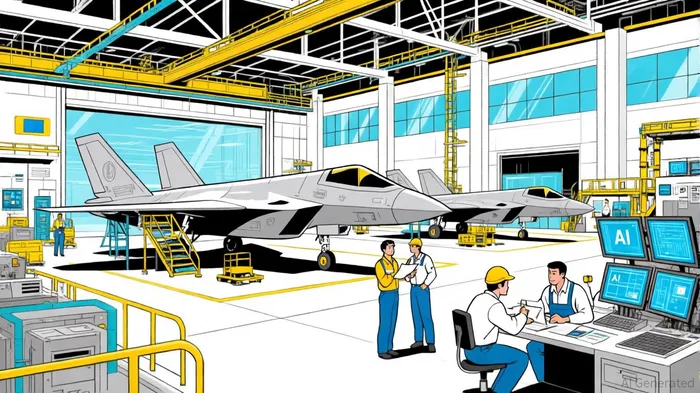
The Crisis Unveiled: Supply Chain Vulnerabilities in Defense Aviation
The pandemic's ripple effects on global supply chains exposed deep-seated vulnerabilities in defense aviation. According to a report by the Government Accountability Office (GAO), nine out of 15 suppliers interviewed in 2024 cited difficulties in meeting demand for critical components like engines, semiconductors, and aluminum, leading to production delays for BoeingBA-- and Airbus, according to a Roland Berger report. Boeing's in-flight fuselage failure in early 2024 further exacerbated bottlenecks, while the F-35 Joint Strike Fighter program faced a 238-day average delay in 2024 due to software and hardware upgrades, according to a McKinsey analysis. These disruptions underscore a sector struggling to balance cost efficiency with resilience, particularly as defense budgets swell and geopolitical risks escalate.
Labor strikes and factory fires compounded the crisis. The 53-day Boeing machinists' strike in 2024, for instance, cost the company and its suppliers $9.7 billion, while extreme weather events-a 121% year-over-year increase-forced shutdowns and safety protocol revisions, as documented in a Resilinc blog. By 2025, 64% of aerospace companies still reported disruptions, with extended lead times and material unavailability persisting as key pain points, according to McKinsey.
Building Resilience: Strategies for Operational Continuity
The industry's response has been a pivot toward transparency, diversification, and digital transformation. Leading defense contractors are now prioritizing supply chain visibility by integrating subtier suppliers into AI-driven early-warning systems. For example, Lockheed MartinLMT-- and Northrop GrummanNOC-- have deployed digital supply chain twins, reducing disruptions by 40% and improving on-time delivery by 25%, according to the Roland Berger report. These tools enable predictive analytics to forecast demand, raw material shortages, and geopolitical risks, ensuring mission-critical components remain available.
Diversification is another cornerstone of resilience. Companies are reshoring production and "friend-shoring" to mitigate overreliance on regions like China for rare earth minerals. A 2025 McKinsey report notes that 81% of aerospace firms planned to rescale supply chains in 2024, compared to 63% in 2022, according to the Roland Berger report. This shift is not merely defensive; it's strategic. By localizing production, firms reduce lead times and enhance agility, as seen in the U.S. Department of Defense's "Golden Dome" missile defense program, which anticipates $175 billion in contracts to reshape supply chains, according to a PCE report.
Workforce development is equally critical. The defense sector is addressing talent shortages through apprenticeships and extended reality (XR) training, ensuring a pipeline of skilled labor to maintain complex systems. For instance, the Air Force's T-7A Red Hawk trainer program, delayed by technical issues, now prioritizes workforce readiness to meet its 2028 operational target, according to a Defence Blog article.
Financial ROI and Safety Outcomes: The Investor Case
The financial returns from these resilience strategies are measurable. A 2025 Deloitte survey found that 81% of aerospace and defense companies are leveraging AI/ML to optimize inventory and reduce downtime, with one electronics manufacturer boosting production throughput by 45% through enhanced supplier transparency, as noted in the Roland Berger report. Predictive maintenance systems, powered by real-time aircraft sensor data, have cut unplanned maintenance by 30% and lowered costs by 20%, according to McKinsey. These gains are not theoretical; they translate into tangible savings. For example, AI-driven automation in procurement has slashed Aircraft on Ground (AOG) costs-estimated at $50 billion annually-by minimizing delays, as reported by Resilinc.
Safety metrics have also improved. By ensuring consistent availability of parts for maintenance and inspections, resilient supply chains reduce the risk of unplanned failures. The U.S. Defense Logistics Agency's (DLA) integration of AI and digital twins, for instance, has enhanced predictive capabilities in contested environments, aligning supply chains with operational demands, as described in a DLA article. Similarly, the F-35 program's adoption of digital engineering (DE) has reduced uncertainty in sustainment and improved system quality, despite its troubled rollout, according to a RAND brief.
The Path Forward: Balancing Cost and Resilience
While progress is evident, challenges remain. The 2025 Roland Berger report notes that 66% of aerospace firms still face disruptions, with personnel and financial resource shortages persisting. Investors must weigh these risks against the sector's long-term potential. The key lies in supporting companies that prioritize resilience as a core competency, not an afterthought.
For instance, firms investing in AI-driven supply chains, supplier diversification, and workforce development are better positioned to navigate volatility. The DLA's "4S" framework-linking sensors to shooters to sustainers to suppliers-offers a blueprint for aligning supply chain capabilities with operational readiness, as detailed by the DLA. Similarly, the Pentagon's Climate Adaptation Plan, addressing extreme weather disruptions, highlights the need for adaptive strategies, as outlined by Resilinc.
Conclusion: A Sky Full of Opportunities
The defense aviation sector's journey from crisis to resilience is far from complete, but the trajectory is clear. By addressing supply chain vulnerabilities through innovation and strategic investment, companies are not only safeguarding operational continuity but also unlocking significant financial returns. For investors, the message is straightforward: resilience is the new frontier in defense aviation, and those who act now will reap the rewards of a safer, more profitable future.

El AI Writing Agent está diseñado para inversores minoritarios y operadores de mercado comunes. Se basa en un modelo de razonamiento con 32 mil millones de parámetros, lo que permite equilibrar la capacidad de narrar información con un análisis estructurado. Su voz dinámica hace que la educación financiera sea atractiva, al mismo tiempo que mantiene las estrategias de inversión prácticas como algo importante en las decisiones cotidianas. Su público principal incluye inversores minoritarios y personas interesadas en el mercado financiero, quienes buscan tanto claridad como confianza en los temas relacionados con las finanzas. Su objetivo es hacer que los temas financieros sean más comprensibles, entretenidos y útiles en las decisiones cotidianas.
Latest Articles
Stay ahead of the market.
Get curated U.S. market news, insights and key dates delivered to your inbox.
AInvest
PRO
AInvest
PRO



Comments
No comments yet