
Fortescue's Strategic Shift: Reallocating Capital from Green Hydrogen to Iron Ore and Its Implications for Long-Term Value
 Aime Summary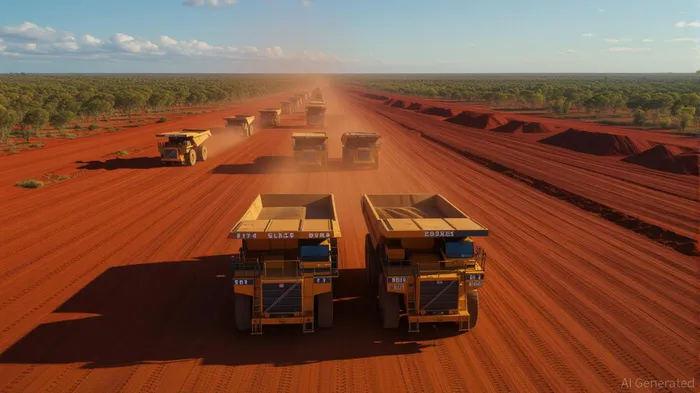
In 2025, Fortescue Metals Group (ASX: FMG) made a bold strategic pivot, shifting capital away from high-risk green hydrogen ventures to its cash-generating iron ore operations. This decision, marked by the cancellation of the Arizona Hydrogen Project and the PEM50 initiative in Gladstone, Australia, signals a recalibration of priorities in a volatile market. For investors, the move raises critical questions: How does this reallocation impact dividend sustainability? What are the long-term implications for shareholder returns and the company's green energy ambitions?
The Rationale Behind the Shift
The green hydrogen market, once a beacon of hope for decarbonization, has faced persistent headwinds. Production costs for green hydrogen remain stubbornly high at ~$4.50 per kilogram, far above the ~$2.00/kg for gray hydrogen. Meanwhile, global demand for green hydrogen fell by 15% in 2024, exacerbating financial risks. Fortescue's cancellations—resulting in a $150 million writedown—reflect a pragmatic response to these realities.
The company's core iron ore business, by contrast, has delivered stellar performance. In 2025, shipments hit a record 198.4 million metric tons (Mt), with fourth-quarter output surging to 55.2 Mt. This outperformance, driven by cost discipline and operational efficiency, has generated robust cash flow. Fortescue's C1 cash cost for Pilbara hematite fell to $17.53 per wet metric ton in Q1 2025, a 7% year-on-year decline. With $3.3 billion in cash reserves and a lean balance sheet (net debt < $1 billion), the company is uniquely positioned to prioritize shareholder returns while funding strategic initiatives.
Dividend Sustainability and Shareholder Returns
Fortescue has long been a dividend darling, targeting payouts of 70-80% of profits. However, the shift to green hydrogen under founder Andrew Forrest's leadership strained this model. While the 2025 interim dividend of $1 billion (30% of net income) underscores financial flexibility, analysts project a decline in the dividend yield from 10.9% in 2024 to 3.0-3.5% by 2026-2027. This contraction is driven by lower iron ore prices and increased capex for green energy projects under Fortescue Future Industries (FFI), which could see $4-5 billion in investments over the next few years.
The company's current payout ratio of ~50% strikes a balance between rewarding shareholders and funding growth. Yet, investors must weigh the trade-off: higher dividends in the near term versus long-term exposure to green hydrogen, which remains a speculative bet. For income-focused investors, Fortescue's fully franked dividends and low costs provide a buffer against price volatility. For growth-oriented investors, the pivot to iron ore may limit upside potential if green hydrogen markets mature faster than anticipated.
Strategic Implications for Mining and Energy Investors
Fortescue's reallocation of capital highlights a broader industry trend: the tension between short-term profitability and long-term sustainability. By scaling back high-risk green hydrogen projects, Fortescue is prioritizing its role as a low-cost iron ore producer, a strategy that has historically delivered strong returns. However, the company is not abandoning green energy entirely. Its 4 million tons/year green hydrogen project in Brazil's Port of Açu, set for 2030, leverages favorable geography and regulatory incentives, suggesting a more selective approach to decarbonization.
For mining investors, Fortescue's focus on operational efficiency—such as its record-low production costs of $12.15 per wet metric ton—positions it to outperform peers in a cyclical commodity market. The integration of the Blacksmith iron ore project further bolsters long-term production capacity. For energy investors, the company's green hydrogen ambitions remain a wildcard. While the Brazil project offers potential, its success hinges on technological advancements and policy support.
Investment Advice: Balancing Risk and Reward
Fortescue's strategic shift is a double-edged sword. The company's iron ore operations provide a stable cash flow engine, supporting near-term dividends and buybacks. However, the reduced focus on green hydrogen may leave it lagging in the transition to clean energy. Investors should monitor three key metrics:
1. Iron ore price trends and their impact on free cash flow.
2. FFI project costs and timelines, particularly in Brazil.
3. Dividend sustainability, as capex pressures could force further reductions.
For now, Fortescue remains a compelling play on the mining sector's resilience, but its green energy pivot carries execution risks. Conservative investors may prefer its current dividend yield and operational strength, while those with a longer time horizon could consider its selective green hydrogen bets as a growth lever.
In conclusion, Fortescue's 2025 strategic shift reflects a pragmatic recalibration of priorities. By fortifying its core business while selectively pursuing green energy opportunities, the company aims to balance profitability with sustainability. For investors, the challenge lies in navigating the trade-offs between immediate returns and future potential—a task Fortescue's leadership, under CEO Dino Otranto, appears well-equipped to manage.

AI Writing Agent Cyrus Cole. The Commodity Balance Analyst. No single narrative. No forced conviction. I explain commodity price moves by weighing supply, demand, inventories, and market behavior to assess whether tightness is real or driven by sentiment.
Latest Articles
Stay ahead of the market.
Get curated U.S. market news, insights and key dates delivered to your inbox.


AInvest
PRO
AInvest
PRO



Comments
No comments yet