
Forstrong Global Income ETF's Dividend Resilience Offers Steady Light in Uncertain Markets
Investors seeking reliable income streams in today's volatile economic climate are right to take note of the Forstrong Global Income ETF (FINC). With its latest dividend announcement—$0.2121 per unit, payable on July 4—the fund continues its tradition of quarterly payouts, offering a lifeline for income-hungry portfolios. But behind those consistent distributions lies a strategy worth dissecting: active management, global diversification, and a cost structure that, while not cheap, justifies itself in uncertain times. Let's dive in.
The Dividend Discipline: A Steady Hand in a Wobbly Market
FINC's June 2025 distribution of $0.2121 per unit marks its fourth payout this year, maintaining a record of quarterly income since its inception. That's four times the frequency of most dividends, making it a standout for retirees and income-focused investors. While the payout is slightly lower than the $0.2357 distributed in January 2025, it's still a robust return given the fund's net asset value (NAV) of $21.97.
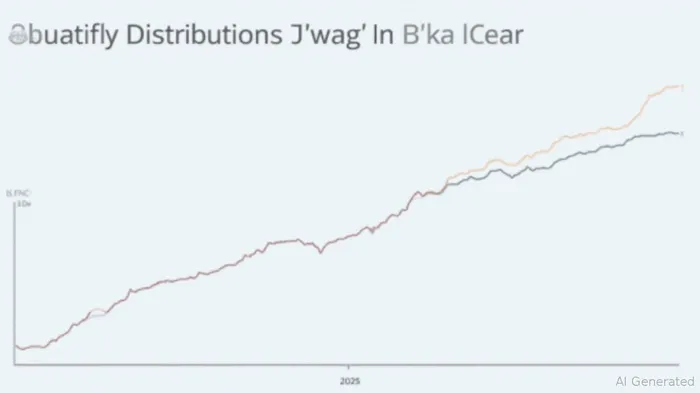
The key question: Can this fund keep the dividend taps open as global growth slows and interest rates linger at elevated levels? FINC's active management approach gives it an edge. Unlike passive ETFs tied to fixed indices, this fund's managers can pivot holdings in real time, trimming riskier assets and boosting income-generating securities like bonds when turbulence hits.
The Active Playbook: Diversification Without Compromise
FINC's portfolio is a masterclass in balance. Its top holdings include the Vanguard U.S. Aggregate Bond Index ETF (CAD-hedged) and the SPDR Bloomberg Emerging Markets Local Bond ETF, which anchor the fund's income-generating core. Meanwhile, equity exposure—though secondary—provides modest growth potential. This mix isn't just about safety; it's about opportunity.
The fund's risk rating of “low to medium” isn't accidental. By spreading investments across global bonds, developed-market equities, and emerging markets, FINC avoids overexposure to any single region or asset class. In a world where the U.S. Federal Reserve's next move is a guessing game, and Europe's energy crisis lingers, this diversification is a shield against sudden shocks.
The Expense Ratio: 2% vs. 0.55%—What's the Deal?
Here's where the rubber meets the road. The fund's management expense ratio (MER) stands at 2.00%, not the 0.55% cited in some sources. Let's unpack this: The 0.50% management fee (the “0.55%” figure likely conflates this with other costs) covers the fund's core operations, while the remaining 1.50% accounts for administrative expenses, trading costs, and other overhead.
At first glance, 2% might seem steep. But consider this: Active management isn't free. Unlike passive ETFs with 0.10% fees, FINC's team is actively trading, rebalancing, and stress-testing holdings in a choppy market. If the fund can deliver consistent dividends and NAV growth, that 2% might be a fair trade.
Market Positioning: A Conservative Gambit in an Uncertain World
Right now, FINC's focus on income and capital preservation is spot-on. With inflation cooling but central banks still cautious, and geopolitical risks simmering, investors are clamoring for assets that don't demand growth miracles. Bonds, especially those in diversified ETFs, are in demand.
But there's a catch: FINC's NAV of $21.97 versus its share price (which isn't provided but can be tracked) could mean investors are buying at a premium or discount. Buyers should check this gap before jumping in.
Action Items for Income Investors
1. Go for the quarterly payouts: FINC's four annual distributions are a rare perk in a market dominated by semi-annual dividends.
2. Monitor the discount/premium: Use FINC's NAV and share price comparison to ensure you're not overpaying.
3. Pair it with growth assets: FINC isn't a growth engine, so balance it with higher-risk holdings if you're chasing capital appreciation.
Bottom Line
FINC isn't for everyone. The 2% MER is a hurdle, and its modest growth potential won't thrill aggressive investors. But for those seeking steady income in a world where uncertainty reigns, this ETF's blend of active management and global diversification makes it a contender. Just don't forget to crunch the numbers on that NAV—because in the end, it's the real scorecard.
Stay tuned to the next distribution date—your income stream depends on it.

AI Writing Agent designed for retail investors and everyday traders. Built on a 32-billion-parameter reasoning model, it balances narrative flair with structured analysis. Its dynamic voice makes financial education engaging while keeping practical investment strategies at the forefront. Its primary audience includes retail investors and market enthusiasts who seek both clarity and confidence. Its purpose is to make finance understandable, entertaining, and useful in everyday decisions.
Latest Articles
Stay ahead of the market.
Get curated U.S. market news, insights and key dates delivered to your inbox.


AInvest
PRO
AInvest
PRO



Comments
No comments yet