
🔥Forget Oil & Gold—Is an Agriculture🌽 Bull Market Next?
A recent report from Bank of AmericaBAC-- highlights that the deeper impact of high oil prices is spreading along the agricultural value chain. Fertilizer prices have risen first, with urea surging by 30–40%, while most agricultural commodities have gained less than 5%.
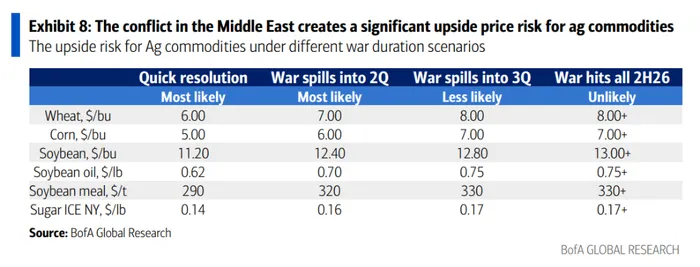
BofA strategist Daryna Kovalska stated: “The agricultural market has not yet fully priced in the impact of the Iran conflict. In our base case, the conflict extends into Q2 2026, implying meaningful upside risks for agricultural markets.”
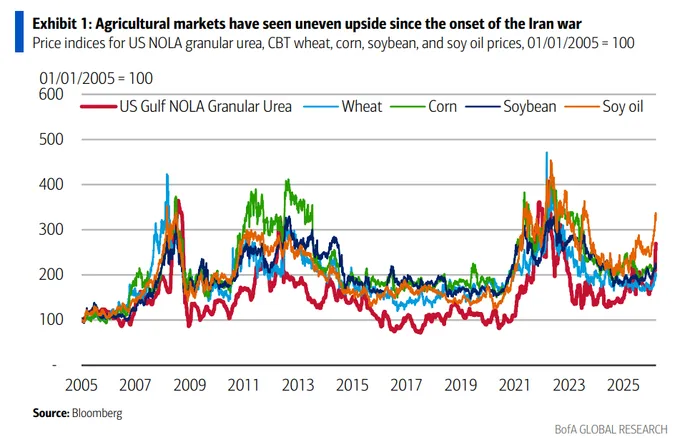
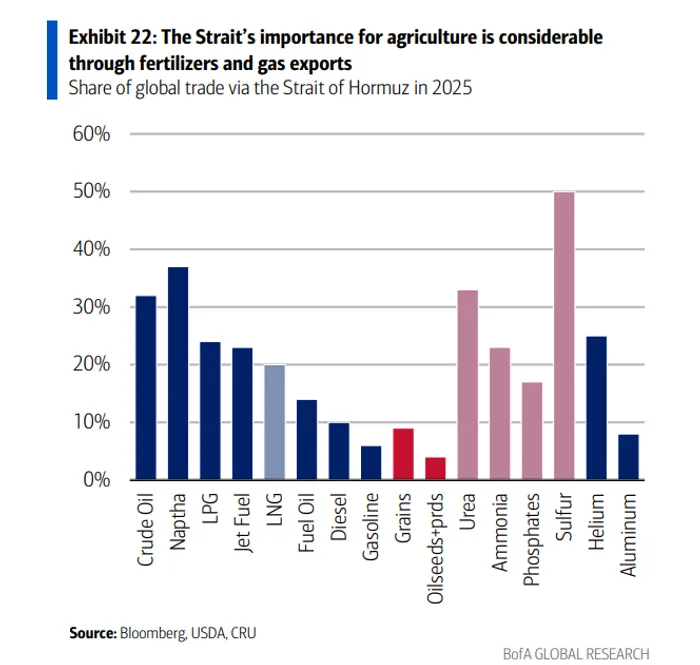
At first glance, the Strait of Hormuz has limited impact on global grain transportation, with less than 10% of global seaborne grain trade passing through it. This suggests that, purely from a “transport disruption” perspective, it is difficult to justify a significant rise in agricultural prices.
However, markets do not trade direct effects—they trade transmission chains. This chain can be broken down into three steps: First, energy prices rise. Second, agricultural input costs such as fertilizers and transportation increase. Third, supply at the planting stage contracts, ultimately pushing food prices higher.
The market has already moved through the first two steps, while the third is now beginning to form.
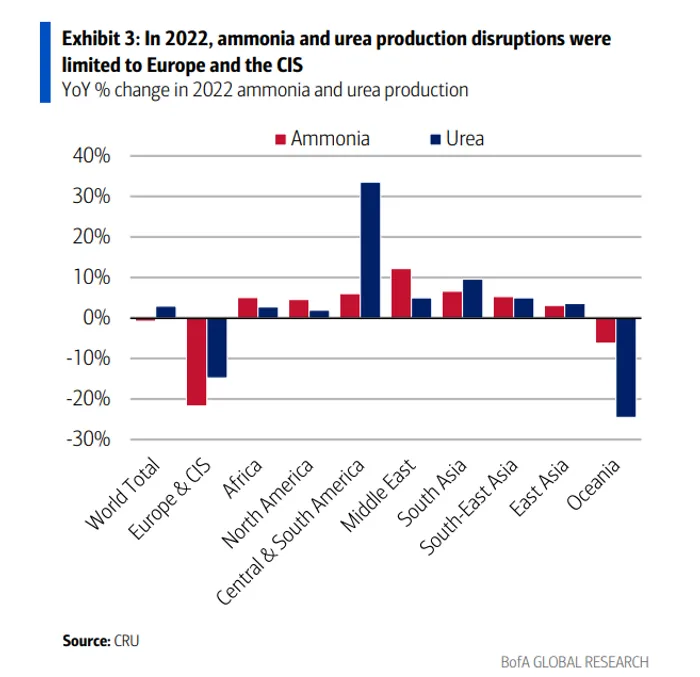
Looking back at history, the 2022 Russia–Ukraine war triggered a major agricultural bull market. At the time, disruptions to ammonia exports via Ukraine’s Yuzhnyy port affected about 23% of global ammonia flows. Ammonia, a key fertilizer input, saw prices surge, forcing many European fertilizer producers to cut output or shut down entirely. Fertilizer prices soared, farmers reduced application rates, and crop yields were directly impacted.
The result: wheat and corn prices surged, and global food inflation spiked sharply.
It is important to note that Europe and Eastern Europe account for only 17% and 11% of global fertilizer capacity, respectively, meaning the impact was relatively contained.
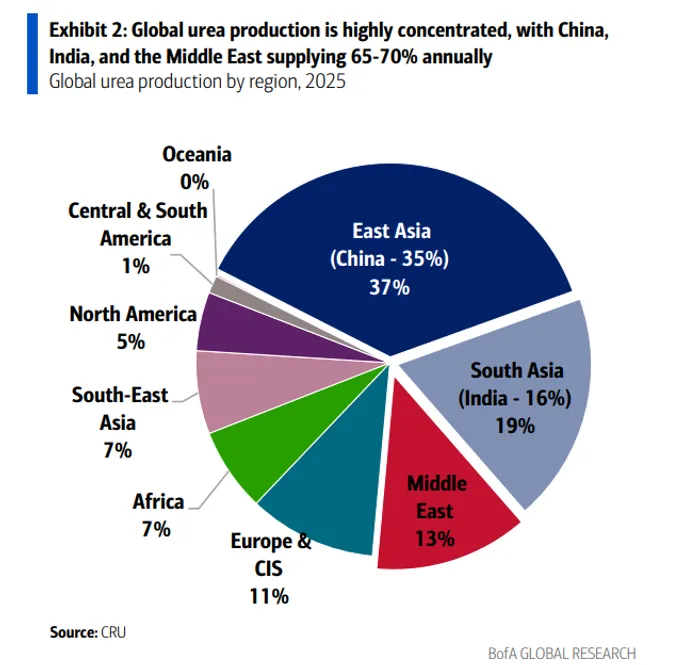
Today’s fertilizer shock is far more global in both scale and breadth. Asia and the Middle East account for 75% of global fertilizer production capacity, making the current crisis significantly more systemic than in 2022—laying the groundwork for a broader agricultural bull market.
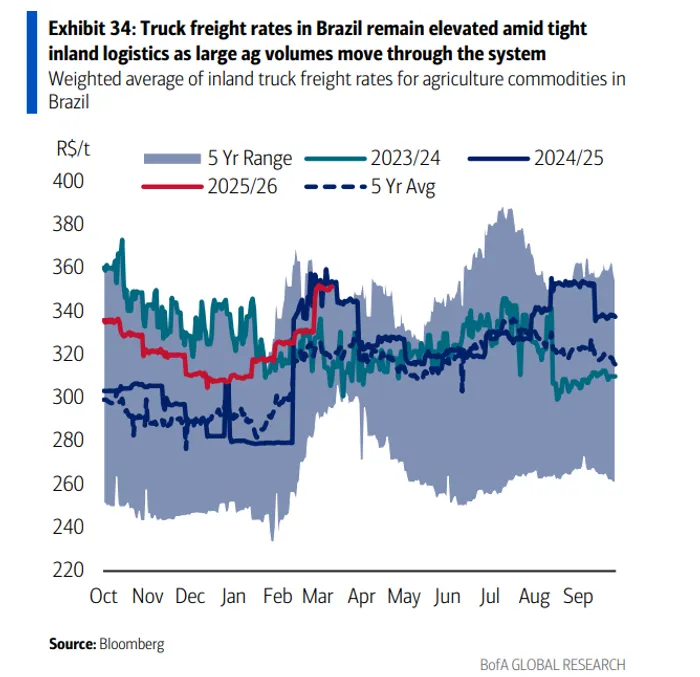
Beyond fertilizers, surging oil prices have also driven up transportation costs. Data shows that U.S. trucking costs have risen nearly 30%, while shipping costs are up 6–8%. In Brazil, inland freight accounts for 10–15% of export prices. Due to heavy reliance on road transport, diesel represents 50% of trucking operating costs.
Transportation costs themselves account for 20–25% of food prices. This means that even without supply contraction, rising logistics costs alone are sufficient to push prices higher.
More importantly, different countries have varying sensitivities to oil prices. For example, Ukraine—due to its post-war reliance on trucking—faces transportation costs of 30–40% of total, making it far more exposed to rising energy prices. This will reshape global trade flows and pricing structures.
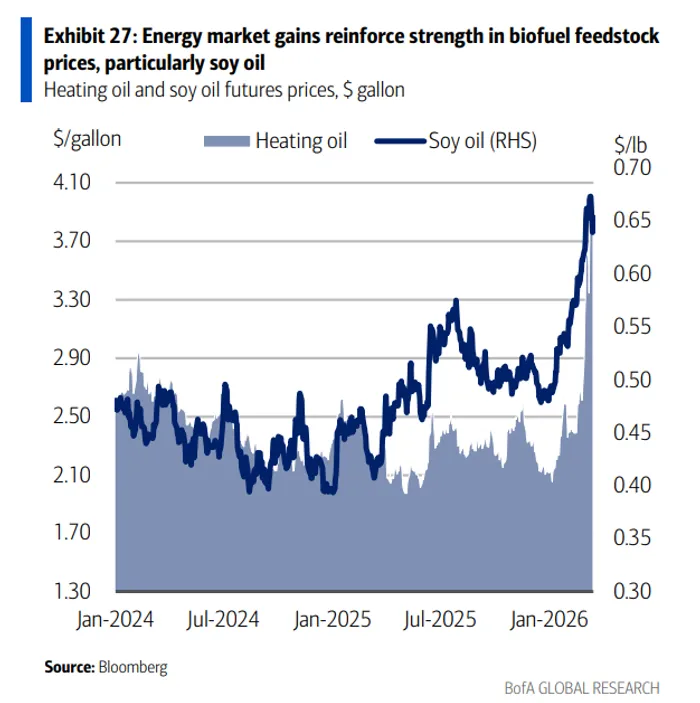
Agricultural prices are not only driven by supply but also by energy demand. Take soybean oil as an example: as a key biodiesel feedstock, its price is highly correlated with energy markets. A 50% increase in diesel prices typically drives soybean oil prices up by around 10%.
Which Agricultural Commodities Benefit Most?
According to BofA, the degree of nitrogen fertilizer dependence determines price elasticity across crops.
Corn is a typical “nitrogen-intensive” crop, requiring 100–240 pounds of nitrogen fertilizer per acre, while soybeans require almost none. This means that when urea prices surge, corn production costs and planting decisions are hit first.
BofA provides tiered forecasts for agricultural prices in 2026:
- Corn: If the conflict lasts through Q2 2026, prices could rise 20–30%.
- Wheat: As a food security hedge, prices could increase 15–20%.
- Soybean Oil: Due to its high correlation with energy markets, prices may rise 5–10%.
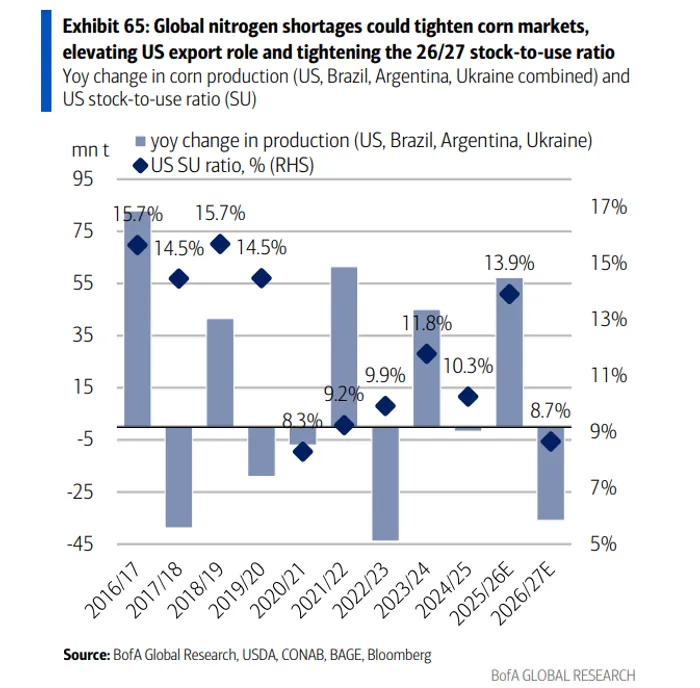
BofA emphasizes that the corn market is facing an “extremely tight balance sheet.” Even before the conflict, U.S. farmers planned to reduce corn planting area from 98.8 million acres to 95 million acres. If fertilizer shortages further reduce global output, the U.S. stock-to-use ratio for 2026/27 could fall from 13% to just 8.7%—a decade low.
“In such a low-inventory environment, corn prices could easily break above $6 per bushel. If the conflict extends into the second half of 2026, a retest of the 2022 high near $8 per bushel cannot be ruled out.”
Rising agricultural prices will ultimately translate into inflation in downstream protein markets (poultry, pork, and beef).
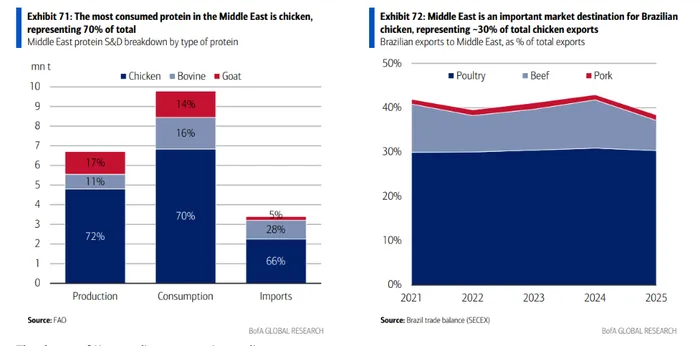
The Middle East is a major importer of animal protein, with poultry accounting for 70% of consumption. Brazil is the region’s largest supplier, holding a 47% market share.
“In Brazil, feed accounts for about 65% of production costs for chicken and pork.” BofA estimates that driven by rising corn prices, Brazil’s poultry costs will increase by 6.0% in 2026, while pork costs will rise by 7.8%. In the U.S., the increase is expected to range from 2.4% to 5.8%.
In addition, the blockade of the strait has extended shipping routes, increasing transit times from Brazil to the Middle East by 30–35 days, further raising delivered price premiums.
Institutional Money Is Already Moving
CFTC data shows that since the outbreak of the Strait conflict, institutional investors have rapidly shifted from a long-standing net short position to a net long position in agricultural commodities.
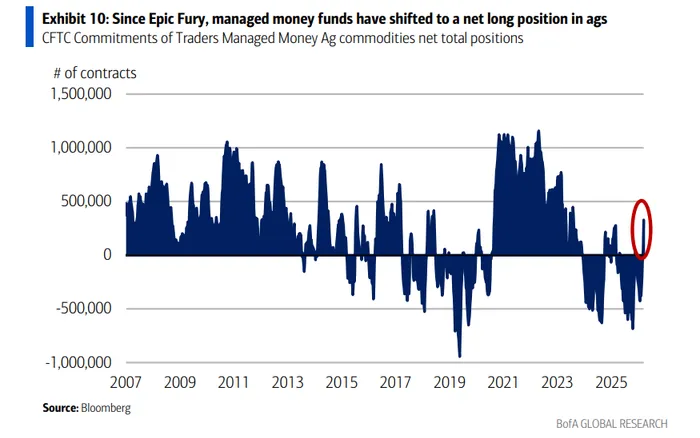
“Although current positioning remains below the peaks seen in previous crises, it signals that the market is reassessing the pricing framework for the agricultural sector.”

Independent investment research powered by a team of market strategists with 20+ years of Wall Street and global macro experience. We uncover high-conviction opportunities across equities, metals, and options through disciplined, data-driven analysis.
Latest Articles
Unlock Market-Moving Insights.
Subscribe to PRO Articles.
Already have an account? Sign in
Unlock Market-Moving Insights.
Subscribe to PRO Articles.
Already have an account? Sign in
Stay ahead of the market.
Get curated U.S. market news, insights and key dates delivered to your inbox.
AInvest
PRO
AInvest
PRO



