
Ford's Universal EV Platform: A Bet on the Cost-Centric S-Curve


 Aime Summary
Ford's move is a classic infrastructure bet on the technological S-curve. The company is abandoning its headlong EV push to focus on hybrids and extended-range vehicles, but it is making one final, concentrated play to capture the mass-market adoption phase. That bet is the Universal EV Platform, a last major EV initiative built by a secretive team racing to undercut both TeslaTSLA-- and the rising tide of Chinese OEMs on production cost.
The pivot is stark. Just a few years ago, FordF-- championed a full EV transition. Now, it is effectively shelving its pure-electric lineup, with the F-150 Lightning ending production last month. The new strategy is a retreat to familiar ground, but the Universal EV Platform is its last great hope for a competitive, affordable electric vehicle. CEO Jim Farley has been clear: the ultimate competition is not from legacy rivals, but from the "affordable Tesla and the Chinese OEMs." The platform's sole mission is to drive down costs to meet that threat.
To build this cost-centric vehicle, Ford has assembled a specialized force. A secretive, 300-person team known as Ford Advanced EV has aggressively recruited talent from the front lines of the EV revolution. This includes more than 20 engineers from Tesla, around 50 from RivianRIVN--, and a dozen from cash-strapped Canoo. The team also hired senior aerodynamicists from Formula 1 and engineers from Lucid, Apple's Project Titan, and eVTOL startups. This isn't a general hiring spree; it's a targeted acquisition of expertise in low-cost manufacturing, battery systems, and efficient design.
Farley has openly cited Elon Musk's approach as a learning model. He created a "skunk works" team on the West Coast, mirroring Musk's start-from-scratch ethos, to build an affordable EV. The goal is to move fast and play catch-up, as the CEO admitted Ford was "decades behind" its Asian competitors in certain respects. By siloing this team from the traditional corporate structure, Ford is attempting to replicate the agility of a startup while leveraging its own scale. The platform is being built by a team that has learned the hard lessons of the EV race, aiming to deliver the fundamental rails for mass adoption at a price point that can finally compete.
The Cost-Centric S-curve: Platform Economics and Autonomy
Ford's bet hinges on a brutal economic calculus. The Universal EV Platform is engineered to match the "full system cost" of leading Chinese OEMs across eight body styles. This isn't just about the battery pack or the motor; it's about the total vehicle system cost, from raw materials to final assembly. The target is a roughly $30,000 electric pickup, a price point that sits squarely in the mass-market sweet spot. For context, that's well below the starting price of most current EVs and aims to undercut the entire competitive field, including the affordable Tesla models and the rising Chinese brands.
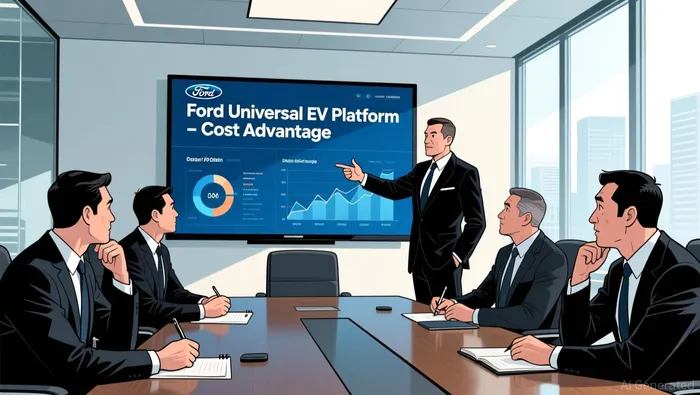
This cost focus is the platform's core infrastructure layer. By standardizing across eight body styles-from a small pickup to crossovers and sedans-Ford aims to achieve massive economies of scale in tooling, supply chain, and manufacturing. The platform's design prioritizes simplicity and efficient production, a direct response to the high costs that plagued earlier EV launches. The goal is to build the fundamental rails for mass adoption at a price that finally makes sense for the average buyer.
Yet, Ford is not betting on a cheaper, dumb vehicle. The company is integrating a key differentiator from the start: advanced autonomy. Ford plans to introduce eyes-off Level 3 autonomous driving capability on the first vehicle built on this platform by 2028. This is a deliberate strategic move. While Tesla's current focus is on AI and the Cybercab, Ford is aiming to leapfrog that product lineup by offering a low-cost, affordable vehicle with a next-generation autonomy system. The plan is to launch new hardware and software in 2027, with the eyes-off capability arriving just a year later.
This integration is the crux of the S-curve bet. Ford is attempting to compress two technological transitions-mass-market EV adoption and the democratization of autonomy-into a single platform. The aim is to put advanced driving assistance into the vehicles people actually buy, not just into expensive prototypes. Whether this system will expand beyond highways into urban settings remains unclear, but the ambition is to deliver a significant leap in capability at a fraction of the current premium. In doing so, Ford is trying to build the infrastructure for the next paradigm, not just another car.
Financial and Competitive Implications
Ford's strategic pivot is a calculated financial retreat that buys time while building a new infrastructure layer. The shift allows the company to preserve cash and focus on the profitable hybrids and extended-range vehicles that are now its core. This discipline is critical as the competitive landscape has hardened. In 2025, BYD overtook Tesla as the world's best-selling electric automaker, a stark reminder of the cost and scale advantage that Chinese OEMs command. By shelving its pure-EV ambitions and concentrating resources on the Universal EV Platform, Ford is attempting to play catch-up on the cost curve without bleeding capital on a losing product line.
The platform's financial viability hinges entirely on its ability to achieve the targeted cost structure. If Ford can deliver a $30,000 electric pickup with a "full system cost" matching leading Chinese OEMs, it would directly compete on price. This would be a paradigm shift for the company, moving from a premium EV player to a mass-market contender. Success here would allow Ford to finally enter the adoption phase of the EV S-curve at a competitive point, potentially unlocking new volumes and revenue streams. Failure, however, would validate the skepticism around its ability to match Asian rivals on manufacturing efficiency and supply chain control.
Ford's existing service network and dealership footprint provide a logistical advantage over Tesla's direct-sales model for customer support. While Tesla is scaling its autonomy software globally, Ford's established infrastructure can offer a more familiar and accessible path for service and repairs. This is a key differentiator in the real world of vehicle ownership, where support networks matter as much as the technology itself. The company's strategy is to leverage this physical advantage to build trust and scale, even as it races to deliver the low-cost, high-tech vehicle of the future.
Catalysts, Risks, and What to Watch
The thesis for Ford's Universal EV Platform now enters a critical validation phase. The primary catalyst is the 2027 production start of the first Universal EV platform vehicle, a roughly $30,000 electric pickup. This launch will test the platform's core promises: delivering a mass-market vehicle at a competitive cost while integrating advanced autonomy. Success here would prove Ford can finally build the infrastructure for the next paradigm. Failure would confirm the execution gap that has plagued its EV ambitions.
Execution is the paramount risk. The platform must deliver on its "full system cost" matching leading Chinese OEMs to be viable. Achieving this requires flawless integration of the recruited talent team, which has been assembled with the explicit goal of low-cost manufacturing. Investors should watch for further cost reductions and the scaling of this specialized workforce. Equally ambitious is the autonomy timeline. Ford plans to introduce eyes-off Level 3 autonomous driving capability in 2028, just one year after the vehicle's launch. This compressed schedule demands flawless hardware and software development, a significant challenge given the complexity of the system.
The competitive landscape adds another layer of risk. Ford's strategy is a direct response to the rising tide of affordable Chinese EVs and Tesla's dominance in autonomy. The company must now contend with Tesla's own aggressive expansion in 2026. As noted, Tesla is poised to spread its Full Self-Driving (FSD) and Robotaxi technology to the masses, with a focus on global rollout and the launch of the dedicated Cybercab. If Tesla can scale its autonomy software faster and more affordably, it could undermine Ford's key differentiator. The 2027 production start of Ford's $30K pickup will therefore be a race against both its own execution and the accelerating pace of Tesla's paradigm shift.

Eli escribe principalmente para inversores, profesionales del sector y audiencias curiosas económicas, con un estilo directo y en constante investigación, con el objetivo de desafiar las perspectivas comunes. Su análisis adopta una actitud balanceada pero crítica en cuanto a la dinámica de los mercados, con el propósito de educar, informar y, ocasionalmente, desafiar las narrativas conocidas. Mientras mantiene su credibilidad y influencia en la prensa financiera, Eli se enfoca en temas económicos, tendencias del mercado y análisis de inversiones. Su estilo analítico y directo garantiza la claridad, permitiendo que incluso temas complejos del mercado sean accesibles para un público amplio, sin sacrificar la rigurosidad.
Latest Articles
Stay ahead of the market.
Get curated U.S. market news, insights and key dates delivered to your inbox.




Comments
No comments yet