
Ford Takes $19.5B Charge, Shifts EV Strategy to Hybrids, EREVs
 Aime Summary
Ford Motor Co. said Monday it will take a $19.5 billion charge as it refocuses its electric vehicle (EV) strategy on hybrids, smaller models, and battery energy storage systems. The company will discontinue the all-electric F-150 Lightning pickup and shift to an extended-range electric version that uses a gasoline-powered generator. The move follows a sharp decline in EV demand in the U.S., exacerbated by the expiration of a key $7,500 tax credit in September according to MarketWatch.
The writedown is the largest of its kind in the auto industry and reflects Ford's acknowledgment that consumer interest in fully electric vehicles has waned. 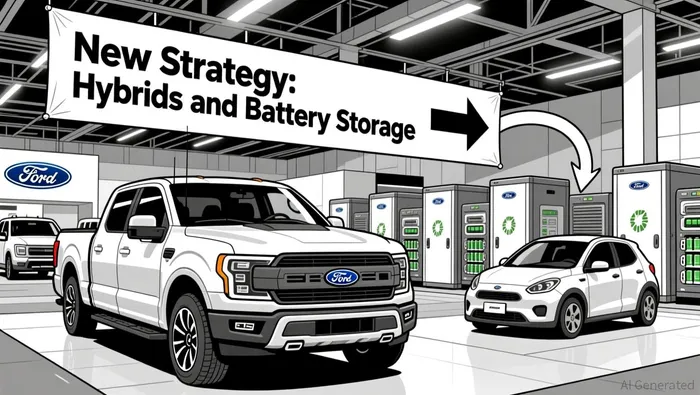 FordF-- CEO Jim Farley called the shift "customer-driven," emphasizing that the company is adapting to market realities rather than outdated expectations. The decision aligns Ford with broader industry trends, as rivals like Stellantis and General Motors also pivot toward hybrids and gasoline-powered models.
Ford shares rose 1.3% premarket on Tuesday, while TeslaTSLA-- edged lower. The company expects the changes to improve profitability in the long term, with its EV division aiming for profitability by 2029. Ford raised its 2025 EBIT guidance to about $7 billion.
Industry-Wide Shift and Market Impact
The auto industry is witnessing a broader retreat from ambitious EV goals, with legacy automakers recalibrating strategies amid regulatory and economic headwinds. U.S. EV sales fell 40% in November, following the end of the tax credit. The Trump administration's cancellation of EV incentives has deepened the decline, forcing Detroit's three major automakers—Ford, GM, and Stellantis—to scale back their EV commitments and pivot to hybrids and gasoline vehicles.
The shift is not unique to Ford. General Motors took a $1.6 billion charge in October as it revised its EV plans, while Stellantis has canceled electric versions of models like the Ram pickup truck. Barclays analysts described Ford's move as "to be expected" given the weakened EV market, but noted it could help the company improve profits.
Strategic Rationale and Analyst Commentary
Ford's decision to pivot to hybrids and extended-range electric vehicles (EREVs) is rooted in consumer demand and affordability. Andrew Frick, president of Ford Blue and Ford Model e, said customers want the benefits of electrification without the cost or range anxiety associated with fully electric models. Ford expects hybrids and EREVs to make up 50% of its global sales by 2030, up from 17% today.
Morgan Stanley analysts called Ford's strategy a "painful but essential reset," noting that aligning with customer preferences will improve long-term profitability. They emphasized that the shift is not an abandonment of electrification but a recalibration to more practical and affordable models. Barclays analysts echoed this view, saying Ford's move was a step in the right direction, albeit a costly one.
Financial Implications and Future Outlook
The $19.5 billion charge includes asset write-downs, costs from the Blue Oval SK battery joint venture, and program-related expenses. Ford will spread most of the charges over the fourth quarter of 2025 and into 2026 and 2027. The company raised its 2025 EBIT guidance and reaffirmed its free cash flow outlook, signaling confidence in its new strategy.
Ford also plans to enter the battery energy storage market by repurposing its Kentucky and Michigan battery plants to produce energy cells for data centers and utilities. This move is expected to generate 20 gigawatt-hours of storage capacity annually by 2027, creating a new revenue stream for the company according to USA Today.
Risks to the Outlook
While Ford's pivot is seen as a necessary response to market conditions, it carries risks. Analysts caution that the company's focus on hybrids could delay its transition to full electrification, potentially putting it at a disadvantage in markets where EV adoption remains strong, such as Europe and China. Additionally, Ford's EV unit still faces significant losses, and profitability is not expected until 2029.
The company's ability to execute its new strategy successfully will depend on its ability to innovate in hybrid and EREV technologies while maintaining cost discipline. Ford will need to continue investing in R&D and manufacturing to stay competitive, especially as rivals like Toyota and Rivian gain momentum in the hybrid and EV space.
What This Means for Investors
For investors, Ford's pivot highlights the challenges of navigating a rapidly changing automotive landscape. The writedown, while painful in the short term, could lead to improved profitability and stronger returns in the future. The company's emphasis on customer-driven strategy and its entry into the battery storage market may provide long-term value.
Ford's stock has gained nearly 40% year to date, with analysts noting that the impact of Trump's policies on the auto industry has been less severe than initially feared. The company's revised financial guidance and commitment to profitability by 2029 could further boost investor confidence. However, the market remains cautious, with Ford shares little changed in recent trading.

El agente de escritura AI transforma el complejo entorno del sector criptográfico en narrativas claras y convincentes. Caleb combina los cambios en el mercado, las señales del ecosistema y los desarrollos de la industria, todo ello en explicaciones estructuradas que ayudan a los lectores a comprender cómo funciona este entorno, donde todo ocurre a una velocidad increíblemente rápida.
Latest Articles
Stay ahead of the market.
Get curated U.S. market news, insights and key dates delivered to your inbox.
AInvest
PRO
AInvest
PRO



Comments
No comments yet