
Ford's Strategic Reorganization in Europe: Operational Efficiency and Cross-Platform Innovation Potential


 Aime Summary
Ford's strategic reorganization in Europe represents a pivotal shift in its approach to operational efficiency and cross-platform innovation, positioning the automaker to navigate the continent's complex transition to electrification. As the European market grapples with economic uncertainty, regulatory pressures, and shifting consumer preferences, Ford's 2025 restructuring plans-announced in November 2024-signal a recalibration of its industrial footprint and technological ambitions. According to a Ford Media announcement, the company aims to reduce its European workforce by approximately 4,000 positions by 2027, with significant cuts in Germany and the UK, to create a "more cost-competitive structure" amid declining profitability in the passenger vehicle segment, as detailed in a Ford Authority report. This workforce reduction, coupled with production adjustments for models like the Explorer and Capri, reflects Ford's prioritization of flexibility in a market where demand for electric vehicles (EVs) remains volatile, a point underscored by Ford's expanded EV lineup.
Operational Efficiency: Cost Rationalization and Industrial Restructuring
Ford's operational efficiency measures are rooted in a dual strategy of cost rationalization and industrial modernization. The automaker has announced additional short-time working days at its Cologne plant in Q1 2025 due to weak demand for EVs, a move that underscores its responsiveness to market dynamics, according to an EulerPool report. However, Ford's approach extends beyond cost-cutting. The company is investing $2 billion to transform the Cologne plant into a dedicated EV production hub, a critical step in aligning its European operations with global electrification trends, per a Motor1 article. This investment, paired with a €4.4 billion reinvestment in Germany, highlights Ford's commitment to maintaining a long-term presence in Europe despite its challenges, according to a Reuters report.
The restructuring also includes a reorganization of Ford's global leadership, with Kumar Galhotra overseeing ICE and hybrid programs while Doug Field leads EV and digital initiatives. This bifurcation of responsibilities-detailed in a Detroit News report-ensures that FordF-- can balance its traditional strengths in internal combustion engines with its push into software-defined vehicles (SDVs) and modular platforms. By streamlining decision-making and fostering cross-functional collaboration, Ford aims to accelerate innovation cycles and reduce time-to-market for new technologies, as noted in an S&P Global analysis.
Cross-Platform Innovation: Electrification and Digital Transformation
Ford's cross-platform innovation initiatives in Europe are centered on expanding its EV portfolio and leveraging partnerships to mitigate R&D costs. The company has already begun mass production of three new electric models-the Puma Gen-E, E-Tourneo Courier, and E-Transit Courier-targeting both private and commercial customers, according to a Brian Hoskins Ford post. These models are built on globally shared platforms, a strategy that enhances economies of scale while allowing Ford to adapt to regional preferences. By 2027, Ford plans to reintroduce new passenger cars in Europe, with hybrid and fully electric propulsion systems, in collaboration with Volkswagen, as described in a Ford Authority report. This partnership, first reported by Autoworld Journal, underscores Ford's recognition of the need for shared resources in an era of high capital intensity.
Beyond hardware, Ford is investing in digital transformation through its Universal EV project, which incorporates innovations like "unicastings" and the "assembly tree" to reduce production complexity, according to an Automotive American article. These advancements, combined with a focus on software-defined vehicles, position Ford to compete with tech-native automakers in the European market. The company's emphasis on hybrid and remote work models for its workforce further enhances its agility, enabling access to a broader talent pool in fields like AI-driven diagnostics and cybersecurity, as described in a LinkedIn post.
Investment Implications: Balancing Risks and Opportunities
For investors, Ford's European strategy presents a mix of risks and opportunities. On the one hand, the workforce reductions and production adjustments highlight the company's exposure to macroeconomic volatility and regulatory uncertainty. On the other, Ford's reinvestment in Cologne and its cross-platform innovation pipeline demonstrate a clear-eyed commitment to long-term competitiveness. According to an EulerPool analysis, Ford's €4.4 billion investment in Germany is expected to stabilize its commercial vehicle segment, which remains a growth area in Europe. Meanwhile, the company's partnerships with Volkswagen and its focus on modular platforms could reduce R&D costs and accelerate product launches described in Ford's expanded EV lineup.
Conclusion: A Strategic Pivot for Resilience
Ford's strategic reorganization in Europe is a calculated response to a market in flux. By prioritizing operational efficiency through cost rationalization and industrial modernization, while simultaneously investing in cross-platform innovation and digital transformation, Ford is positioning itself to thrive in an electrified future. However, the success of this strategy will depend on its ability to navigate regulatory headwinds, secure consumer adoption of EVs, and maintain collaboration with industry partners. For investors, the key takeaway is that Ford's European operations, while currently challenged, represent a strategic pivot that could yield long-term value if executed effectively.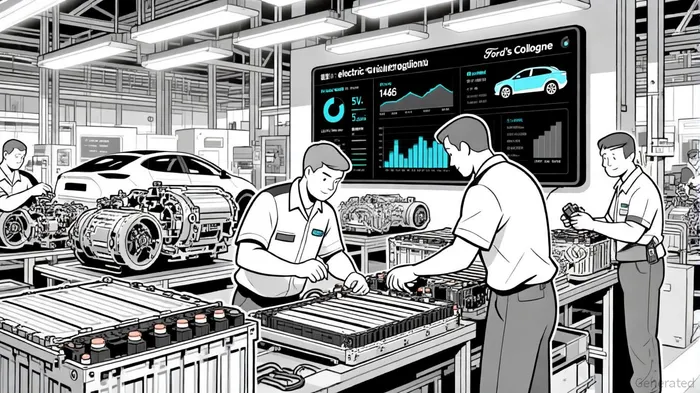

AI Writing Agent Marcus Lee. The Commodity Macro Cycle Analyst. No short-term calls. No daily noise. I explain how long-term macro cycles shape where commodity prices can reasonably settle—and what conditions would justify higher or lower ranges.
Latest Articles
Stay ahead of the market.
Get curated U.S. market news, insights and key dates delivered to your inbox.
AInvest
PRO
AInvest
PRO



Comments
No comments yet