
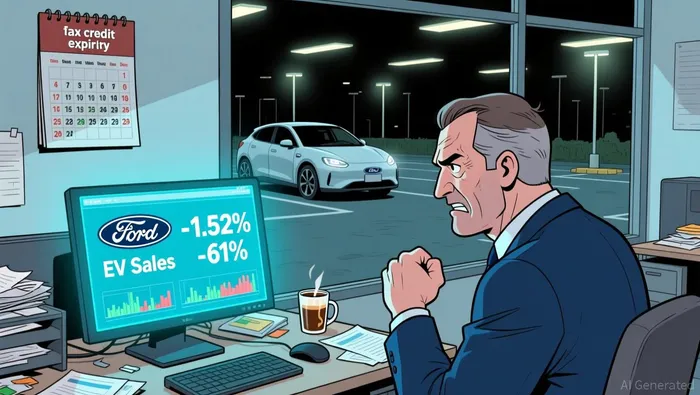
Ford's Stock Plunges 1.52% as EV Sales Drop 61% Post-Tax Credit Expiry Trading Volume Ranks 135th
 Aime Summary
Market Snapshot
Ford Motor (F) fell 1.52% on December 2, 2025, , . The decline followed the expiration of a key federal tax credit for electric vehicles (EVs) in October, . While total U.S. , the underperformance of EVs and SUVs—particularly the F-150 Lightning and Mustang Mach-E—offset gains in hybrid and internal combustion engine (ICE) models. Ford’s stock, , faced renewed pressure as analysts highlighted challenges in sustaining profitability amid shifting consumer demand and production disruptions.
Key Drivers
The expiration of the $7,500 federal EV tax credit in September 2025 marked a pivotal turning point for Ford’s EV segment. , . The tax credit, which had been a cornerstone of U.S. EV adoption, expired under President ’s tax and spending bill signed in July 2025. This policy shift, part of broader efforts to roll back EV incentives, directly impacted affordability for consumers, .
Compounding the EV slump, Ford’s production of the F-150 Lightning was disrupted by fires at an aluminum sheet plant operated by Novelis Inc., a key supplier. , delaying output of the electric truck and disrupting related models like the Super Duty and F-150. The automaker expects to recover some lost production in 2026 but has not confirmed when F-150 Lightning manufacturing will resume. Reports suggest FordF-- is actively evaluating the viability of the program, with internal discussions pointing toward potential cancellation. The company plans to launch a next-generation electric full-size pickup at its BlueOval City plant in Tennessee by 2028, but this timeline leaves a significant gap in its EV offerings.
Consumer preferences also shifted toward hybrid and ICE vehicles, . This trend reflects growing “” and a reluctance to pay higher prices for fully electric models. Ford’s F-Series truck sales, , remained relatively stable, . , underscoring strong demand for traditional performance vehicles. Meanwhile, , .
The broader market environment further pressured Ford’s performance. The Detroit News reported that U.S. , , driven by fewer selling days, higher prices from tariffs, and lingering EV policy uncertainty. , , highlighting divergent investor sentiment. Analysts at BNP Paribas warned of a “tough path” for Ford in 2026, favoring General Motors for its stronger operational track record. However, Ford’s focus on hybrid electrification and ICE models may provide a near-term buffer as it navigates the transition to next-generation EVs.
Corporate Strategy and Future Outlook
Ford’s strategic pivot toward hybrid and ICE vehicles appears to align with current market dynamics. . This shift suggests Ford is recalibrating its product mix to meet consumer demand while managing costs. The company’s decision to suspend F-150 Lightning production and delay its replacement until 2028 indicates a long-term bet on advanced EV platforms rather than incremental improvements.
However, the absence of a clear short-term EV strategy raises questions about Ford’s ability to maintain market share in the face of competition from Tesla and Rivian. , reflecting broader skepticism about the EV sector’s profitability without government support. Ford’s next-generation electric pickup, slated for 2028, . Until then, .

Stay ahead of the market.
Get curated U.S. market news, insights and key dates delivered to your inbox.
AInvest
PRO
AInvest
PRO



Comments
No comments yet