
Ford Revolutionizes EV Production with Innovative Universal System and $2 Billion Investment
 Aime Summary
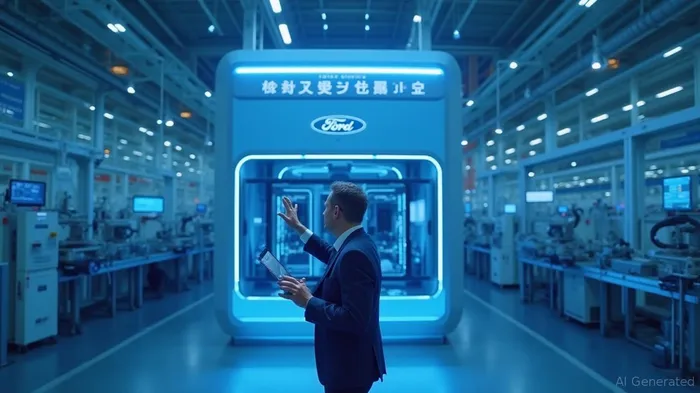
Ford is embarking on a transformative journey in its electric vehicle (EV) production approach, focusing on a shift to more efficient manufacturing processes and competitive pricing. CEO Jim Farley detailed the innovative FordF-- Universal EV Production System, marking a departure from traditional auto manufacturing methods. This approach involves constructing EVs in three distinct sections—front, middle, and rear—and assembling them at the end. Such a configuration contrasts with the conventional linear production line, enabling faster and cost-effective production.
The novel manufacturing strategy is expected to optimize speed and reduce costs by converting assembly lines into an 'assembly tree,' where the main vehicle sections are assembled concurrently before being merged. The use of large single-piece aluminum unicastings in the front and middle sections further eradicates the need for multiple smaller parts, which have traditionally increased production complexity and costs.
Farley highlighted that this system allows operators to work directly inside the vehicle during assembly, reducing the requirement for various ancillary supports and enhancing efficiency. The Ford Universal EV Production System will be rolled out with a $2 billion investment in the Louisville assembly plant, rendering the production process 40 percent faster while decreasing workstations significantly. Additionally, with a decline in the number of required parts by 20 percent and fasteners by 30 percent, Ford aims to streamline its EV manufacturing.
Concurrent with changes in production, Ford is developing new vehicle designs through its Ford Universal EV Platform, featuring a 400-volt Duplo-style architecture. This modular system is adaptable, supporting a range of vehicle types from smaller B-segment cars to larger vans and SUVs. A pivotal element of this platform is the integration of Ford-manufactured lithium-iron phosphate prismatic batteries, which serve as the structural floor and are favored for cost-effectiveness and safety.
The first model emerging from this platform will be a midsize four-door electric pickup, anticipated to hit the market in 2027 with a competitive starting price of $30,000. Ford has ambitious targets for this vehicle, projecting an acceleration comparable to the Mustang EcoBoost and more passenger room than the prevalent ToyotaTM-- RAV4.
Integral to this initiative is Doug Field, Ford's chief EV digital and design officer, who has spearheaded a covert team in developing this project, dubbed CE1 internally. Field's expertise in EV design, drawn from his tenure at AppleAAPL-- and TeslaTSLA--, has been instrumental in overcoming the engineering challenges posed by the new production system.
Field described the innovative structural battery approach, wherein the battery cells form the vehicle's floor, negating the need for a separate chassis frame. This 'cell-to-body' method sets itself apart from existing technologies, demanding intricate engineering solutions to ensure rigidity and accuracy during vehicle assembly and painting.
Despite adopting techniques akin to those utilized by Tesla and Chinese EV producers, Ford's distinct ability to assemble vehicles in entirely separate modules is unprecedented. This development, coupled with the rapid formation of a dedicated team, underscores Ford's proactive approach to innovation in the face of global automotive competition.
Ford's strategy aims not only to innovate but also to compete against burgeoning automakers like BYD in China. Farley asserts that through this advanced propulsion system, innovation can counterbalance competitors’ advantages in scale and vertical integration.
Further, Ford announced an investment of $5 billion in US operations, emphasizing the company’s commitment to domestic manufacturing amidst shifting geopolitical and economic landscapes. This includes $2 billion allocated to the Louisville plant and an additional $3 billion towards a new battery production facility in Michigan, collectively anticipated to secure and create a total of 4,000 American jobs.
Ford's announcement promises enhanced affordability in its EV lineup, including a comparison to more expensive models like the Ford F-150 Lightning. The company's push in the EV segment is underscored by significant losses, as EV revenue surged yet continued to incur costs. The restructuring of production lines into a tree layout reflects Ford’s pursuit of efficiency and innovation.
With an eye toward overcoming industry pitfalls of unsuccessful affordable vehicle launches, Ford emphasizes the need for a sustainable business model, ensuring profitability and stability for its workforce and local communities.
Ford’s bold, innovative leap, anchored in American production, seeks to redefine the automotive industry, challenging international competitors and aiming to reclaim the universal appeal characterized by its historic Model T success.

Manténgase al tanto de las últimas noticias de Wall Street en tiempo real.
Latest Articles
Stay ahead of the market.
Get curated U.S. market news, insights and key dates delivered to your inbox.
AInvest
PRO
AInvest
PRO



Comments
No comments yet