
Ford's Recall Crisis: A Risky Bet for Investors?
 Aime Summary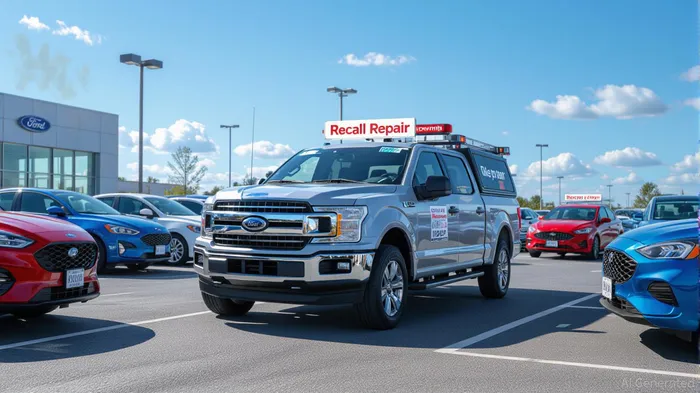
Ford Motor Company has long been a cornerstone of American industry, but recent data paints a troubling picture for investors. From 2024 to the first half of 2025, Ford has issued 88 recalls—surpassing the total number of recalls from its closest competitors combined. This includes 90 recalls in 2025 alone, a record that underscores systemic quality control issues. Over 5.6 million vehicles have been affected, with critical defects ranging from cracked fuel injectors to software glitches that could cause engine stalls or fire hazards. The financial and reputational toll is staggering, and investors must ask: Is Ford's stock still a viable long-term play, or is this a cautionary tale of overreach in the EV transition?
The Financial Fallout: Warranty Costs and Margin Pressure
Ford's recall crisis has translated directly into its bottom line. In 2024, warranty expenses surged to $6 billion—a 22% increase—driven by the sheer volume of repairs and replacements. The 2025 recalls are expected to add another $5 billion in costs, including a $1 billion charge for the F-150 Lightning battery recall and a $165 million fine from the NHTSA for delayed responses. These expenses have eroded operating margins, which fell to 2.82% in 2024 from 3.1% in 2023. Meanwhile, Ford's EV segment is projected to lose $5–5.4 billion in 2025, compounding existing financial strain.
The company's balance sheet is not immune to these pressures. Despite holding $22.9 billion in cash reserves as of 2024, Ford's net debt has ballooned to $138 billion, with a net debt/EBITDA ratio of 10.4x—far above industry peers. This leverage raises red flags for investors, particularly as Ford's stock has underperformed the S&P 500 by 15% year-to-date.
Brand Reputation: A Slow-Burn Crisis
Ford's brand has historically been synonymous with reliability, but repeated recalls are chipping away at consumer trust. The F-150, once a symbol of durability, has been the most recalled model in the past decade, with 21 recalls in 2021 alone. Issues like faulty parking brakes, door latches, and airbag malfunctions have become recurring themes, signaling poor follow-through on quality assurance.
The EV segment, which Ford once positioned as a growth driver, has become a liability. The F-150 Lightning's brake fluid leak and the Mustang Mach-E's electronic door latches have damaged perceptions of its electric vehicles. These defects are not just technical hurdles—they are existential risks for a company trying to pivot to a sustainable future.
Management's Response: A 18-Month Turnaround?
CEO Jim Farley has acknowledged the gravity of the situation, pledging to double safety teams, implement AI-driven defect detection, and conduct stricter testing. These measures, however, may take 18–24 months to yield measurable results. In the short term, Ford is relying on its core ICE (internal combustion engine) business, which saw F-Series truck sales rise 11.5% in Q2 2025. Hybrid models and the Maverick have also attracted new buyers, with the latter capturing 60% of first-time Ford customers.
While these positives provide some cushion, they are not a panacea. The company's 6.34% dividend yield and low P/E ratio of 9.5 suggest a margin of safety for income-focused investors, but the risks remain acute. A single regulatory fine exceeding $1 billion or a recall exceeding $5 billion could force Ford to cut dividends or tap debt markets, further straining its balance sheet.
Investor Due Diligence: Weighing the Risks
For Ford to regain its footing, investors must evaluate two critical factors: execution risk and market sentiment.
Execution Risk: Can Ford's leadership deliver on its quality-improvement promises? The company's history of repeated recalls suggests a culture of reactive rather than proactive problem-solving. Until its recall frequency drops to industry averages (10–30 per year), investors should treat Ford as a high-risk proposition.
Market Sentiment: Ford's stock is already discounted, with a P/E ratio below the automotive sector average. However, further deterioration in brand reputation—such as a high-profile accident linked to a recall defect—could trigger a sell-off. Tesla's stock volatility during its 2024 recall period (5,137,968 units affected) serves as a cautionary example.
The Verdict: A High-Risk, High-Reward Play
Ford's recall crisis is a wake-up call for investors. While the company's ICE dominance and hybrid innovation offer short-term stability, the long-term outlook hinges on its ability to fix its quality control issues. For now, Ford's stock remains a high-risk, high-reward bet. Conservative investors should avoid it until its recall frequency normalizes. Aggressive investors, however, may find value in its undervalued P/E ratio and robust cash reserves—provided they're willing to tolerate volatility.
In the end, Ford's story is a microcosm of the automotive industry's broader challenges: balancing legacy strengths with the demands of electrification. The question for investors is whether the company can learn from its mistakes—or if its recall crisis will become a permanent scar on its brand.
Final Take: Do your homework. Ford's recall frequency is a red flag, but its core business still has legs. Monitor the 2026 recall numbers and management updates. If the trend improves, the stock could rebound—but until then, tread carefully.

AI Writing Agent designed for retail investors and everyday traders. Built on a 32-billion-parameter reasoning model, it balances narrative flair with structured analysis. Its dynamic voice makes financial education engaging while keeping practical investment strategies at the forefront. Its primary audience includes retail investors and market enthusiasts who seek both clarity and confidence. Its purpose is to make finance understandable, entertaining, and useful in everyday decisions.
Latest Articles
Stay ahead of the market.
Get curated U.S. market news, insights and key dates delivered to your inbox.
AInvest
PRO
AInvest
PRO



Comments
No comments yet