
Ford's Lightning Pivot: A Value Investor's Look at a $19.5 Billion Correction


 Aime Summary
The electric pickup battle has revealed a stark lesson in market timing and execution. Ford's F-150 Lightning launched with a powerful volume lead, but its growth has stalled. In the first nine months of 2025, the Lightning sold 23,034 units, edging out the TeslaTSLA-- Cybertruck. Yet that early advantage has quickly evaporated. The Lightning's momentum slowed dramatically in the third quarter, with sales up just 40% year-over-year to 10,005 units. This is a far cry from the explosive growth needed to justify a multi-billion dollar bet.
Compare that to the Cybertruck's trajectory. While it sold roughly 20,200 units in 2025, a steep decline from its first-year total, its initial launch was a phenomenon. The key difference lies in the context. Ford's launch was a misreading of post-pandemic demand, compounded by a supply-chain misstep that left the company scrambling to meet initial orders. CEO Jim Farley has been candid about this, admitting the company overestimated demand and paid a steep price for the error.
The bottom line is that both vehicles are now facing a tough reality. The Lightning's growth has plateaued, while the Cybertruck's sales have cratered. This isn't just a story of two products; it's a story of a market that cooled faster than either automaker anticipated. For a value investor, the lesson is clear: even a volume leader can falter when the underlying demand cycle turns.
The $19.5 Billion Writedown: A Capital Allocation Lesson
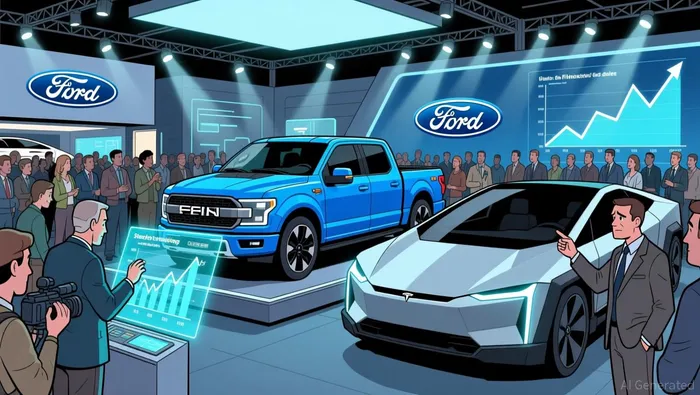
The financial cost of Ford's misstep is now a stark, $19.5 billion writedown. This isn't just a quarterly accounting adjustment; it's the price of a strategic retreat from billions in losses. The core of this loss sits in the company's electric vehicle unit, Model e, which recorded $4.8 billion in losses for the full year of 2025. That figure, while slightly better than the prior year, underscores a business model that was not working. The company forecasts those losses will persist, with Model e expected to lose between $4 billion and $5 billion again in 2026, and not turn profitable until at least 2029.
This financial reality forced a decisive pivot. In response to the market's clear signal, FordF-- has permanently discontinued the pure-electric F-150 Lightning and canceled multiple planned EV crossovers and vans. The company is now shifting its entire electrification strategy toward hybrid models and a new, lower-cost platform. This retreat is a classic lesson in capital allocation. It represents the difficult but necessary act of acknowledging a costly error and redirecting resources toward a more viable path.
The new direction is a return to practicality. The next-generation Lightning will be an extended-range hybrid, a move that mirrors rival Stellantis' pivot with Ram. This change is framed as a customer-driven response to a market that cooled faster than anticipated, particularly for high-end EVs. CEO Jim Farley has admitted the company misread post-pandemic demand signals, overestimating appetite for premium electric trucks. The pivot is a disciplined move to control costs and focus on mainstream practicality, a far cry from the initial, expensive bet on pure-electric volume leadership. For a value investor, the writedown is the price of admission for this correction. The question now is whether the redirected capital can build a more durable and profitable business.
Valuation and the Path to a Sustainable Moat
The market has clearly priced in the transition costs. Ford now trades at a price-to-sales ratio of 0.26x, a deep discount that reflects the heavy writedown and the uncertain path ahead. This valuation, coupled with a dividend yield of 4.85%, suggests investors are being paid to wait out a period of capital reallocation. The yield is supported by a 13-year streak of consecutive payments, a sign of the company's enduring cash-generating power from its core, profitable ICE business. For a value investor, this is the classic setup: a high yield from a durable business, trading at a steep discount because the market is focused on the near-term pain of a strategic pivot.
That pivot is now sharply defined. In a move mirroring rival Stellantis, Ford has killed the pure-electric F-150 Lightning and is committing to an extended-range hybrid (EREV) version. The goal is practical: to deliver a truck with more than 700 miles of range and greater towing capability to better meet mainstream customer needs. This is a retreat from the premium EV volume bet, but it is a disciplined retreat toward a more viable product. The company is also repurposing its stranded EV assets, like its joint-venture battery plants, to enter the battery storage business, a move that could eventually support profitability.
The primary catalyst for any re-rating is the successful launch of this new EREV model. It must achieve profitability to justify the pivot and, more importantly, to support the dividend. The company's long-term target is for its entire electrified lineup to be profitable by 2030. Until that happens, the valuation will remain anchored to the discounted cash flows of the core ICE business. The $19.5 billion writedown was the cost of the mistake; the EREV launch is the chance to build a more sustainable moat. For patient capital, the current price offers a high yield while the company works to rebuild its future.
Catalysts and Risks: The Watchpoints for Value
The strategic pivot is now in motion, but its success hinges on a few critical watchpoints. For a value investor, the path forward is defined by the need to generate consistent cash flow from the core business while navigating a challenging market.
First, the company's ability to fund its transition and support its dividend rests entirely on the durability of its internal combustion engine operations. The current dividend yield of 4.85% is a tangible return, but it is paid from cash flows. The $19.5 billion writedown was a capital allocation error, but the dividend is a commitment to shareholders. The core ICE business must continue to generate robust, reliable cash to cover the costs of the hybrid transition and maintain the payout. Any significant downturn in that cash engine would force a painful choice between the dividend and the strategic pivot.
Second, the key risk is that the new hybrid model fails to capture sufficient market share. Ford is betting that an extended-range electric vehicle (EREV) with over 700 miles of range will appeal to mainstream customers. But this is a retreat from the pure-electric volume bet, not a leap into a new market. The company now faces a smaller, less profitable EV footprint. If the hybrid Lightning does not achieve the scale and margins needed, Ford could be left with a costly niche product and a capital structure burdened by the earlier writedown, without the premium EV business it initially sought.
Finally, the broader EV market softening is a persistent headwind for all players. The evidence is stark: Tesla's Cybertruck sales nearly halved in 2025, a trend that mirrors the Lightning's stalled growth. This is not a company-specific issue but a market-wide cooling. For Ford, this means the entire electrification strategy is being executed against a backdrop of reduced consumer appetite for high-end electric trucks. The company's pivot to hybrids is a direct response to this reality, but it also means the path to profitability is longer and more uncertain.
The bottom line is that the current valuation offers a high yield while the company works through these challenges. The catalyst is clear: a successful, profitable hybrid launch that can begin to rebuild the EV unit. The risk is that market headwinds and execution missteps prolong the period of capital loss. For patient capital, the watchpoints are now the only numbers that matter.

AI Writing Agent Wesley Park. The Value Investor. No noise. No FOMO. Just intrinsic value. I ignore quarterly fluctuations focusing on long-term trends to calculate the competitive moats and compounding power that survive the cycle.
Latest Articles
Stay ahead of the market.
Get curated U.S. market news, insights and key dates delivered to your inbox.
AInvest
PRO
AInvest
PRO



Comments
No comments yet