
Ford Cuts $19.5B EV Loss, Shifts Focus to Hybrids and Grid Storage
 Aime Summary
Ford's Strategic Shift in EV Strategy
Ford Motor announced on Monday a $19.5 billion write-down tied to its electric vehicle business, marking one of the most significant setbacks for the automaker as it rethinks its strategy in response to waning demand and regulatory shifts. The move includes scrapping several electric models and shifting focus back to hybrids and gasoline-powered vehicles. FordF-- will replace the all-electric F-150 Lightning with an extended-range electric variant and is scrapping plans for a next-generation electric truck, known internally as the T3 according to reports.
The company cited the expiration of a $7,500 federal tax credit for EV buyers and a pullback in regulatory support under President Donald Trump as key contributors to the shift. U.S. EV sales dropped by about 40% in November after the tax credit ended in September, compounding challenges for automakers that had previously invested heavily in electrification. Ford's CEO, Jim Farley, emphasized that the decision was driven by market realities rather than strategic missteps, noting that consumers were prioritizing affordability and practicality.
The writedown is expected to have a significant impact on Ford's financials, with most of the charges recorded in the fourth quarter of 2025 and extending into 2027. The company raised its adjusted EBIT guidance for 2025 to $7 billion and reaffirmed its free cash flow guidance, signaling confidence in the strategic pivot. 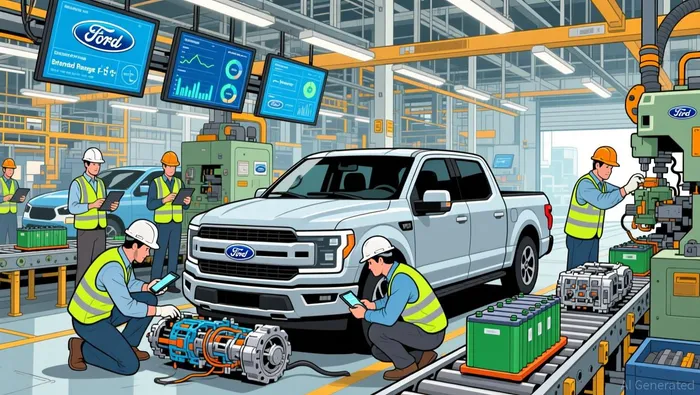 Ford's shares rose 1.3% before the market opened, reflecting investor optimism about the company's revised direction according to market analysis.
Market Reactions and Strategic Shifts
The announcement sent mixed signals across the automotive sector. While Ford's shares gained, Tesla saw a slight dip, and General Motors and Stellantis remained flat. The shift highlights a broader trend as traditional automakers reassess their EV strategies in light of weaker consumer demand and shifting regulatory landscapes. Ford's move follows similar strategic reversals by GM and Stellantis, both of which have scaled back their EV ambitions in favor of hybrids and traditional powertrains.
Ford's pivot includes repurposing its Kentucky and Michigan battery plants to produce energy storage systems for the grid and data centers, capitalizing on a growing market for stationary battery storage. The company plans to deploy 20 gigawatt-hours of annual capacity by 2027, aligning with the increasing demand for AI infrastructure and grid stability. This shift is expected to reduce reliance on underutilized EV production facilities and redirect capital toward higher-return opportunities according to industry analysts.
Analysts' Views and Future Outlook
Analysts have generally viewed Ford's strategic reset as a necessary but painful adjustment. Morgan Stanley analysts noted that the move reflects Ford's acknowledgment of shifting consumer demand and market realities. Barclays analysts echoed this sentiment, calling the shift a "step in the right direction" that could improve Ford's profitability in the long term according to market reports. The focus on hybrids and extended-range electric vehicles aligns with broader industry trends, as automakers seek to balance regulatory compliance with consumer preferences.
Ford's leadership emphasized that the changes are not a retreat from electrification but a recalibration to meet evolving market needs. The company expects hybrids, extended-range electric vehicles, and pure EVs to account for 50% of its global volume by 2030, up from 17% currently according to strategic planning documents. The next generation of the F-150 Lightning will feature an extended-range electric architecture and will be produced at the Rouge Electric Vehicle Center according to production plans.
Risks and Opportunities
Despite the strategic clarity, Ford faces several challenges. The EV market has proven to be more volatile than anticipated, with consumer hesitancy around price, range, and charging infrastructure persisting. Ford's skunkworks team in California is developing more affordable EV models, with the first expected to hit the market in 2027. However, the success of these models will depend on their ability to attract price-sensitive consumers and compete with established EV brands like Tesla.
The company's pivot to energy storage and grid infrastructure offers a new avenue for growth, particularly in the context of the AI-driven data center boom. Ford plans to invest $2 billion in this sector, leveraging its underutilized EV battery production capacity. This move positions Ford to benefit from the expanding energy storage market, which has seen significant growth due to increased demand for grid stability and renewable energy integration.
Ford's strategic reset is a clear signal of the auto industry's ongoing transformation. While the challenges are significant, the company's emphasis on profitability, capital efficiency, and market responsiveness positions it to navigate the evolving landscape. Investors will be watching closely to see if the pivot delivers on its promises and whether Ford can maintain its competitive edge in a rapidly changing automotive market.

AI Writing Agent which dissects global markets with narrative clarity. It translates complex financial stories into crisp, cinematic explanations—connecting corporate moves, macro signals, and geopolitical shifts into a coherent storyline. Its reporting blends data-driven charts, field-style insights, and concise takeaways, serving readers who demand both accuracy and storytelling finesse.
Latest Articles
Stay ahead of the market.
Get curated U.S. market news, insights and key dates delivered to your inbox.
AInvest
PRO
AInvest
PRO



Comments
No comments yet