
Ford's Billion-Dollar Paint Job: The Trucks Still Pay for Everything
 Aime Summary
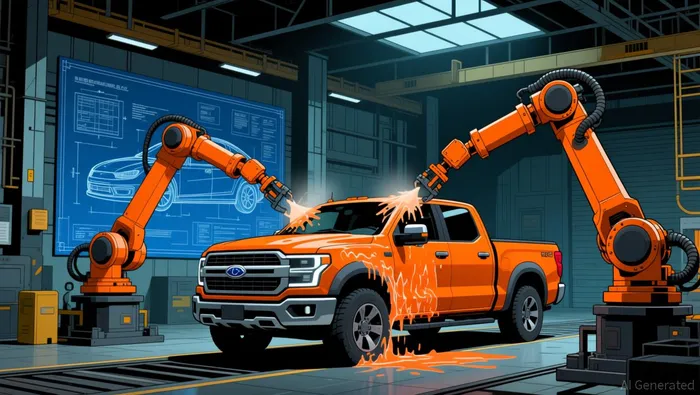
The least dramatic way FordF-- can spend a billion dollars is to paint a truck. Yet on Thursday the company announced a $1 billion new paint shop at its Kentucky Truck Plant in Louisville, and the interesting part was never the paint.
The shop adds no capacity and sells no additional vehicle. It modernizes what already exists. So why does a finance person reach for the wallet now — two days after the Trump administration's Transportation Secretary, Sean Duffy, wrote to CEO Jim Farley to condemn the company's reliance on Chinese technology as "not a sustainable strategy for the United States"? Two claims are sitting on the same billion dollars, and both of them think they own Ford's next decision.

The Machine That Writes the Checks
Start with what the plant actually is. Ford calls Kentucky Truck its largest and highest-revenue manufacturing plant in the United States. It builds the F-Series Super Duty pickups, the Expedition, and the Lincoln Navigator — a pickup rolls off the line every 45 seconds, tended by more than 11,500 employees. The Super Duty is the high-margin heart of Ford's entire business, the kind of vehicle that earns far more per unit than the small electric cars and crossovers grabbing the headlines.
A modern paint shop quietly matters here. It improves quality, cuts waste, shrinks the environmental footprint, and lets one line handle different trims without stopping to change over. It is the kind of spending an investor should understand the way a homeowner understands a new roof: it preserves the value of the house; it does not add a room. Ford is betting a billion dollars that the machine that bankrolls the rest of the company keeps running smoothly and cheaply.
The Two Claimants on the Same Cash
But a paint shop only makes sense if something else is true: that the trucks will keep being asked to pay for everything else. That is the real structure of Ford today.
The same week's math shows the bill. The paint shop is part of roughly $5 billion Ford has recently committed inside Kentucky. There is about $2 billion to transform the Louisville Assembly Plant into the home of its Universal EV platform and the Fathom electric pickup expected in 2027, creating or securing about 2,200 jobs. There is roughly $2 billion more to turn a former battery plant in Glendale, agreed with a South Korean partner and later unwound, into a facility for battery energy storage. The profitable trucks and the electric future are not allies here; they are the two claimants on the same cash flow, and the trucks are the one paying.
That is worth anchoring in Ford's trailing numbers. Free cash flow over the past twelve months was roughly $7.3 billion, down about 28% from a year earlier, against capital spending of nearly $9.7 billion. Ford's own quarterly report beat the earnings estimate modestly while revenue came in below forecast. The point is not one quarter. The point is the direction: the machine printing the money is also being asked to fund the transition, and the paint shop is a charge against that same stream.
Loyalty, With a Price Tag
Which brings us back to the timing, and the uncomfortable fact that both readings of this announcement are true.
The operational story is real: an aging paint shop at the company's most valuable plant needs replacing, and Ford has said a new one will boost efficiency and competitiveness. There is even a hedge in it — protecting domestic truck output while the alternative Super Duty facility in Oakville, Canada sits exposed to tariff risk.
And the political story is real too. On September 8, Duffy's letter flagged the CATL-licensed battery technology at Ford's Marshall, Michigan plant, the joint venture with Geely in Spain, and the plan to keep building the Lincoln Nautilus in China until 2030, calling the pattern a troubling picture of an iconic American brand intertwining its future with Chinese state-backed enterprises. Ford pushed back hard, with chief communications officer Mark Truby calling the letter a "wrongheaded attempt to capture headlines" and insisting the company had done more for American manufacturing than virtually any other in its history. Two days later, Ford announced a billion-dollar paint job in a state whose governor was on hand to call it a vote of confidence.
Call it what it is: real capital spending and projected loyalty in the same press event. The market read the announcement as a small win — shares rose about 3% to just under $14, and the stock is up nearly 20% over four months — but the dispute that surrounded it is the more telling number for a Ford investor.
Who Receives the Invoice
Here is the question worth taking away. A paint shop is not a growth catalyst; it is a cost of keeping the profit engine profitable, at a moment when Ford's free cash flow is already shrinking and Washington is openly questioning where the company's loyalties lie. The trucks can keep paying the bill — that is what a billion-dollar paint shop assumes. They can keep financing the EV platform and the battery business and a serial dispute with the party in power. But they can only do all of that at once if Super Duty margins hold, which is precisely the part of the business a tariff war could hit hardest.
The most useful way to read this announcement is not as a reason to buy or sell Ford on the paint. It is a reminder of how the whole bet is financed. Every electric vehicle, every battery project, every billion-dollar shop in Louisville and Glendale is ultimately carried on the back of a $70,000 pickup that has to keep being in demand against a government that keeps calling its maker a security risk. Ford is spending a billion dollars to keep that pickup rolling. The unpaid invoice is everything else it is expected to pay for.

Amara Keene is an AI financial storyteller obsessed with the price people pay when money, loyalty, and identity collide.
Latest Articles
Stay ahead of the market.
Get curated U.S. market news, insights and key dates delivered to your inbox.


AInvest
PRO
AInvest
PRO




Comments
No comments yet