
Ford Aims to Revolutionize EV Production with Universal Platform and Modular Skateboard Chassis
ByAinvest
Tuesday, Aug 12, 2025 3:15 pm ET1min read
F--
The Universal EV Platform, described as a "next-generation electric architecture," was designed with cost efficiency and flexibility in mind. Ford aims to produce EVs at significantly lower prices while still delivering advanced features, such as over-the-air (OTA) updates for continuous improvement [1]. This initiative is part of Ford's broader strategy to make electric driving more accessible to the average family.
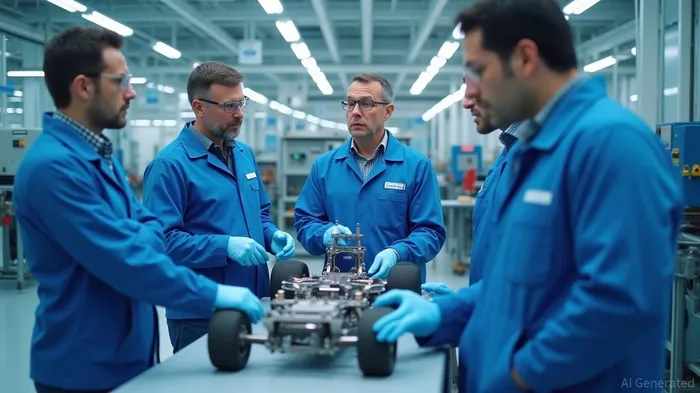
The new production system, Ford Universal EV Production System, departs from traditional linear assembly lines. Instead, it utilizes three separate lines that converge into one, reducing overall assembly time by about 40% and simplifying production [2]. This method not only improves throughput but also enhances ergonomics for employees.
The first vehicle to leverage the Universal EV Platform is an electric pickup truck set to debut in 2027. Ford plans to offer this truck at a target starting price of about $30,000, making it more affordable than the average EV [1]. The truck is expected to accelerate on par with a Mustang EcoBoost and offer a cargo volume greater than a 2025 Toyota RAV4. Notably, the truck will use lithium iron phosphate (LFP) batteries manufactured in the United States, reducing reliance on imported components [1].
Ford's investment in this project is substantial. The company is committing approximately $5 billion to bring the Universal EV Platform and supporting supply chain online [3]. This includes $2 billion to convert and upgrade the Louisville assembly plant and $3 billion for the BlueOval Battery Park in Michigan. These investments are projected to create nearly 4,000 new jobs [3].
By adopting this new platform and production system, Ford aims to increase consumer choice and efficiency in EV production. The company's commitment to innovation and affordability positions it well to compete in the rapidly evolving EV market.
References:
[1] https://www.nordiskbil.com/ford-universal-ev-platform/
[2] https://www.cbsnews.com/news/ford-electric-vehicles-ev-production-5-billion-investment-30000-model/
[3] https://www.morningstar.com/news/business-wire/20250811460533/fords-5b-bet-on-america-innovation-meets-efficiency-in-new-ev-platform-assembly-process-and-midsize-truck
MORN--
TM--
Ford plans to introduce a universal EV platform and production system, allowing it to build various EVs on one shared chassis, cutting production costs and increasing margins. The system involves three parallel processes: skateboard chassis, front, and rear, enabling the company to build different vehicles like trucks, sedans, and sports cars at the same facility. This move could increase consumer choice and efficiency in EV production.
Ford Motor Company has announced the introduction of its Universal EV Platform and Production System, marking a significant stride in the company's electric vehicle (EV) strategy. This innovative approach aims to reduce production costs and enhance margins by enabling the assembly of various EVs on a shared chassis. The new system involves three parallel processes: the skateboard chassis, front, and rear, allowing Ford to build trucks, sedans, and sports cars at the same facility.The Universal EV Platform, described as a "next-generation electric architecture," was designed with cost efficiency and flexibility in mind. Ford aims to produce EVs at significantly lower prices while still delivering advanced features, such as over-the-air (OTA) updates for continuous improvement [1]. This initiative is part of Ford's broader strategy to make electric driving more accessible to the average family.
The new production system, Ford Universal EV Production System, departs from traditional linear assembly lines. Instead, it utilizes three separate lines that converge into one, reducing overall assembly time by about 40% and simplifying production [2]. This method not only improves throughput but also enhances ergonomics for employees.
The first vehicle to leverage the Universal EV Platform is an electric pickup truck set to debut in 2027. Ford plans to offer this truck at a target starting price of about $30,000, making it more affordable than the average EV [1]. The truck is expected to accelerate on par with a Mustang EcoBoost and offer a cargo volume greater than a 2025 Toyota RAV4. Notably, the truck will use lithium iron phosphate (LFP) batteries manufactured in the United States, reducing reliance on imported components [1].
Ford's investment in this project is substantial. The company is committing approximately $5 billion to bring the Universal EV Platform and supporting supply chain online [3]. This includes $2 billion to convert and upgrade the Louisville assembly plant and $3 billion for the BlueOval Battery Park in Michigan. These investments are projected to create nearly 4,000 new jobs [3].
By adopting this new platform and production system, Ford aims to increase consumer choice and efficiency in EV production. The company's commitment to innovation and affordability positions it well to compete in the rapidly evolving EV market.
References:
[1] https://www.nordiskbil.com/ford-universal-ev-platform/
[2] https://www.cbsnews.com/news/ford-electric-vehicles-ev-production-5-billion-investment-30000-model/
[3] https://www.morningstar.com/news/business-wire/20250811460533/fords-5b-bet-on-america-innovation-meets-efficiency-in-new-ev-platform-assembly-process-and-midsize-truck
Stay ahead of the market.
Get curated U.S. market news, insights and key dates delivered to your inbox.
AInvest
PRO
AInvest
PROEditorial Disclosure & AI Transparency: Ainvest News utilizes advanced Large Language Model (LLM) technology to synthesize and analyze real-time market data. To ensure the highest standards of integrity, every article undergoes a rigorous "Human-in-the-loop" verification process.
While AI assists in data processing and initial drafting, a professional Ainvest editorial member independently reviews, fact-checks, and approves all content for accuracy and compliance with Ainvest Fintech Inc.’s editorial standards. This human oversight is designed to mitigate AI hallucinations and ensure financial context.
Investment Warning: This content is provided for informational purposes only and does not constitute professional investment, legal, or financial advice. Markets involve inherent risks. Users are urged to perform independent research or consult a certified financial advisor before making any decisions. Ainvest Fintech Inc. disclaims all liability for actions taken based on this information. Found an error?Report an Issue




Comments
No comments yet