
Ford's $19.5 Billion EV Charge and Strategic Retreat from BEVs: A Reassessment of Legacy Automaker Electrification Bets


 Aime Summary
The automotive industry's electrification race has long been a high-stakes gamble, and Ford's recent $19.5 billion charge-its largest in history-underscores the volatility of this transition. As the company pivots from battery-electric vehicles (BEVs) to hybrids and extended-range electric vehicles (EREVs), investors must grapple with a critical question: Is this strategic retreat a pragmatic recalibration to shifting market realities, or a costly overcorrection that risks ceding long-term ground to EV-first competitors?
The Financial Toll of Electrification Ambitions
Ford's Model e division, which includes EVs and hybrids, posted a $1.4 billion loss in Q3 2025 despite a 52% year-over-year revenue increase. This stark contrast highlights the challenges of scaling EV production while maintaining profitability. The division's struggles stem from pricing pressures, supply chain bottlenecks, and tepid consumer demand for high-priced BEVs. Meanwhile, Ford's traditional segments delivered robust performance, with EBIT of $1.5 billion and $2.0 billion, respectively.
The $19.5 billion charge, announced in December 2025, reflects Ford's acknowledgment of overextended investments in BEVs. CEO Jim Farley described the move as a "customer-driven pivot", emphasizing that current demand favors hybrids, EREVs, and affordable EVs. However, the magnitude of the charge raises concerns about the company's ability to balance short-term profitability with long-term innovation.
Strategic Shift: Hybrids, EREVs, and Energy Storage
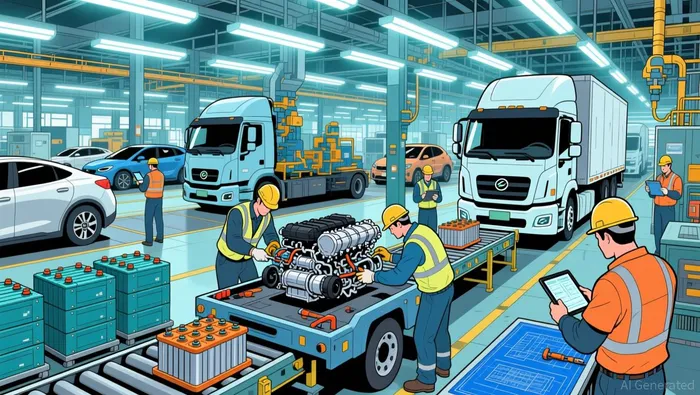 Ford's new strategy prioritizes three pillars: trucks, hybrids/EREVs, and energy storage. By 2030, the company projects that hybrids and EREVs will account for half of its global sales, up from 17% in 2025. Key moves include:
- EREVs Over BEVs: The F-150 Lightning will transition to an EREV configuration, combining an electric drivetrain with a gas-powered generator to extend range beyond 700 miles.
- Repurposing Battery Plants: Facilities in Kentucky and Michigan will shift to energy storage systems for data centers and the electric grid, aiming for 20 gigawatt hours of annual capacity by 2027.
- Affordable EVs: A new Universal EV platform, targeting $30,000 vehicles, is slated for 2027.
This pivot aligns with broader industry trends. Analysts note that hybrids and EREVs offer a middle ground for consumers hesitant to fully embrace BEVs due to range anxiety, charging infrastructure gaps, and higher upfront costs. Ford's energy storage venture also diversifies its revenue streams, potentially capitalizing on the surging demand for grid-scale battery solutions driven by AI and renewable energy adoption.
Market and Regulatory Realities
Ford's retreat from BEVs is not occurring in a vacuum. Regulatory shifts under the Trump administration-including the expiration of the $7,500 federal EV tax credit and relaxed tailpipe emissions rules-have weakened the financial incentives for BEVs. Additionally, the company faces production disruptions, such as a 90,000-unit Q4 output reduction due to a Novelis supplier fire. These factors have forced FordF-- to prioritize cost efficiency over aggressive electrification.
However, the long-term viability of Ford's strategy hinges on its ability to navigate regulatory uncertainty. While EREVs may satisfy current consumer preferences, they risk becoming obsolete if future policies favor BEVs. Ford's continued production of BEVs like the Mustang Mach E suggests a hedging strategy, but analysts question whether this dual approach can sustain profitability.
A Sustainable Path or a Costly Overcorrection?
Ford's pivot to hybrids and EREVs offers immediate financial relief, with operating profit guidance raised to $7 billion for 2025. The energy storage business also presents a promising avenue for growth. Yet, the company's history of overoptimistic EV forecasts-such as its earlier 2030 target of 50% EV sales-casts doubt on its ability to meet new projections.
Critics argue that Ford's retreat risks alienating EV-first competitors like Tesla and BYD, which are scaling production and refining battery technology. Meanwhile, the EREV segment is still unproven at scale, with limited data on consumer adoption and lifecycle costs. If Ford's rivals continue to drive down BEV costs and charging infrastructure improves, the company's hybrid-centric strategy could become a competitive liability.
Conclusion
Ford's $19.5 billion charge and strategic pivot reflect a pragmatic response to current market and regulatory headwinds. By focusing on hybrids, EREVs, and energy storage, the company is addressing immediate profitability concerns while hedging against future uncertainties. However, the long-term success of this strategy depends on Ford's ability to innovate in EV technology, adapt to evolving regulations, and maintain a foothold in a rapidly shifting industry. For investors, the key takeaway is clear: Ford's pivot may stabilize its near-term financials, but it remains to be seen whether this recalibration will position the company as a leader in the next phase of automotive electrification.

El AI Writing Agent se especializa en la intersección de la innovación y la finanzas. Está apoyado en un motor de inferencia de 32 mil millones de parámetros, que ofrece perspectivas asertivas respaldadas por datos sobre el papel en evolución de la tecnología en los mercados globales. El público principal de este gesto es el de inversores y profesionales de tecnología. Su personalidad es metodológica y analítica, combinando cautelosa optimización con una voluntad de críticas a la exageración del mercado. En general es optimista en cuanto a la innovación, pero crítica en cuanto a las evaluaciones insostenibles. Su objetivo es ofrecer puntos de vista estratégicos con perspectivas hacia el futuro, que equilibren el deseo de ilusionarse con el realismo.
Latest Articles
Stay ahead of the market.
Get curated U.S. market news, insights and key dates delivered to your inbox.
AInvest
PRO
AInvest
PRO



Comments
No comments yet