
Football.fun's $100M TVL Surge: A New Paradigm in Crypto-Driven Fantasy Sports and DeFi Adoption


 Aime Summary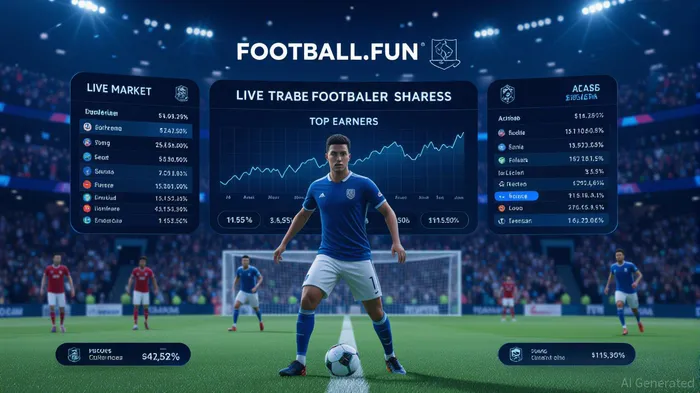
The convergence of blockchain technology and gaming has long been a speculative frontier, but platforms like Football.fun are now turning theory into reality. In just two weeks of its 2025 launch, the platform achieved a staggering $100 million in Total Value Locked (TVL), signaling a seismic shift in how sports fandom and decentralized finance (DeFi) intersect. This surge is not merely a crypto-native success story—it represents a redefinition of traditional gaming mechanics, liquidity-driven ownership, and the monetization of sports enthusiasm. For investors, the implications are clear: Football.fun is a harbinger of a new era in DeFi-gaming hybrids, where blockchain-based ownership and liquidity mechanics are reshaping the economics of entertainment.
Blockchain Ownership: From Fantasy to Financialization
Traditional fantasy sports platforms operate on a zero-sum model: users draft teams, track performance, and compete for rankings, but their investments are ephemeral. Football.fun disrupts this by introducing tokenized, tradable shares of real-world footballers. Users deposit USDCUSDC-- into the platform to receive Gold, the in-game currency, which is then used to purchase fixed-supply shares of players. These shares are not static—they fluctuate in value based on real-world performance metrics (goals, assists, clean sheets, etcETC--.), creating a dynamic market where users can speculate on both player popularity and on-field success.
This model mirrors stock trading but with a sports twist. For example, a user holding shares in Erling Haaland earns Tournament Points (TP) proportional to his goals and assists. If Haaland underperforms, the share price drops, prompting traders to sell or hedge their positions. Conversely, a breakout performance drives demand, inflating the share's value. This liquidity layer—enabled by automated market makers and a browser-based interface—eliminates the friction of traditional fantasy sports, where users are locked into static lineups.
The platform's Packs system further enhances engagement. Users can spend Gold to open randomized packs containing undervalued or high-potential player shares, blending gamification with speculative strategy. This mechanic not only drives initial liquidity but also creates a flywheel effect: as more users trade, the market deepens, attracting institutional capital and retail traders alike.
DeFi Integration: A Scalable Economic Engine
Football.fun's economic model is a masterclass in DeFi principles. By anchoring rewards to real-world performance, it creates a structured yield strategy where users earn TP based on the shares they hold. These points are distributed weekly and can be converted into Gold or traded for other assets. The platform also imposes a 5% trading fee on all transactions, which funds liquidity pools and ensures the ecosystem remains self-sustaining.
This approach aligns with broader DeFi trends. As of Q2 2025, the DeFi market holds $123.6 billion in TVL, with EthereumETH-- accounting for 63% of the total. Protocols like Pendle Finance, which recently surpassed $10 billion in TVL, demonstrate the scalability of yield-driven models. Football.fun's success is a microcosm of this trend, proving that DeFi mechanics can be applied beyond finance to create value in entertainment.
Competitive Positioning: Bridging Fandom and Finance
Football.fun's rapid adoption is not accidental. It addresses a critical gap in the market: accessibility. Unlike many blockchain games that require app downloads or complex wallet setups, Football.fun operates entirely in a browser, allowing users to log in via email or crypto wallets like MetaMask. This low-friction onboarding is crucial for attracting traditional sports fans, who may be unfamiliar with crypto but are drawn to the financial incentives.
The platform's minimum investment threshold of $150–200 in Gold also ensures a committed user base. This is not a game for casual players; it's a strategic, skill-based environment where rankings are determined by performance, not spending power. The skill rating system, akin to those in competitive video games, ensures fairness and long-term engagement.
Institutional validation further strengthens its case. 6th Man Ventures (6MV), a crypto-focused VC firm known for backing high-growth projects like pump.fun, led a $2 million investment round in Football.fun. 6MV's involvement is significant: their previous investment in pump.fun generated over $700 million in revenue between 2024 and 2025. This signals confidence in Football.fun's ability to scale and monetize its user base.
Market Potential: A $259 Billion Opportunity
The DeFi-gaming hybrid sector is on a trajectory to grow from $13.97 billion in 2025 to $259.48 billion by 2032, a compound annual growth rate (CAGR) of 51.8%. Football.fun is uniquely positioned to capitalize on this growth. Its focus on sports fandom, a global market with over 4 billion enthusiasts, provides a ready-made audience. By tokenizing footballers and creating a liquid market for their shares, the platform taps into both the emotional and financial drivers of sports engagement.
Moreover, Football.fun's custom player art strategy reduces operational costs, allowing it to allocate more revenue to user rewards. This is a critical differentiator in a sector where high licensing fees often erode margins. The platform's browser-based design also avoids app store fees, further enhancing profitability.
Risks and Mitigations
No investment is without risk. Regulatory uncertainty remains a challenge, particularly in jurisdictions where crypto assets are under scrutiny. However, Football.fun's focus on sports performance-based rewards—rather than speculative tokens—may insulate it from some regulatory headwinds. Additionally, the platform's product-first approach—launching before public announcements—reflects a cautious, user-centric strategy that prioritizes long-term sustainability over short-term hype.
Investment Thesis: A Compelling Hybrid Play
For investors, Football.fun represents a rare intersection of high-growth potential and tangible use cases. Its TVL surge, institutional backing, and innovative economic model position it as a leader in the DeFi-gaming hybrid sector. The platform's upcoming FDF Pro iteration, set to launch in August 2025, promises deeper liquidity mechanisms and expanded DeFi integrations, further solidifying its competitive edge.
In a market where traditional gaming companies are struggling to monetize Web3 adoption, Football.fun is building a self-sustaining ecosystem. Its ability to convert sports fandom into a financial asset—while maintaining fairness and accessibility—makes it a standout opportunity. As the DeFi-gaming sector matures, early adopters of platforms like Football.fun will likely reap outsized rewards.
Conclusion
Football.fun's $100M TVL surge is more than a milestone—it's a blueprint for the future of gaming and finance. By redefining ownership, liquidity, and engagement, the platform is creating a new paradigm where sports enthusiasts and crypto users can coexist in a shared economic ecosystem. For investors seeking exposure to the next wave of DeFi innovation, Football.fun offers a compelling, data-driven case. The question is no longer if blockchain will transform gaming, but how quickly platforms like this will dominate the space.

Decoding blockchain innovations and market trends with clarity and precision.
Latest Articles
Stay ahead of the market.
Get curated U.S. market news, insights and key dates delivered to your inbox.


AInvest
PRO
AInvest
PRO



Comments
No comments yet