
Food Safety Regulation and Retail Supply Chain Risk: Lessons from the 2025 Shredded Cheese Recall


 Aime Summary
The recent U.S. Food and Drug Administration (FDA) recall of over 1.5 million bags of shredded cheese produced by Great Lakes Cheese Co. underscores a critical vulnerability in the packaged food sector: the intersection of supply chain complexity, regulatory oversight, and investor risk. This incident, which spanned 31 states and Puerto Rico, highlights how food safety crises can rapidly erode consumer trust, disrupt distribution networks, and expose systemic weaknesses in supply chain management. For investors, the recall serves as a stark reminder of the financial and reputational risks inherent in an industry where quality control is paramount.
The Shredded Cheese Recall: A Case Study in Supply Chain Fragility
The FDA's December 2025 recall of Great Lakes Cheese Co. products-sold under private-label brands at retailers like WalmartWMT--, TargetTGT--, and Aldi-was triggered by contamination with metal fragments from supplier raw materials
according to reports. Classified as a Class II recall, the incident posed risks of temporary or reversible injuries, such as dental damage or internal lacerations
according to analysis. While no illnesses were reported, the scale of the recall-spanning long sell-by dates and large package sizes-increased the likelihood of accidental consumption
as data shows.
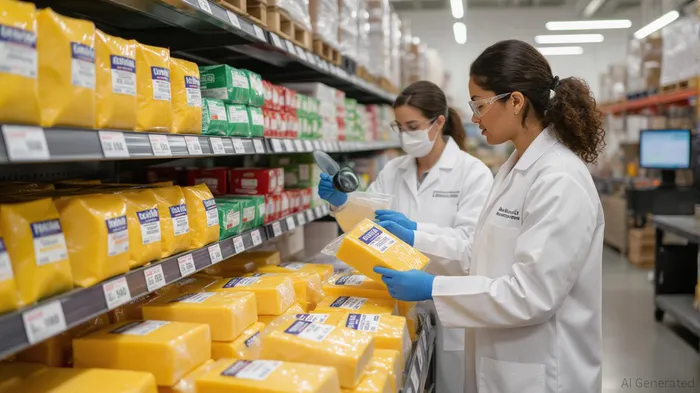 This crisis exposed a key flaw in the supply chain: overreliance on third-party suppliers. Great Lakes Cheese Co., like many manufacturers, sources raw materials from multiple vendors, creating opportunities for contamination to slip through quality checks
as industry reports indicate. The recall also amplified broader industry challenges, including labor shortages in production and logistics, which strain capacity and delay responses to safety issues
according to supply chain experts.
Investment Risks in a Fragmented Food Sector
The shredded cheese incident is emblematic of a troubling trend: frequent food recalls in 2025 have tested consumer patience, leading to "recall fatigue" and a shift away from packaged foods
according to market analysis. For investors, this raises two critical concerns:
1. Brand Reputation and Consumer Trust: A single recall can tarnish a brand's image, particularly for private-label products sold by major retailers. Great Lakes Cheese Co.'s association with high-profile retailers like Walmart and Target magnifies the reputational fallout
according to consumer research.
2. Financial Exposure: Recalls incur direct costs (product retrieval, lawsuits) and indirect costs (lost sales, regulatory fines). Analysts estimate that Great Lakes Cheese Co. faced significant losses due to the scale of the recall and its impact on retailer relationships
as financial reports indicate.
Moreover, the incident highlights the sector's susceptibility to geopolitical and climate-related disruptions. For example, extreme weather events in 2025 disrupted crop yields and cold storage operations, compounding supply chain fragility
according to industry reports. These factors, combined with rising input costs and inflationary pressures, create a volatile environment for food manufacturers.
Regulatory and Technological Responses: A Path Forward?
The FDA's upgraded Class II classification of the cheese recall reflects heightened regulatory scrutiny. Meanwhile, the global food safety testing market-projected to grow at a 9.7% CAGR through 2030-signals an industry-wide push for advanced diagnostics and automation
according to market analysis. Technologies like PCR-based assays and AI-driven supply chain analytics are being adopted to detect contaminants faster and trace product origins
as industry sources report.
However, these solutions come with challenges. High costs and inconsistent regulatory standards across regions create operational hurdles for multinational companies
according to compliance experts. For instance, the EU's Corporate Sustainability Due Diligence Directive (CSDDD) and the UK's Modern Slavery Act now require stringent supply chain mapping, adding compliance burdens
as regulatory bodies state.
Strategic Implications for Investors
For investors, the shredded cheese recall underscores the need to prioritize companies with robust supply chain resilience. Key metrics to monitor include:
- Supplier Diversification: Firms with diversified supplier bases are better positioned to mitigate contamination risks
according to industry analysis.
- Transparency Technologies: Investments in blockchain-based traceability or AI-driven quality control can reduce recall likelihood
as market reports indicate.
- Regulatory Preparedness: Companies proactively aligning with evolving food safety regulations (e.g., CSDDD) are likely to outperform peers
according to market research.
Conversely, firms reliant on opaque supply chains or cost-cutting measures that compromise safety face heightened exposure. The 2025 recall fatigue phenomenon also suggests that consumer preferences are shifting toward brands perceived as trustworthy, further amplifying the stakes for quality control
as consumer sentiment shows.
Conclusion
The 2025 shredded cheese recall is not an isolated incident but a symptom of deeper systemic risks in the packaged food sector. As supply chains grow more complex and regulatory expectations rise, investors must weigh not just financial metrics but also operational transparency and crisis preparedness. For companies like Great Lakes Cheese Co., the path to recovery will depend on rebuilding consumer trust and investing in resilient, technology-driven supply chains. For investors, the lesson is clear: in an era of heightened food safety scrutiny, preparedness is the ultimate competitive advantage.

Stay ahead of the market.
Get curated U.S. market news, insights and key dates delivered to your inbox.
AInvest
PRO
AInvest
PRO



Comments
No comments yet