
Food Safety Recalls and Their Impact on Consumer Staples Stocks: Assessing Brand Resilience and Supply Chain Risk in the Wake of the FDA's Shredded Cheese Recall


 Aime Summary
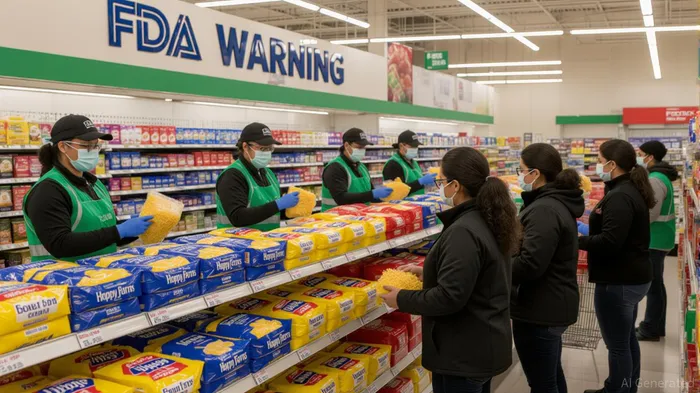
The U.S. . Inc. and distributed by major retailers like Aldi, WalmartWMT--, and Target-has reignited scrutiny over food safety protocols and their financial implications for the consumer staples sector. This recall, , underscores the fragility of supply chains and the critical role of brand resilience in mitigating reputational and financial damage.
Brand Resilience: Transparency and Consumer Trust
The immediate response of retailers like Aldi and Walmart to the recall highlights the importance of transparency in preserving consumer trust. Aldi, which sold the affected cheese under its "Happy Farms" label, swiftly removed the product from shelves and updated its recall page to inform customers. Similarly, Walmart provided detailed guidance on its website, urging customers to return the products for a full refund. These actions align with broader industry trends where rapid communication and accountability are seen as key to minimizing long-term brand erosion.
Great Lakes Cheese Co. Inc., the supplier, also demonstrated a degree of cooperation by working with retailers to expedite product removals. However, the company's prior recall in March 2025-related to stainless steel contamination in its Happy Farms Colby Jack cheese-raises questions about its quality control systems. For investors, repeated recalls signal systemic vulnerabilities that could undermine supplier credibility, even if immediate financial disclosures remain opaque.
Supply Chain Risk: A Sector-Wide Challenge
. states and Puerto Rico-exposes the inherent risks of centralized supply chains. According to a report by GreyB, , . This trend is exacerbated by the reliance on private-label brands, where retailers bear the reputational fallout despite limited control over production.
Emerging technologies, such as blockchain-based traceability systems and AI-driven contamination detection, are increasingly seen as critical investments for mitigating such risks according to GreyB. Yet, the absence of detailed financial disclosures from Great Lakes Cheese Co. Inc. or its retail partners suggests that many companies remain unprepared for the operational and reputational costs of large-scale recalls. Historical data indicates that food recalls , .
Financial Impact: Sector Volatility and Investor Sentiment
While specific stock price data for Great Lakes Cheese Co. Inc. or its retail partners post-recall is not publicly available, the broader consumer staples sector has shown signs of vulnerability. The Consumer Staples Select Sector SPDR Fund (XLP), a benchmark for the sector, , . A major recall, particularly one involving high-volume products like shredded cheese, could amplify these trends.
Historical precedents, such as the 2015 ice cream , demonstrate how recalls can trigger sharp declines in stock performance. In that case, in direct costs, . For Aldi and Walmart, which sell the recalled products under private-label brands, the financial impact may be compounded by the need to absorb recall-related expenses while maintaining competitive pricing in a cost-conscious market.
### Conclusion: Balancing Risk and Resilience
The December 2025 cheese recall serves as a cautionary tale for the consumer staples sector. While Aldi and Walmart have taken commendable steps to address the crisis, the incident highlights the need for more robust supply chain oversight and proactive risk management. For investors, the key takeaway lies in evaluating companies not just by their immediate recall responses but by their long-term commitment to transparency, technological innovation, and supplier accountability. In an era where food safety incidents are becoming increasingly common, resilience is no longer optional-it is a competitive necessity.

Delivering real-time insights and analysis on emerging financial trends and market movements.
Latest Articles
Stay ahead of the market.
Get curated U.S. market news, insights and key dates delivered to your inbox.
AInvest
PRO
AInvest
PRO



Comments
No comments yet