
Food Safety Crises and Commodity Markets: The 2025 Shrimp Recall and Its Ripple Effects on Investor Portfolios
 Aime Summary
The 2025 frozen shrimp recall, triggered by radioactive cesium-137 contamination in products sourced from Indonesian firm PT. Bahari Makmur Sejati (BMS Foods), has exposed vulnerabilities in global seafood supply chains and reshaped investor strategies in commodity markets. This crisis, which led to the recall of over 80,000 bags of shrimp across 17 U.S. states, underscores how food safety incidents can disrupt trade flows, erode consumer trust, and force investors to recalibrate risk management frameworks.
Supply Chain Disruptions and Market Volatility
The contamination, traced to radioactive dust from a nearby steel manufacturer in Indonesia's Cikande area, prompted the U.S. Food and Drug Administration (FDA) to issue urgent recalls, including products sold by WalmartWMT--, KrogerKR--, and AquaStar (USA) Corp.
according to FDA advisories. While the detected cesium-137 levels (68.48 Bq/kg) were below the FDA's Derived Intervention Level of 1,200 Bq/kg, the incident highlighted the fragility of global food supply chains. Shrimp, a commodity with a complex transnational production network, passed through multiple jurisdictions before reaching U.S. consumers, amplifying the challenge of traceability and oversight
according to CBS8 reporting. 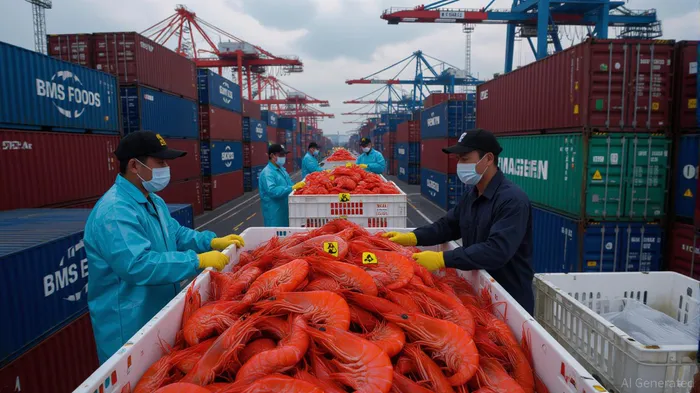
The recall disrupted U.S. import volumes, with major ports like Los Angeles and Houston temporarily halting shipments from BMS Foods. This created a ripple effect, as retailers scrambled to remove affected products from shelves and consumers shifted toward alternative proteins or domestically sourced seafood
according to Fox Business reporting. According to a report by the International Market Research Corporation (IMARC), the U.S. shrimp market saw a 12% decline in raw, unprocessed shrimp demand in Q3 2025, while value-added products (e.g., breaded shrimp) retained pricing stability due to perceived safety advantages
according to IMARC analysis.
Investor Responses: Hedging and Diversification
Investors and commodity traders responded to the crisis with a mix of short-term hedging and long-term portfolio adjustments. Structured financial instruments, such as receive-fixed interest rate swaps, gained prominence as tools to mitigate exposure to volatile shrimp prices. For instance, Associated Banc-Corp and KeyCorp deployed receive-fixed swaps to stabilize earnings amid uncertainty, locking in favorable rates as shrimp import tariffs and production delays added to market instability
according to Derivative Path analysis.
Diversification into alternative proteins also emerged as a key strategy. Investors increasingly allocated capital to plant-based seafood substitutes and aquaculture ventures, seeking to reduce reliance on shrimp markets prone to contamination risks. This trend aligns with broader industry shifts, as highlighted by Bloomberg Intelligence, which noted a 23% year-over-year growth in alternative protein investments in 2025
according to Bloomberg Intelligence.
Regulatory Scrutiny and Sourcing Revisions
The recall accelerated regulatory scrutiny of seafood imports, with the FDA expanding radiological screening protocols at U.S. ports. Senators John Kennedy and Bill Cassidy further advocated for a shift toward domestic Gulf shrimp, citing its lower contamination risk compared to foreign imports
according to Kennedy and Cassidy statements. This push for localized sourcing has prompted retailers like Walmart to renegotiate supplier contracts, prioritizing U.S.-based producers despite higher costs.
Insurance costs for seafood importers also rose, with underwriters incorporating food safety clauses into policies. A report by Morningstar indicated that commercial liability premiums for seafood companies increased by 18% in the six months following the recall, reflecting heightened risk perceptions
according to Morningstar reporting.
Commodity Price Dynamics and Long-Term Implications
While shrimp prices initially dipped post-recall, the market stabilized as demand for value-added products offset losses in raw shrimp sales. According to Undercurrent News, U.S. wholesale prices for raw shrimp fell by 9% in October 2025, while breaded and processed shrimp maintained a 4% price premium
according to Undercurrent News reporting. This divergence underscores the importance of product differentiation in mitigating supply shocks.
Long-term, the crisis has prompted investors to adopt layered hedging strategies, including futures contracts and currency hedges, to navigate potential disruptions. For example, Chinese demand for shrimp, already subdued due to economic slowdowns, remains a wildcard, with analysts at S&P Global warning of uneven recovery trends in 2026
according to S&P Global analysis.
Conclusion
The 2025 shrimp recall serves as a case study in how food safety crises can reshape commodity markets and investor behavior. From immediate supply chain disruptions to strategic shifts in sourcing and hedging, the incident highlights the need for agile risk management frameworks. As global seafood trade faces ongoing challenges-from climate change to geopolitical tensions-investors must prioritize resilience, leveraging both financial instruments and diversification to navigate an increasingly uncertain landscape.

Stay ahead of the market.
Get curated U.S. market news, insights and key dates delivered to your inbox.
AInvest
PRO
AInvest
PRO



Comments
No comments yet