
FOGO Launches High-Speed Blockchain Mainnet With 40-Millisecond Block Times
 Aime Summary
- Fogo launched its mainnet with 40ms block times and 136,866 TPS, claiming to be 18 times faster than Solana and Sui.
- The platform is built on the SolanaSOL-- VirtualCYBER-- Machine (SVM) to enable seamless migration for developers.
- The FOGO token is used for staking, governance, and transaction fees, and is listed on major exchanges.
Fogo launched its mainnet with a 40ms block time and 136,866 TPS according to reports. The platform aims to redefine blockchain speed benchmarks and position itself as a strong competitor in the high-performance blockchain space.
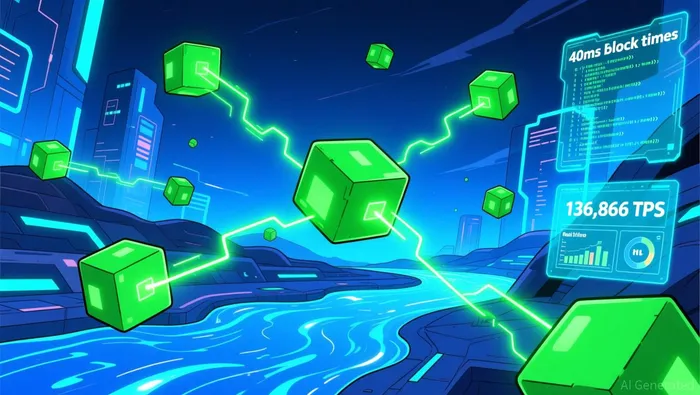
The network’s architecture includes parallel execution and optimized consensus mechanisms to reduce congestion and maintain low fees. This is designed to support real-time DeFi and high-frequency trading applications.
The FOGO token is a utility token with multiple functions in the ecosystem. Despite being listed on major exchanges like Binance and OKX, it dropped 14% after the airdrop due to low liquidity and selling pressure.
FOGO aims to attract institutional-grade applications and developers by providing a fast, scalable blockchain. The network’s ability to sustain its performance claims in real-world conditions will be crucial for long-term success.
Fogo’s mainnet launch marks the beginning of a live, public blockchain that must now prove its capabilities under real-world conditions. The network’s performance, stability, and developer adoption will determine its position in the high-speed blockchain landscape.
Is Fogo’s Mainnet a Valid Competitor to Solana and Sui?
Fogo claims to be 18 times faster than Solana and Sui, but this must be validated under real-world conditions. The platform’s use of the SVM allows developers to easily migrate applications from Solana.
The 40ms block time is a significant improvement, but it must be sustained under high load. Fogo’s zoned consensus mechanism aims to reduce congestion while maintaining low fees.
The FOGO token supports staking, governance, and transaction fees. Its performance on exchanges highlights the challenges of early-stage blockchain projects in stabilizing investor confidence.
What Are the Risks for Fogo’s Ecosystem?
The FOGO token dropped 14% after the airdrop due to low liquidity and selling pressure. This indicates early-stage volatility and the need for strong demand to sustain price.
Fogo’s success depends on real-world validation of its speed claims and the ability to attract developers and users. The network’s ability to sustain high TPS under peak load is a key performance indicator.
The network’s long-term viability will be measured by the number and utility of applications built on it. Fogo must continue to scale validator sets and onboard dApps to build a sustainable ecosystem.
The FOGO token’s market performance will be influenced by factors such as network usage, transaction volume, and community growth. Fogo’s team has a strong background in institutional finance and blockchain engineering, which could aid in attracting enterprise-grade applications.
How Does Fogo Plan to Attract Developers and Users?
Fogo’s mainnet launch includes 10 live dApps in DeFi, lending, and liquid staking. The FOGO token supports on-chain governance and incentivizes participation by token holders.
The platform’s use of the SVM reduces barriers for developers and allows for seamless migration from Solana. This could attract developers seeking high throughput and fast finality.
Fogo’s focus on real-time DeFi and high-frequency trading positions it as a potential platform for institutional-grade applications. The network’s MEV mitigation strategies aim to maintain low fees and fast finality.
Fogo’s roadmap includes developer grants, ecosystem funding, and strategic partnerships. The coming year will serve as a critical proving ground for the network’s ability to deliver on its promises under real-world demand.
The platform’s success will depend on its ability to validate its speed claims and attract a diverse range of developers and users. Fogo’s architecture and tokenomics must work in tandem to create a sustainable and decentralized ecosystem.

Blending traditional trading wisdom with cutting-edge cryptocurrency insights.
Latest Articles
Stay ahead of the market.
Get curated U.S. market news, insights and key dates delivered to your inbox.


AInvest
PRO
AInvest
PRO



Comments
No comments yet