
FOGO Launches High-Speed Blockchain Mainnet With 40-Millisecond Block Times
 Aime Summary
Fogo is a new high-speed Layer 1 blockchain compatible with Solana’s VirtualCYBER-- Machine, offering 40-millisecond block times and aiming to support fast transaction finality for dApps according to reports. The network raised $7 million through a Binance token sale and supports live decentralized applications in DeFi, lending, and liquid staking as reported. Fogo’s native token, FOGO, has multiple utilities, including staking, governance, and transaction fees, and is listed on major exchanges like Binance and OKX according to data.
Fogo recently launched its public mainnet, positioning itself as a high-speed blockchain with block times of 40 milliseconds and throughput exceeding 1,200 transactions per second according to reports. The platform leverages SolanaSOL-- Virtual Machine (SVM) compatibility to allow developers from the Solana ecosystem to migrate easily as noted. This feature is designed to reduce latency and improve overall usability for developers and end users.
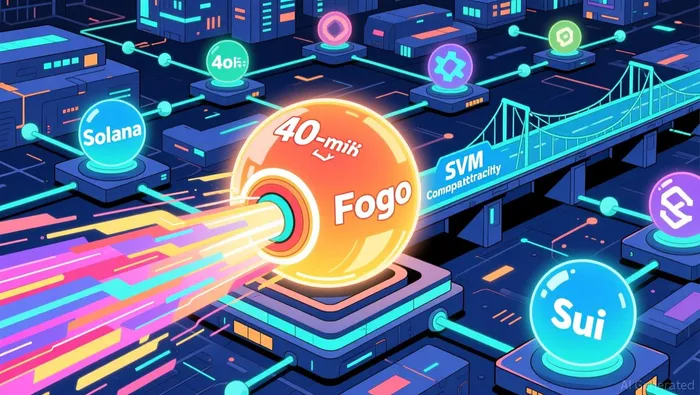
The project has already deployed 10 live decentralized applications, including Valiant (DEX), Pyron (lending), and Brasa (liquid staking), with plans to double this number in the coming months according to data. Fogo’s mainnet is optimized for decentralized finance, gaming, and high-throughput use cases, aiming to challenge existing leaders like Solana and SuiSUI-- as reported.
The FOGO token serves as the native utility token of the ecosystem, enabling users to participate in governance, pay transaction fees, and stake for network security according to Bitget. It is currently listed on multiple centralized exchanges, including Binance, OKX, Bybit, and Bitget, allowing for easy access for investors as reported.
How does Fogo compare to existing high-speed blockchains like Solana?
Fogo claims to outperform Solana and Sui in terms of speed and throughput, with block generation times of 40 milliseconds. This allows for sub-second finality, potentially making it more attractive for applications requiring real-time settlement according to analysis.
The platform is built on SVM, which is known for its efficiency and compatibility with the Solana ecosystem. This compatibility allows developers to deploy existing Solana applications on Fogo with minimal effort, lowering migration barriers as noted.
Fogo also claims a throughput of 136,866 transactions per second, which could position it as a viable alternative for developers looking to scale their applications according to reports.
What role does the FOGO token play in the ecosystem?
The FOGO token is central to the Fogo ecosystem, serving multiple functions, including staking, governance, and transaction fees as reported. It is designed to incentivize participation and encourage long-term engagement with the network.
Token holders can use FOGO to participate in on-chain governance proposals, influencing key decisions related to network upgrades and development. The token also acts as a medium for securing the network, with staking rewards provided to validators who maintain network consensus according to data.
The token’s utility is further enhanced by its integration with decentralized applications already live on the Fogo network, such as Valiant and Fogolend, where users can trade assets and access lending services as reported.
What are the technical and operational updates to Fogo’s validator client?
The Fogo validator client is distributed as a source code tarball, with ongoing updates focused on improving performance, reliability, and functionality according to documentation. These releases include changes related to gossip and repair services, block limits, and RPC improvements.
Recent updates have introduced support for native token wrapping and transferring, along with adjustments to default ports for gossip and repair services as detailed. These changes aim to enhance the network’s scalability and throughput, supporting the growing number of dApps on the platform.
The Fogo team continues to iterate on the platform, addressing bugs that may prevent nodes from reaching consensus or cause memory issues according to updates. These improvements are essential for maintaining the network’s stability as it expands its ecosystem and user base.
What are the challenges and limitations of Fogo’s approach?
Despite its high-speed claims, Fogo’s performance under real-world conditions remains untested according to analysis. The network must demonstrate its ability to handle high transaction volumes consistently to prove its value proposition.
Fogo also faces competition from established high-performance blockchains like Solana and Sui, which have larger developer ecosystems and more mature infrastructure as noted. The success of Fogo will depend on its ability to attract developers and users willing to migrate from these platforms.
The project must also navigate the risks associated with market volatility and regulatory uncertainty. As a relatively new blockchain, Fogo must build trust with investors and users while maintaining transparency and security across its ecosystem.

Blending traditional trading wisdom with cutting-edge cryptocurrency insights.
Latest Articles
Stay ahead of the market.
Get curated U.S. market news, insights and key dates delivered to your inbox.


AInvest
PRO
AInvest
PRO



Comments
No comments yet