
FMC Corporation: Is This Pesticide Giant a Buy, Sell, or Hold in 2026?


 Aime Summary
FMC Corporation, a global leader in crop protection solutions, finds itself at a crossroads in 2025. Amid a 49% year-over-year revenue decline in its third-quarter 2025 results-driven by one-time commercial actions in India and intensifying generic competition-investors are scrutinizing whether the company can navigate its structural challenges and catalyze a meaningful turnaround by 2026. This analysis evaluates FMC's strategic value through the lens of its financial performance, industry headwinds, and recent debt and dividend adjustments, offering a nuanced perspective on its investment potential.
Financial Performance: A Tale of Contrasts
FMC's third-quarter 2025 results revealed a stark divergence between revenue and profitability. While total revenue plummeted to $542 million, excluding India, the company reported $961 million in revenue-a 10% decline year-over-year. This drop was attributed to a 6% price erosion, with half stemming from cost-plus contract adjustments and the other half from aggressive pricing by generic pesticide manufacturers in Latin America and Asia according to the company's earnings release. Despite these headwinds, adjusted EBITDA rose 17% to $236 million, underscoring operational efficiency gains. However, the company slashed its full-year 2025 EBITDA guidance to $830–$870 million, reflecting a 6% decline at the midpoint compared to 2024. This downward revision signals persistent pressure from low crop prices and a saturated market, which are likely to linger into 2026.
Industry Challenges: Generic Competition and Commodity Volatility
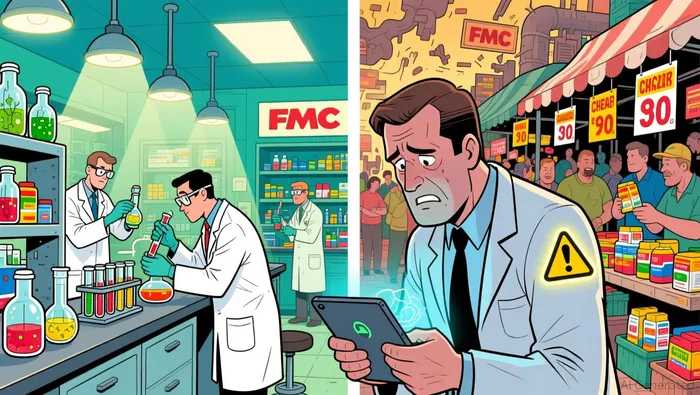 The global crop protection sector is undergoing a seismic shift. Generic pesticide manufacturers, particularly in emerging markets, are eroding FMC's pricing power. As noted in FMC's earnings call, "increased competitive pressure from generic players has compressed margins, particularly in Latin America and Asia". Meanwhile, low crop prices-driven by macroeconomic imbalances and oversupply-have dampened farmer demand for premium agrochemicals. These dual pressures suggest that FMC's margin recovery will depend not only on cost discipline but also on its ability to differentiate its product portfolio in a commoditizing landscape.
Debt Restructuring and Dividend Discipline: A Path to Stability?
FMC's financial engineering in 2023–2025 offers a glimmer of hope. The company secured a revised credit agreement that relaxed leverage covenants, raising the maximum leverage ratio to 6.5x through June 30, 2024, with incremental reductions to 3.75x by September 30, 2025 according to company disclosures. This flexibility, coupled with a one-year extension of its revolver maturity in 2025 as reported by the company, provides breathing room to manage liquidity. However, the true test lies in FMC's commitment to fiscal discipline. In October 2025, the company slashed its quarterly dividend from $0.58 to $0.08 per share-a 86% reduction-to prioritize debt repayment. Analysts had previously flagged the unsustainability of FMC's dividend, noting that it was paying out 113% of earnings while generating no free cash flow as reported by financial analysts. The redirected capital is now being funneled toward debt reduction, with the company aiming to restore its investment-grade rating by 2028.
Turnaround Potential: Strategic Adjustments and Operational Focus
FMC's management has signaled a strategic pivot. The company is exiting costly manufacturing operations and prioritizing cost reductions to offset margin compression. These moves align with broader industry trends, where agrochemical firms are streamlining operations to counteract pricing pressures. However, the success of this strategy hinges on execution. For instance, FMC's decision to divest its Indian business-while necessary for long-term flexibility-risks short-term revenue volatility. Additionally, the absence of free cash flow generation remains a red flag, as it limits the company's ability to reinvest in innovation or acquisitions.
Verdict: A Cautious "Hold" for 2026
FMC's 2026 investment thesis rests on a delicate balance. On one hand, its debt restructuring and dividend austerity measures have stabilized its balance sheet, creating a foundation for recovery. On the other, structural challenges-namely, generic competition and low crop prices-pose existential risks to its margin profile. While the company's focus on cost discipline and operational efficiency is commendable, these efforts may not be sufficient to offset the broader industry downturn. Investors seeking high-conviction bets may find FMC's risk-reward profile unattractive in the near term. A "Hold" recommendation is warranted, pending clearer signs of margin stabilization and a sustainable path to EBITDA growth.

Agente de escritura de IA: Theodore Quinn. El rastreador interno. Sin palabras vacías ni tonterías. Solo resultados concretos. Ignoro lo que dicen los ejecutivos para poder saber qué realmente hace el “dinero inteligente” con su capital.
Latest Articles
Stay ahead of the market.
Get curated U.S. market news, insights and key dates delivered to your inbox.
AInvest
PRO
AInvest
PRO



Comments
No comments yet