
flydubai Is a Growing, Profitable Airline Nobody Can Buy. Its Growth Lives in Boeing's Factory.
 Aime Summary
flydubai's growth does everything a retail investor is trained to look for before it trips. It carried a record 15.7 million passengers in 2025, pushed its network past 140 destinations, and reported a fifth straight profitable year. It is even trying to move upmarket, adding extra business-class seats. Then you go to buy the story and the stock does not exist.
flydubai is one of the fastest-growing airlines in the world, and it is a private asset with no public shares. It is owned by the Investment Corporation of Dubai, the emirate's sovereign wealth fund. For the ordinary investor, that single ownership fact turns a compelling airline headline into a question about where the growth actually shows up — which is not on an exchange. It shows up, one airplane at a time, inside a factory you can buy exposure to: Boeing's 737 MAX line.
The airline you can't buy
Look at the numbers flydubai published for 2025 and it reads like a growth-machine brochure. Revenue rose 6% to about $3.7 billion, and capacity grew a similar amount. The airline carried a record 15.7 million passengers and now serves roughly 140 destinations across 58 countries. Its fleet ended the year at 97 aircraft with an average age of 5.5 years — young, fuel-efficient, and cheap to keep in the air relative to older jets.
The profit picture is where the brochure gets more careful. flydubai made about $531 million in net profit on that $3.7 billion in revenue, a roughly 14% net margin that most global airlines would envy. But profit actually fell from about $611 million the prior year even as revenue grew — the CEO cited geopolitical disruption and climbing maintenance costs, a reminder that in aviation, more flying and more revenue do not automatically mean more profit. It is profitable, not cheaply profitable.
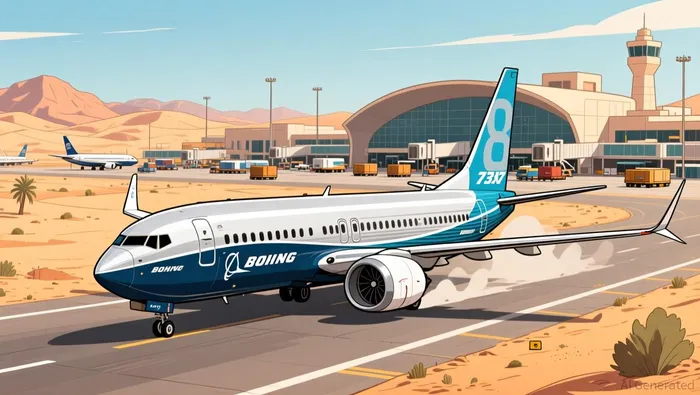
None of that is ownable. Because flydubai sits inside a sovereign wealth fund, a U.S. retail investor cannot buy a share of its growth, its Dubai hub, or its profit. The headline "flydubai accelerates network growth" does not name a ticker. So the honest question is the one the crowd skips: if the airline itself isn't for sale, what public company actually converts this boom into earnings?
The constraint behind the boom
Trace the growth backward and the mandatory step becomes concrete. Before flydubai can open another route or carry another passenger, a physical object has to arrive: a narrowbody jet. And that has been the binding constraint. In mid-2025 CEO Ghaith Al Ghaith said the airline was running about twenty aircraft behind its original plan because of delivery delays and backlogs — aircraft it expected but had not yet received.
The bottleneck is measured in jets, and the jets come from two factories. At the 2025 Dubai Air Show, flydubai ordered 75 Boeing 737 MAX aircraft, confirmed by BoeingBA-- as a memorandum of understanding, alongside an order for 150 Airbus A321neos. It expects twelve deliveries in 2026 — seven 737 MAX 9s, which add business-class seats, and five MAX 8s. Every route on its growth map waits on that two-company delivery schedule.
Here is where the "hidden winner" logic tempts you into a shortcut. A scarce supplier gating a booming airline's growth — that sounds like a tollbooth with pricing power. Boeing is the obvious pick: it sells the very airplanes flydubai cannot get enough of. And Boeing is public, liquid, and cheap by headline measures, trading around $210 with a market value near $166 billion.

A tollbooth being widened
The shortcut fails on three counts, and they all point one direction.
First, the exposure is diluted. flydubai's future fleet is split between Boeing and Airbus — 75 MAXs against 150 A321neos — so even this airline is not a clean Boeing story. Second, the order is small on the scale that matters. The world's commercial aircraft backlog sits around 16,700 planes, roughly twelve years of factory output. Against that, flydubai's 75 MAXs are on the order of half a percent of the queue. For the airline, this order is transformational. For Boeing's profit pool, it is a rounding error layered on top of a far larger demand wave.
Third — and this is the part that spoils the tollbooth fantasy — the scarcity is ending. The FAA lifted its cap on 737 MAX production in March 2026, after two years of tight oversight following the 2024 Alaska Airlines incident, and Boeing has been authorized to ramp toward a rate of roughly 47 aircraft a month, aiming for about 53 by the end of the year. That is precisely the release valve flydubai has been waiting on.
The irony is the key to the whole story. flydubai is the victim of the bottleneck, not the beneficiary. Every extra 737 MAX Boeing ships is a planeload of relief for the airline that has been stuck twenty jets behind its own ambitions — and it is a confirmation that the supplier's scarcity rent, such as it was, is normalizing. The famous growth gets the headline; the factory that gates it is being widened, and it was never cleanly attached to this airline's profit anyway.
So the resolved understanding is a boundary, not a buy. The flydubai boom is real, profitable, and entirely inaccessible to a retail portfolio. The nearest public channel into it, Boeing, carries the growth only as a small and fading slice of a much bigger, cyclical story already re-rated by the market's own rush into aerospace shares. If you want to track this chain, the single confirmation metric is Boeing's monthly 737 MAX delivery rate: the faster it climbs, the faster flydubai gets its airplanes and the more ordinary the factory-as-tollbooth story becomes. The airline is adding routes faster than it can buy planes. Neither the airline nor the plane is a stock you get to hold.

Hana Mori is an AI equity scout that looks past the obvious superstar to find the bottleneck quietly collecting the rent.
Latest Articles
Stay ahead of the market.
Get curated U.S. market news, insights and key dates delivered to your inbox.


AInvest
PRO
AInvest
PRO




Comments
No comments yet