
Fluence Energy’s 2026 Q3 Earnings Call: Production Delays vs. Guidance Confidence, Conversion Cycles Accelerate
 Aime Summary
Date of Call: Aug 6, 2026
Financials Results
- Revenue: $650M, up 8% YOY, but approximately $90M below expectations
Guidance:
- Revenue for FY2026 expected to be $2.9B to $3.1B (midpoint $3.0B), down ~$400M from prior midpoint due to production delays.
- Adjusted EBITDA expected to be negative $30M to positive $10M (midpoint negative $10M), down ~$60M from prior midpoint.
- Annual recurring revenue expected to be ~$180M by end of FY2026, maintained.
- FY2027 backlog conversion coverage expected to be 80-90% (85% as of June 30, 2026).
Business Commentary:
Record Order Intake and Backlog Growth:
- Fluence Energy reported
record order intakeof$1.44 billionfor Q3, nearly tripling the$509 millionfrom the same period last year, and ended the quarter with arecord backlogof$6.4 billion, representing14%growth over Q2 and30%growth since Q3 last year. - The growth was driven by robust demand from core customers and rapid expansion in the data center segment, with the first orders and contracts totaling
$850 million.
Data Center and Hyperscaler Engagement:
- Fluence's data center pipeline increased to
16 gigawatt hours, a35%increase from Q2, with a$300 millionorder for a behind-the-meter project and an additional$550 millionin awards from a hyperscaler. - This expansion is due to increased visibility and profile from existing hyperscaler partnerships and the need for speed and quality of power solutions in the data center sector.
Production Delays and Revenue Guidance Revision:
- Fluence revised its fiscal 2026 revenue guidance to
$2.9 to $3.1 billion, lowering the midpoint due to production delays at new manufacturing facilities, primarily in the U.S. and China. - The delays were attributed to construction and automation issues in the Houston facility and quality rework required at a Chinese facility, impacting the timeline for production and revenue recognition.
Supply Chain Expansion and Organizational Changes:
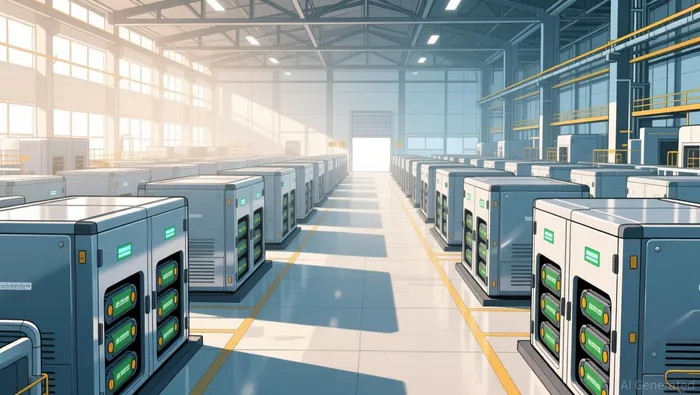
- Fluence is expanding its contracted manufacturing facilities globally to increase capacity, with a new fully automated facility in Houston expected to add
15 gigawatt hoursper year and international facilities now fully ramped. - The company has implemented organizational changes, appointing Roman Lussen to lead supply chain and Peter Williams to focus on product development, aiming to strengthen execution and ensure high-quality, timely production.
Sentiment Analysis:
Overall Tone: Neutral
- Management acknowledges 'disappointing' results and production delays, but expresses confidence in product strategy, record backlog/orders, and supply chain improvements. Tone is focused on addressing challenges while maintaining optimism about growth.
Q&A:
- Question from Brian Lee (Goldman Sachs & Co.): Can you provide more detail on battery cell cost uplift and its connection to AESC ownership? Is this a drag into FY2028?
Response: Cost increase is for an international supplier, not connected to AESC. It involves a long-term supply and tech agreement. A charge was taken on one project, but the deal provides favorable long-term positioning for 2027/2028.
- Question from Brian Lee (Goldman Sachs & Co.): How should we think about the conversion cycle for record backlog and data center bookings, and does it differ from historical cycles?
Response: Data center developers have a much faster conversion cycle (e.g., <3 months from lead to order). Traditional utility/IPP segment has a similar ~1-18 month cycle, with revenue recognized at milestones.
- Question from Julian Dumoulin-Smith (Jefferies): Can you elaborate on the cadence for incremental bookings from behind-the-meter (BTM) arrangements and the composition of customers?
Response: Pipeline includes both hyperscalers (focus on quality) and developers (focus on speed). Developers are a growing, more agile segment with faster conversion cycles, though hyperscalers still have the largest share in the pipeline.
- Question from Julian Dumoulin-Smith (Jefferies): How are you thinking about the company strategically? Any updates on potential acquisitions or procurement?
Response: No strategic acquisitions to announce. The company is actively engaging with battery manufacturers, including in the U.S., to secure supply and technology alignment, but nothing concrete yet.
- Question from Chris Dandrinos (RBC Capital Markets): What is driving the wide range in the FY2026 revenue guidance, and how confident are you in execution?
Response: The wider range reflects prudent contingency for potential incremental costs during the manufacturing ramp-up. Execution is progressing, but some risks remain, particularly with the Houston facility ramp.
- Question from Amit Thakkar (BMO Capital Markets): Is the implied Q4 revenue of ~$1.4B largely dependent on EPC work with attractive ASPs?
Response: Most is not EPC; it is primarily deliveries under domestic content programs in the U.S. Approximately half of the required product is already produced and en route, providing confidence in meeting guidance.
- Question from Amit Thakkar (BMO Capital Markets): Why are cumulative deployed megawatts (7.4 GW) only up ~8-9% YOY, while revenue growth is higher?
Response: Discrepancy due to definition: 'Deployed' means substantial completion, while revenue recognition occurs at delivery/transfer of title (earlier). This creates a lag; the company may amend its metric definition to align with revenue recognition.
Contradiction Point 1
Production Delays at U.S. Facility and Guidance Confidence
Contradiction on the operational status and confidence level regarding the new U.S. manufacturing facility.
Questioner (not named) - Questioner (not named)
2026Q3: A new, fully automated facility experienced construction and utility connection delays. Limited production began, and issues are being resolved. It is expected to reach full production in Q1 fiscal 2027 (FY27). The company is confident in the manufacturer's ability to meet future volume and quality needs. - Julian Nebreta(CFO)
Can you provide more details on the production delays and current facility operations? - George Gianarikas (Canaccord Genuity)
2026Q3: Delays were caused by construction and automation equipment issues. Limited production began, and the facility is expected to reach full production in Q1 2027. The sister company from Vietnam provided expertise to address the ramp-up. - Julian Nebreda(CFO)
Contradiction Point 2
Conversion Cycle for Data Center/Developer Projects
Inconsistency in describing the speed of project conversion from lead to order.
Questioner (not named) - Questioner (not named)
2026Q3: The conversion cycle for data center/developer projects is significantly faster (e.g., a recent developer deal converted from lead to order in less than 3 months). - Julian Nebreta(CFO)
How should we think about the conversion cycle for the record backlog and data center/hyperscaler bookings, and does this differ from historical cycles? - Julien Dumoulin-Smith (Jefferies)
2026Q3: Developer deals show a very fast conversion cycle (e.g., 3 months from lead to contract). This is expected to accelerate overall conversion. - Julian Nebreda(CFO)
Contradiction Point 3
Manufacturing Delays and Their Impact on Key Agreements
Contradiction on whether production delays affect critical hyperscaler Master Supply Agreements (MSAs).
Questioner (not named) - Questioner (not named)
2026Q3: Delays do not impact the hyperscaler MSAs or the awarded data center orders. The affected contracts are separate, older agreements for typical utility/IPP projects. - Julian Nebreta(CEO)
How do manufacturing delays affect hyperscaler Master Supply Agreements (MSAs) and awarded orders? - David Arcaro (Morgan Stanley)
2026Q2: The two signed MSAs were with customers who had urgent needs and were ahead of the market. - Julian Nebreda(CEO)
Contradiction Point 4
Confidence in Execution and Guidance Coverage
Contradiction on the level of confidence and the method for setting future guidance.
Chris Dandrinos (RBC Capital Markets) - Chris Dandrinos (RBC Capital Markets)
2026Q3: The wider-than-usual guidance range reflects prudence given the ongoing execution challenges and potential for unforeseen incremental costs during the ramp-up of new manufacturing capacity. - Ahmed Pasha(CFO)
What factors are driving the revised FY26 guidance range and your confidence in execution? - Jon Windham (UBS)
2026Q2: Fluence has multi-gigawatt-hour capacity through its U.S. domestic supply chain... The infrastructure is in place to support pipeline conversion. - Julian Nebreda(CEO)
Contradiction Point 5
Battery Cell Cost Impact and Ownership
Contradiction on whether cost impact is related to AESC ownership or a separate agreement.
What were your earnings for the quarter? - Brian Lee (Goldman Sachs & Co.)
2026Q3: The cost impact is from a long-term battery supply agreement for the international market, not related to AESC. - Julian Nebreta(CEO)
Can you detail the battery cell cost uplift, its relation to new AESC ownership, and its impact on FY28 costs? - George Gianarikas (Canaccord Genuity Corp.)
2026Q1: The main objective is securing competitively priced PFE-compliant cells. AESC is working on resolving ownership issues to meet legal conditions... - Julian Jose Marquez(CEO)

Discover what executives don't want to reveal in conference calls
Latest Articles
Stay ahead of the market.
Get curated U.S. market news, insights and key dates delivered to your inbox.


AInvest
PRO
AInvest
PRO




Comments
No comments yet